


 Francais
 Deutsch
 Italiano
Refine Your Search
Greek-Civil-War stock footage and images
- Showing 1423 to 1428 of 27579 results more
more Hide
Hide
Aviation in U.S. after World War I. Inauguration of air mail. Barnstorming and wing walking
World War One - war is over, Armistice signed. Crowd celebrates and waves flags in New York celebrating end of World War 1. America cuts down its Air services to much extent. American troops march on streets. American airman is decorated by the French. Captain Eddie Rickenbacker,in uniform, in front of line of airplanes, and later in civilian clothes, after leaving military service. Former World War I flyer,and Army Captain Fiorella LaGuardia, parading with American Legion, in streets of New York. Scenes of U.S. Air Mail service inauguration attended by President and Mrs. Wilson, shows U.S. Air Mail wagon and President Wilson holding first air mail letter. Men load mail sacks onto aircraft. Pilot talks to President Wilson. Pilot boards the plane and takes off. .View from an airplane, of a forest fire as airplanes were employed by the Forest Service to watch for fires. Two JN-1 "Jenny" airplanes flown by "barnstormers" after World War I. "Wing walkers" switch from one airplane to the other during flight, to entertain spectators. A Curtis Pusher airplane in flight. Crowds looking up at barnstormers performing with JN-1 airplanes. Wing walker leaves one airplane and grabs hold of another as it passes. One wing walker wears shirt identifying him as one of the so-called "Thirteen Black Cats." Man performs daredevil feats on the wings of the airplane and stands on top of fuselage as the aircraft lands. Many passengers board a large airplane for introductory rides. Interior of airplane shows a lavatory. This is a large twin engine biplane with double main gear wheels and double tail resembling a Caprioni or Handley page design. A man waves his straw hat as the aircraft takes off.
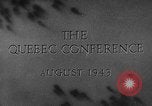
British Prime Minister Winston Churchill in many meetings before and after America's entry into World War II
Opening slate reads: "Quebec Conference August 1943." The English battleship, Prince of Wales, is seen in fog off the Coast of Newfoundland, in August 1941. View of sailor on fore-deck of the British ship. View inside engine room of the ship where sailor manipulates her power. Closeup of engine crankshaft stopping as she drops anchor in Placentia Bay. View of Prime Minister Winston Churchill, greeting U.S. President Franklin D. Roosevelt aboard the Prince of Wales. He proffers a letter to the President, from the King of England. View of Roosevelt and Churchill seated on deck with their respective military leaders standing behind them. Admiral Ernest King, U.S. Chief of Naval Operations converses with U.S. Army Chief of Staff, George Marshall, as they stand behind Churchill and Roosevelt. Wider camera view shows the larger military entourage accompanying the Prime Minister and the President. Glimpse of prisoners and enslaved workers taken by Nazi Germans in Europe. Glimpse of bombs falling from an airplane. Classic film views of the Japanese attack on Pearl Harbor in December 7, 1941. Bombs exploding along "Battleship Row." Heavy smoke rising from the bombed ships. The USS Arizona tilted heavily and burning. Camera pans along the path of destruction, as the voice of President Roosevelt is heard in the background, asking the Congress to declare that the Japanese attack created a state of War between the United States and the Japanese Empire. View of President Roosevelt speaking to the U.S. Congress. Seated behind him are Vice-President Henry Wallace and Speaker of the House, Sam Rayburn. Glimpse of Congress members applauding. Change of scene shows President Roosevelt and Winston Churchill meeting in Washington, DC, in December of 1941, during World War 2. Views of war preparations in the United States, including the building of new war production plants and facilities. A large steel ingot being forged into an artillery gun barrel. Machinist at work turning a gun barrel on a lathe in a munitions factory. Views of manufacturing plants in operation and steel being made. A railroad train carrying new Army trucks. Another meeting of Churchill and Roosevelt in Washington, D.C. June, 1942. Standing behind them is President Roosevelt's special assistant, Harry Hopkins, a British naval officer, and an American navy Captain. American soldiers boarding a troop ship, and closeups of them as they enter the ship, looking out of portholes, and waving from the ship's deck. Glimpse of Washington Monument and its image in the reflecting pool in Washington DC. Closeup of a book entitled, "Time Table for Invasion." General George Marshall with several of his generals doing preliminary planning. Series of scenes involving senior military officers engaged in war planning. A convoy of warships is seen at sea during the Operation Torch Allied invasion of French North Africa during 8–16 November, 1942. Views of Allied Navy ship guns firing. Allied troops riding in landing craft, and advancing from beached craft on shore of Algiers. Aerial view of a flight of Douglas Dauntless bombers in formation. "Bombs away" view from Allied airplane dropping bombs. Allied troops firing camouflaged antiaircraft guns from sandy positions near shore. Enemy shells or bombs exploding nearby. Two U.S. Army soldiers holding a document in French entitled, "Message from the President of the United States.

Georgy Zhukov inspects troops during unveiling of Soviet War Memorial and Russian Revolution anniversary celebrations in Berlin, Germany.
Unveiling of new Soviet War Memorial (Tiergarten) in Berlin Germany, during Russian Revolution anniversary celebrations (28th anniversary), in Berlin, Germany, soon after the end of World War II. Marshal of the Soviet Union Georgy Konstantinovich Zhukov inspects British, French, American and Russian units. Trees in the background. Zhukov and United States Army Major General James Maurice Gavin in a grandstand. A Russian officer speaks from the grandstand in front of the Soviet War Memorial (then also called Russian Victory Monument by Allied forces) on Charlottenburger-Chaussee. A Russian Army band plays. A statue of a Russian soldier atop the Victory Monument. Russian troops parade after unveiling of the Memorial. Honor company of United States Army 82nd Airborne Division marches past. Allied troops seen marching in formation on nearby streets of Berlin. Major General Gavin shakes hands with Soviet leader Marshal Zhukov. Officers place wreaths at the Soviet War Memorial. Russian artillery fires salute. Photographers take photographs. The officers salute in front of the War Memorial. Wreaths placed at the base of the Memorial.
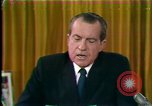
U.S. President Richard Nixon addresses nation about Vietnam War, from White House, Washington DC.
Stand of U.S. President Richard Nixon on Vietnam War. President Nixon addresses the nation about the Vietnam War from White House. He explains what has been described as "The Nixon Doctrine" regarding U.S. involvement in war, foreign policy support, and defense of freedom. He discusses the concept of helping other nations fight wars, rather than fighting wars for them. He illustrates this approach in describing U.S. efforts in Vietnam. He promises that 20% of U.S. combat forces will return by mid December. He notes he will not reveal withdrawal decisions that will compromise efforts at the Paris talks. He indicates he will pursue a path seeking a just peace through a negotiated settlement or through continued vietnamization.
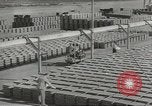
Film about Difficulties of amphibious Assaults in World War II. Montage of invasion scenes.
Opening scene shows large stores of military supplies needed to support invasion forces in various areas during World War 2. An American C-47 transport airplane taking off from a field in a desert area. Local people with a donkey and cart in foreground. View from within a formation of U.S. B-17 flying fortress bombers flying above clouds. View shifts to the bombers silhouetted against clouds below. Complete change of scene to amphibious forces in action. Two American Douglas SBD Dauntless aircraft fly just above the water at high speed to attack enemy shore positions in the Pacific. Close-up of one as it appears above the camera. Sections of a city separated by a body of water, somewhere in Europe. Huge quantities of war materiel stored on a beach in Italy, with mountains in background. Truck convoys transporting supplies away from the area. Landing Ships Tank (LSTs) sit at water’s edge with their bow doors open. One is American LST-350. Large mountain in background. Small multi-masted boats without sails, at an inlet in background. Soldiers are busy unloading equipment and supplies from the LSTs. View from above of cranes on barges loading landing craft with supplies at an established pier. Close-ups of LSTs being offloaded by American soldiers. Troops look out portholes of a transport ship. A number of Higgins Boats pulled up to the shore where trucks are lined up. Solders on a DUKW (amphibious truck 6x6) equipped with an A-frame crane. More views of the port showing a caterpillar bulldozer pulling trailers of supplies, and trucks. A large transport ship tied up at an established port, where it unloads a British Crusader tank. View into the hold of the ship where a number of Crusader tanks are stowed next to one another. Ships of an invasion task off Italy, silhouetted against a sunrise (or sunset). Views from a ship, of Allied minesweepers at work, in the flotilla. A twin funnel P2-SE2-R1 class troop transport ship is seen in the background. A formation of landing craft approaching the beach. Close-up view from beach of one beaching through surf and soldiers charging ashore. A U.S. Navy Douglas SBD Dauntless aircraft flying low over the landing craft. Another landing craft (Higgins boat) hitting the beach and soldiers charging ashore. Next, several USAAF Curtiss P-40 aircraft fly low over the beach. A dog accompanying troops leaving a Higgins boat, has trouble walking across the cross-hatched ramp on the boat. More views of loaded landing craft speeding toward the beach and soldiers running ashore. Soldiers digging foxholes in sandy soil of an orchard of trees. At one point, they all take cover in their foxholes as air attack threatens. Glimpse of troops crouched in a ditch as explosion occurs nearby. (Note: Some of the later scenes in this film show troops in training exercises.) (World War II; WW II; World War 2; World War Two)
Network of United States Veterans Administration offices serving veterans of World War 2
United States Veterans Administration's role for the war veterans of World War II. War veterans of World War 2 exit a separation center building with smiles on their faces, holding up discharge papers in 1945 at the end of World War 2. Veterans at United States Veterans Administration office. A map of United States depicts the 13 cities in which the Veterans Administration offices have been set up. Map of U.S. depicts the network of Veterans administration offices and traveling Veterans Administration representative locations across the United States. A traveling V.A. representative enters the "John Dyson" grocery, feed, fertilizer, and general store in a small town. Sign outside the building reads "Attention Veterans" and describes the weekly visit scheduled at that location.
CRITICALPAST.COM: About Us | Contact Us | FAQs - How to Order | License Agreement | My Account | My Lightboxes | Shopping Cart | Advanced Search | Featured Collections | Website Terms & Conditions | Privacy Policy ©2026 CriticalPast LLC.
License Agreement |
Terms & Conditions |
Privacy Policy
©2026 CriticalPast LLC.