


 Francais
 Deutsch
 Italiano

Refine Your Search
Greek-Civil-War stock footage and images
- Showing 14713 to 14718 of 27579 results more
 Hide
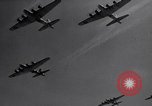
Bombing of rail roads in Bremen by United States B-17 bombers and atom bomb testing during WWII
United States Boeing B-17 Flying Fortress bomber drops bombs on railway tracks in Bremen, Germany during World War II. Bombs making an impact. Low-level strafing and bombing of targets in Europe by low flying U.S. Army Air Force aircraft during World War 2. Bridge is struck by bomb. Explosions on other targets. Separate unrelated shot of United States conducting an early Atomic bomb test (Trinity test is shown on July 16, 1945. The first detonation of a nuclear device). Nuclear explosion and mushroom cloud is seen.

American soldiers escaped and rescued from Japanese prison camp speak about their experiences at the camp in Philippines
A representative of Prisoners War Branch,an MIS-X officer interviews American soldiers who escaped from Japan's 10-A prison camp in Palawan,Philippines, and then were rescued by U.S. forces during World War II. Private first class Eugene Nielson tells how he was captured soon after the fall of Pearl Harbor. He also speaks about food, medical facilities and living conditions at Japanese camp in Palawan. Corporal William J.Balchus shares his experiences about the life at the prison camp.

Good Year's synthetic rubber manufacturing unit in Akron Ohio
Exterior of Goodyear Company synthetic rubber manufacturing buildings in Akron Ohio. Tanks and huge heaps of thousands of old rubber tires are seen at a rubber reclamation center on Goodyear property, for use in recycling for World War 2 war effort.

Allied aircraft bomb the City of Dresden in Germany on February 13, 1945 (British) and again on February 15 (American)
Aerial views of British Royal Air Force Lancaster bomber aircraft heading toward Dresden. View of the Lancaster bombers as they drop bombs over German targets in Dresden during night of February 13-14, 1945, during World War 2. Bombs impact and view of explosions and smoke. Two views of German scarecrow bombs exploding, designed to look like the explosion of an Allied bomber aircraft in order to intimidate the enemy. Next scene is two days later, with aerial views of United States Army Air Force B-17 bombers in flight toward Dresden. They attack the city again on February 15-16, 1945, focusing on railroad marshaling yards. Narrator notes that the population of Dresden before the war was 625,000 people, and that the combined bombing by the American and British forces is estimated to have destroyed virtually the entire city.

General Douglas MacArthur and President Osmeña address the members of the Legislature in Manila, Philippines (WW2)
General Douglas MacArthur and President Sergio Osmeña address the members of the legislature at Malacañang Palace in Manila, Philippines during World War II. On the rebirth of Philippine Commonwealth Government General MacArthur criticizes Japanese attacks on the country whereas President Osmeña talks about the problems of reconstructing the country in post war times. After coming out from the Malacañang Palace, the president salutes a Filipino honor guard and drives into Manila.
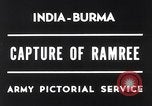
British 26th Indian Division captures Ramree island in Burma (WW2)
A World War II film titled 'Capture of Ramree.' Aboard ship, the Commander, 51st Punjab Regiment, 71st Brigade, briefs his officers about the mission using a map and pointer. U.S Air Force B-24 Liberator bombers drop fragmentation bombs over the island causing thick smoke to rise up. Royal Navy ships bombard the island. British assault troops go ashore from landing craft. Vehicles and artillery pieces are unloaded onto the beach. Out in the water, a British assault craft strikes a mine and blows up. British infantry move through mine clear areas marked with rope lines. They advance towards the war damaged interiors of Kyakpyu town. A wounded Indian soldier is given medical aid. Soldiers occupy the town. A U.S. C-47 aircraft lands bringing U.S. Lieutenant General Raymond A. Wheeler, Deputy Supreme Commander, Southeast Asia, who is met by British Major General Cyril E.N. Lomax, Commander of the 26th Indian Division. The Generals consult together.
CRITICALPAST.COM: About Us | Contact Us | FAQs - How to Order | License Agreement | My Account | My Lightboxes | Shopping Cart | Advanced Search | Featured Collections | Website Terms & Conditions | Privacy Policy ©2026 CriticalPast LLC.
License Agreement |
Terms & Conditions |
Privacy Policy
©2026 CriticalPast LLC.