


 Francais
 Deutsch
 Italiano

Refine Your Search
Greek-Civil-War stock footage and images
- Showing 15061 to 15066 of 27579 results more
 Hide
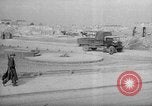
Ruined buildings outside Warsaw, and the first memorial to the Warsaw Ghetto uprising in Poland
Scenes shortly after the end of World War 2. View of the mostly cleared rubble and ruins in Warsaw, Poland, near the intersection of Anielewicza Street, Karmelicka Street, Lewartowskiego Street and Zamenhofa Street in the devastated Warsaw Ghetto district of Muranów, near where the first armed clash of the uprising occurred. Two soldiers walk by on a sidewalk beside the round memorial on the street corner. A truck is parked on an intersecting street. There are mostly open sight lines into the distance with all buildings having been destroyed. A horse cart moves along the road. A jeep with soldiers pass along the road. Closer views of the first memorial to the Warsaw Ghetto Uprising (also later called the Monument to the Ghetto Heroes), designed by Leon Suzin. Views of the inscription on the stone memorial, dated April 19,1946, and commemorating Polish Jews who fought against German military forces in World War 2. Translated, it reads, "To those who fell in an unprecedented and heroic struggle for the dignity and freedom of the Jewish people, for a free Poland, and for the liberation of mankind. Polish Jews." Some flowers laying at the memorial site. (The round 1946 memorial tablet, with its shape symbolizing the underground manholes used during the uprising, was later incorporated into the larger Monument to the Ghetto Heroes, sculpted by Nathan Rapoport and unveiled in 1948.)

U.S. Fifth Armored Division, Prince Arenberg with wife, Duke of Croy and a parachutist in Nordkirchen Castle in Dülmen, Germany
United States Fifth Armored Division in Dülmen, Germany after World War II. U.S. Fifth Armored Division vehicles and soldiers on the bank of a water body. A few soldiers sitting on the shore of the water body. A castle on the other side of the water body. View of the Nordkirchen Castle (Schloß 1, 59394 Nordkirchen, Germany) in Dülmen. Troops on armored vehicles near the entrance of the castle. View of the castle with a courtyard and a statue near the entrance. GIs in the courtyard of the castle. A parachutist colonel holding a document talks to Prince Engelbert-Charles of Arenberg, the 10th Duke von Arenberg. Soldiers in the background. The parachutist colonel and the Duke von Arenberg walk down the steps of the castle. The Duke von Arenberg talking to British war correspondents. The correspondents taking down notes. The Karl Rudolf, 13th Duke of Croÿ flanked by the Duke von Arenberg and his wife Princess Valerie Marie Schleswig-Holstein. The Duke of Croy and the Princess talking to the parachutist colonel. All of them talking near the entrance door of the castle.

Prisoners unload dead bodies from wagons in front of cemetery at Dachau Concentration Camp in Germany.
During liberation of the Dachau Concentration Camp in Germany during World War 2. Huge pile of discarded prison uniforms. German military or civilian prisoners of war, under U.S. Army direction, unload dead bodies from wagons in front of cemetery. A liberated prisoner sprayed with DDT powder for delousing. Large group of men and boy prisoners wait to get sprayed.
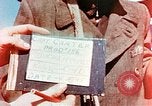
Hungarian, Bavarian and French prisoners at Buchenwald prison in Ettersberg, Germany.
The Buchenwald Concentration Camp in Ettersberg, Germany in World War 2, soon after its liberation in World War II. Hungarian prisoner Max Diamond. A Bavarian political prisoner. Liberated French prisoners stand in front of the prison. A German political prisoner. Prisoners wear black cap with red, white and black band. Red triangle mark on shirts indicates political prisoners. Prisoner with red triangle badge and number 43175. Wired pillar in front of prison.
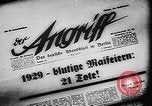
German people during Beer Hall Putsch on the streets to oppose KPD; and later scenes including Adolf Hitler speaking at May Day celebration
Unrest in Germany in decade following World War I. Rally and demonstration in Munich in Marienplatz area, between Communist KPD members, police, and NSDAP brownshirts. This was known as the Beer Hall Putsch or Munich Putsch in November 1923. Crowds opposing the Treaty of Versailles. Trucks and jeeps loaded with policemen at the riot place. Buildings in the background. Scene shifts to a Nazi rally at the Lustgarten in Berlin on May Day (May 1, 1938). A tall May Pole is seen decorated with Nazi flags and streamers. Adolf Hitler addresses a large crowd from a dais on the steps of the Altes Museum. Swastika sign on panels on either side. German biplane aircraft fly in formation overhead, demonstrating German military buildup, re-militarization, and rearmament of Germany leading up to World War 2.

German soldiers, killed by Czechs, lying on roads and fields.Several surviving German soldiers wait to be made POWs.
Dead and dying German soldiers, killed by Czech civilians, are seen on roads and fields in Pilsen,Czechoslovakia, a month before the end of World War II in Europe, after the city's liberation by Allied forces. A couple of the soldiers are still alive and moving. Bucolic Czech countryside seen. American soldiers and Czech civilians moving about on roads. Several surviving German soldiers sits on a fence in a field for processing as Prisoners of War (POWs) by the American soldiers. Wounded and dead German soldiers are transported on hoods of American jeeps. A Czech civilian man turns over a dead German soldier's body to identify it, and writes a notation on a pad.
CRITICALPAST.COM: About Us | Contact Us | FAQs - How to Order | License Agreement | My Account | My Lightboxes | Shopping Cart | Advanced Search | Featured Collections | Website Terms & Conditions | Privacy Policy ©2026 CriticalPast LLC.
License Agreement |
Terms & Conditions |
Privacy Policy
©2026 CriticalPast LLC.