


 Francais
 Deutsch
 Italiano

Refine Your Search
Greek-Civil-War stock footage and images
- Showing 15187 to 15192 of 27579 results more
 Hide
Japanese soldiers advance and give victory banzai in Corregidor Island, Philippines (WWII)
Japanese victory at the Battle of Corregidor during Japanese occupation of Philippines in World War II. Japanese troops land on Corregidor Island (also known as Fort Mills during the American Colonial Period). Japanese troops disembark from boats during their landing at the island of Corregidor. Japanese soldiers climb their way up the island. Soldiers advance on Corregidor Island. Japanese troops march past destroyed buildings. Captured American and Filipino prisoners of war are taken away. Japanese soldiers stand near gun batteries and give victory banzai. View of the Mile Long Barracks of Corregidor. The soldiers advance and walk past a destroyed building. The Japanese flag is raised. Japanese soldiers take down the United States flag in Corregidor.
Damage and destruction at Fort Mills and Corregidor following battle between Japanese and U.S. soldiers
The Japanese invasion and occupation of the Philippine Islands in World War II. An aerial view of Corregidor island. A map shows places. Rubbled buildings and destroyed trees in the area, including bombed Middle Barracks of Fort Mills. Mountains in the foreground. Japanese Soldiers dumping ammunition in gun pits. A destroyed rail road station and wrecked wagons and rails. Prisoner of war soldiers with some of the Japanese forces. Destroyed houses and buildings.
Japanese officials examine wrecked and captured U.S. Army equipment and ammunition on the Philippine Islands.
The invasion of the Philippine Islands by Japanese troops during World War II. Aerial view of vehicles passing on a road. Occupying Japanese officers and Princes Morihiro Higashi-Kuni and Takamatsu inspect wreckage. They inspect wrecked U.S. guns and equipment in Corregidor and at Fort Mills. Mountains in the foreground. Men carrying wooden boxes walk on a street. U.S. prisoners of war in a prison camp. Men bathing at sea. A sign board reads: 'Restricted Road'. Barricades outside the prison camp.
Peacetime activities and contributions by the U.S. Army in the United States.
Scenes from Army Day on April 6, 1934. Secretary of War George Henry Dern, in broadcast to the nation about importance of the Army, in peacetime. Brief glimpses of the Yellowstone River lower falls and Old Faithful and Beehive geysers erupting in Yellowstone Park, Wyoming. View amongst log buildings in Reproduction of Army Fort Dearborn, at the 1933 Century of Progress Exposition in Chicago, Illinois. A pioneer wagon; Native American Indians in ceremonial regalia; antique locomotives and trains at the Exposition. Army General Leonard Wood being sworn in as the Governor General of the Philippines. Closeup of General of the Armies, John J. Pershing, America's highest ranking Military officer. Headquarters of Walter Reed Army hospital, in Washington, DC, named for U.S. Army Major Walter Reed, who confirmed that yellow fever is transmitted by mosquito. Acting on this, the U.S. was able to complete the Panama Canal. View of French dredging equipment sitting idle in the water after Yellow Fever prevented them from completing the Panama Canal. Closeup of U.S. Army General William C. Gorgas, who, in 1904, headed the Sanitary Department that controlled mosquitoes and eradicated Yellow Fever, so the Panama Canal could be finished. View of alligator in swamp near the Panama Canal. Photograph of George Washington Goethals, Chief Engineer credited with making the canal happen. Explosives employed in Panama Canal construction. Earth and rocks being loaded into open rail cars. A steamship transiting the Panama Canal. The Washington Monument; U.S. Library of Congress; and the Lincoln Memorial, cited as examples of accomplishments by U.S. Army engineers. The Wilson Dam, under construction by Army engineers, in Muscle Shoals, Alabama and system of levees being built to control the Mississippi River. The raging Mississippi River during 1927 flood. Flood victims being assisted by U.S. Army soldiers, at a tent camp, receiving food and clothing. An Army airplane flying over a forest fire. Army personnel supervising men in the Civilian Conservation Corps or CCC. Mail being loaded aboard an Army airplane, as airmail service is being opened between Washington DC and New York City. President Woodrow Wilson talking with Army pilot Major Reuben H. Fleet. Mail being loaded into the nose of an airplane. U.S. Army Douglas World Cruiser airplanes in flight, returning from their trip around the world in 1924. A pilot sitting in front seat of a Douglas O-38 airplane, pulls a fabric hood over his cockpit to practice "blind flying". View of the aircraft in flight, with instructor pilot in the open rear cockpit. Army aviators taking a camera and a rifle aboard their airplane as they prepare to leave on an aerial mapping flight. Aerial view of skyscrapers of Manhattan Island, New York City. Army Signal Corps personnel working on communications devices. A cable ship operating at sea, laying cable in support of the U.S. Army's Alaskan cable and telegraph system. Men loading chemicals into hoppers on Army crop dusting airplane. Several views of Army airplanes crop dusting. Glimpse of boll weevil, the target of their efforts. Closeup of Karl Connell, who as a major in the AEF, in World War I, invented a superior gas mask known as the “Connell” or “Victory” mask. A group of miners wearing gas masks enter a smoky mine entrance. The Army invented tear gas, which is shown being used to thwart a bank robbery, in a staged demonstration. Brigadier General Hugh Johnson, appointed by President Franklin Roosevelt, as head of the Great Depression era National Recovery Administration, or NRA, is seen about to give a speech. Narrator cites him as an example of U.S. Army officers who also serve the country in civilian life. Scene shifts to cadets on parade at the United States Military Academy, West Point, New York.

Soldiers jump from a tower and swim under burning oil during their training at Camp Johnston in Florida (WW2)
A World War II military film titled 'The War' depicts the training of troops at Camp Johnston in Florida. Soldiers stand at attention near a waterway. They swim and cross the waterway. They abandon equipment while swimming. Some of the soldiers stand on a tower. They jump from the tower and swim under burning oil.
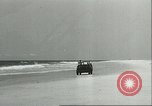
Coast guards on patrol in the U.S., aboard a yacht and a life boat; rescuing men from ships underway at sea
Domestic activities of the United States Coast Guard in the United States during World War II. Coast guardsmen patrol a beach. Men seated in a car drive past on the beach. A U.S. Coast Guard man seated on a horse patrols along the beach. A Coast Guard patrol walks on the beach. Newspaper showing headline and article about disruption of Operation Pastorius by Coast Guard in World War 2, leading to capture of Nazi German would-be saboteurs. View of two of the captured saboteurs being escorted by guards. Smoke in the foreground from the burning of a ship. Men on the deck of a ship. They take an oath. Men aboard a motor boat. Men aboard a yacht and other ships underway at sea. Men aboard a life boat arrive at a beach. They carry the men rescued by them on stretchers.
CRITICALPAST.COM: About Us | Contact Us | FAQs - How to Order | License Agreement | My Account | My Lightboxes | Shopping Cart | Advanced Search | Featured Collections | Website Terms & Conditions | Privacy Policy ©2026 CriticalPast LLC.
License Agreement |
Terms & Conditions |
Privacy Policy
©2026 CriticalPast LLC.