


 Francais
 Deutsch
 Italiano

Refine Your Search
Greek-Civil-War stock footage and images
- Showing 1525 to 1530 of 27579 results more
 Hide
Mob uprisings against Fascists in Europe, during the end of World War II. The Third Moscow Conference of the Allied occupying powers. The Belsen trials.
A mob, seeking revenge against Fascist leaders, fills a city square. They pound on steel gates of a government building. Soldiers and police attempt to protect various persons from the mobs. Others are unprotected and suffer beatings and death. Bodies of Benito Mussolini and his Mistress Clara Petacci are seen hung upside down by Italian Partisans in Milan, Italy, on 28 April 1945. Scene shifts to image of postwar occupying powers, United States, Soviet Union, and Great Britain, whose flags are displayed in the center of a conference table during the Third Moscow Conference. Principals signing agreements, in November, 1943, providing, among other things, for lawful and orderly trials of war criminals, following World War 2. Seen signing are: Soviet Foreign Minister Vyacheslav Mikhailovich Molotov; U.S. Secretary of State, Cordell Hull; and British foreign Secretary, Sir Anthony Eden. View of General Dwight D. Eisenhower, leading a contingent of American wartime Generals on a mission to document Nazi atrocities at liberated German concentration camps. Closeup of a man directing local German citizens who were forced to observe the horrors of the camp. Closeup of an oven used to dispose of bodies of victims. Dead bodies of concentration camp victims strewn in a heap. A room filled with documentary evidence to be analyzed and used in war crimes trials. the body of German General Admiral Hans-Georg von Friedeburg , and of Heinrich Himmler, both of whom committed suicide. A hand holding cyanide capsules. Body of Leipzig City Council deputy mayor Dr. Ernst Kurt Lisso slumped over his desk, following suicide. Body of his daughter, Regina Lisso also a suicide victim. Nazi war criminals being rounded up by Allied military.One being carried on a stretcher. Another, a German officer, is taken into custody. Next, Josef Kramer, the Commandant of Bergen-Belsen concentration camp is seen under guard by a British soldier. British soldiers guarding the court room of the second Belsen trial, convened by the Allied occupational forces, in the Gymnasium building of Luneburg. View of the courtroom with defendants wearing numbers. Closeup of numbers 1 and 2, Josef Kramer, and Fritz Klein, respectively. View of Allied military officers sitting in judgment. Closeups of women defendants, including Irma Grese (number 9) and Elisabeth Volkenrath (number 11). Camera pans around the courtroom.
Queen Elizabeth, the Queen Mother, places a wreath and greets veterans at the Canadian National War Memorial, Ottawa, Canada.
Queen Elizabeth Bowes-Lyon of the United Kingdom (Queen Elizabeth the Queen Mother) arrives at the Canadian National War Memorial (Wellington St, Ottawa, ON K1P 5A4, Canada) in a Cadillac automobile with a clear plastic roof. She walks along a line of Canadian war veterans and converses with some of them. Royal Canadian Mounted Police officer holds back crowd of enthusiastic spectators. The Queen Mother places a wreath at the base of the war memorial, which is already adorned with countless wreaths placed there on Canada's Remembrance Day. Memorial is engraved: "1914-1918." The Queen Mother wears three pearl necklaces. Canadian spectators pack the sidewalks, as the Queen Mother rides along the streets of Ottawa. Views, from a height, of the ceremony at the National War Memorial. The Queen Mother stands before assembled officials. A military band is in formation. Large numbers of spectators are assembled to watch. The Queen Mother's wreath is shown with its card reading: “From Her Majesty Queen Elizabeth, The Queen Mother."
Several scenes of public demonstrations by Russian citizens in Petrograd during World War I
Scenes of unrest in Russia during World War 1. Crowds of Russians, disappointed with the war, their government and the general state of affairs, demonstrate in Petrograd, during the so-called February Revolution immediately preceding the beginning of the Russian Revolution. Some carry banners reading "Freedom and Equality, and similar slogans. (This event triggered the abdication of Tsar Nicholas II and formation of a Provisional Government.) In another sequence, a huge mass of Russians, mostly women, move through a street in Petrograd on International Women's Day, May 8th, during a period of labor strife and unrest. In final sequence, Russians are seen packed together on a warm day, possibly listening to a speaker. (These may be brief scenes from the July Days uprising, in Petrograd, When a peaceful demonstration by half a million people, was put down by armed troops resulting in some 700 deaths.) (World War I; World War 1; WWI; WW1)
Nations in various stages of mobilization before and during World War I
Nations mobilizing for World War 1 (The Great War).from 1914 through 1917-18. Civilians in a Slavic country react to information fastened on a large circular post. Closeup of British Mark II tanks moving near the camera, followed by view of British Whippet tank in front of army trucks. Uniformed, armed, German troops assembling in a town square. German General Paul von Hindenburg leading members of his staff and a diplomat, on inspection of troops. A Russian officer on horseback with troops assembled in a city park. Unusual grouping of Military officers from Germany (wearing Picklehaube helmets); France; and Russia (including a Cossack), gathered in front of a Russian Orthodox Church (presumably somewhere in Russia) prior to World War 1. Anachronistic view of middle-aged Winston Churchill giving an address, before numerous microphones. U.S. Marines hurrying along a waterfront pier, past a variety of boats docked in a city marina. American soldiers looking at a U.S. Connecticut-class battleship docked at a pier, displaying a large American flag, during World War 1. Camera pans across the pier. Crew members seen on Japanese battleship, Settsu. Japanese troops disembarking from a transport ship covered with ice.
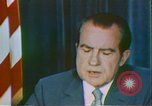
U.S. President Richard Nixon works for peaceful end of Vietnam War, improves domestic conditions and controls drug traffic.
U.S. President Richard Nixon speaks about aftermath of immediate withdrawal from the Vietnam War. U.S. military prisoners of war held by North Vietnam stand before press reporters in Vietnam. President confers with U.S. Secretary of State Dr. Henry Kissinger at his office. Vietnam War draftees being selected by traditional lottery system. Men stand in front of machines that churn out numbered balls for new draft lottery system. Nixon transforms budget expenditure on human needs. Criminals caught by police walk, some covering their faces from the media, as they are led away by police and investigators. Illegal drugs seized by efforts of Nixon administration. View of seized heroin manufacturing equipment. Nixon speaks about the opium farming in Turkey during one of his speeches and mentions agreement with the Turkish government in Ankara to cease all opium poppy production. Customs officers check illegal drug traffic on the border of Mexico and America. Drug enforcement officials search cargo hold of a ship for illegal drugs. Views of drug control officers finding illegal stashed hidden drugs in hiding places in cars and vehicles. Nixon speaks about increased budget to control illegal drug traffic and rehabilitation of drug abusers and drug addicts. He creates the office of Drug Abuse Enforcement and he speaks saying "We must wage what I have called Total War against public enemy number one in the United States: The problem of dangerous drugs." From a pro-Nixon "documentary" called "The Nixon Years: Change Without Chaos" covering President Richard Nixon's first four years in office. Released during his 1972 reelection campaign.
Role of Air Transport Command and increase in naval power of the U.S. during World War II.
Animation depicts the role of Air Transport Command during World War II. A man brushes his teeth. A globe depicts Air Transport Command aircraft flying around the world. Animation depicts Chinese war effort against the Japanese and the amount earned by a Chinese soldier. U.S. Naval Fleet at the beginning of the war. U.S. Naval Fleet after a 14 fold increase in number of ships during the war.
CRITICALPAST.COM: About Us | Contact Us | FAQs - How to Order | License Agreement | My Account | My Lightboxes | Shopping Cart | Advanced Search | Featured Collections | Website Terms & Conditions | Privacy Policy ©2026 CriticalPast LLC.
License Agreement |
Terms & Conditions |
Privacy Policy
©2026 CriticalPast LLC.