


 Francais
 Deutsch
 Italiano

Refine Your Search
Greek-Civil-War stock footage and images
- Showing 15307 to 15312 of 27579 results more
 Hide

Refugees and displaced persons arriving in New York from aboard the SS Marine Flasher, arriving from Bremerhaven Germany
Arrival of displaced persons and refugees of World War 2 in New York, after the war. Men, women, and children arriving at New York City on May 20, 1946 after a voyage that departed Bremerhaven Germany on May 11, 1946. People greet relatives at the dock in New York. Two young men and a girl stand together and show the concentration camp tattoos on their arms. The tattoo numbers are A9496 on the young man with the hat, A13889 on the girl, and B3073 on the young man without a hat. The young man with tattoo B3073 is Berel Gola (later called Bernard Gola) a 20 year old Jewish man from Poland. He had been imprisoned by the Nazis at Treblinka and at the Auschwitz Concentration Camp, where he received the tattoo. A woman and a man holding a young girl stand. Women holding children stand by. A man holding a young child. People debarking from the ship. People crowd at the dock. They meet their relatives. People stand behind a fence. A woman greets her relative. An emotional woman cries when reunited with relatives.

The U.S. Army Quartermaster Corps store procured supplies and enlisted men are trained in quartermaster operations (WW2)
The United States Army Quartermaster Corps in the United States during World War II. A diagrammatic comparison of army manpower of 8,000,000 in December 1943 as against 1,750,000 in December 1941. A diagrammatic representation of huge increase in volume of obligated procurement in 1942 as against 1941. Men wheeling carts of supplies at a store. Men carrying supplies coming down a gangway from a ship onto a dock. Soldiers with guns standing on the dock. Soldiers moving through a wooded area. Men carrying the procured materials for storing. Officers watching the men. Two soldiers wearing their uniforms. People and vehicles moving on a city street. A signboard on a building reads 'Office of the Quartermaster General War Department'. The headquarters building in view. A map of the U.S. showing locations of different procuring offices across the nation. Men and women working in an office at the headquarters. Petroleum, Subsistence and Textile sections at the headquarters. Officers working in the headquarters. Men getting into a truck. Enlisted men being trained in various quartermaster operations at a training center.
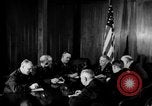
U.S. Army Quartermaster Corps' plan for procurement of materials for military services in the United States (WW2)
The United States Army Quartermaster Corps in the United States. Members of the Headquarters Army Service squad and Quartermaster Corps officers seated around a table during a meeting discuss the procurement plan of items for the military services in World War II. A signboard over the Quartermaster Headquarters building reads 'Office of the Quartermaster General War Department'. A map of the United States shows locations of procurement offices across the nation where authority is given to field officers for procurement. A field officer with a military personnel signing a contract for a fixed amount for the procurement of materials. A map shows the authority given in the procurement of materials which helps in speedy and efficient procurement. A simplified contract form which is used when the prices are known and when the total purchase does not exceed 500 thousand dollars. A purchasing officer hands over the contract to a staff to be sent to a manufacturer or a dealer. The manufacturer in his office signing the contract. Workers at the Quartermaster Headquarters at work.

Members of Congressional Military Affairs Committee including Clare Booth Luce talk to soldiers in the European Theater.
Congressional Military Affairs Committee members visits war front in the European Theater during World War II. Members of Congressional Military Affairs Committee including Clare Booth Luce talk to soldiers and look at a camp bulletin board.

U.S. officials examine a Liberty airplane engine during its unveiling ceremony in the United States.
Liberty airplane engine unveiling ceremony in the United States. A flag draped aircraft engine. The flag is removed from the engine. The engine on a platform guarded by U.S. soldiers and military officials. Officials inspect the engine. (World War I; World War 1; WWI; WW1)
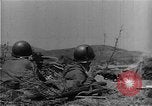
Information about unidentified airplanes is transmitted in the United States.
A public television program by the U.S. Army entitled 'The Big Picture.' U.S. troops are seen hunkered down and looking through binoculars in a defensive position in Korea, during the Korean War. American soldiers riding atop a Sherman tank on a city street in Germany, during World War II. Ski troops moving across snowy hill in Alaska. U.S. Army amphibious assault training on a beach in Puerto Rico. Army Master Sergeant Stuart Queen, narrator, speaks about America's defense against threat of atomic attack in these times of lukewarm peace. View of mountainous region in Alaska. A cluster of Cup'it Eskimo dwellings is seen on Nunivak Island, in the Bering Sea. Several of the local inhabitants are fishing through holes cut in the ice. Vapor trails are seen from Soviet aircraft flying at high altitude. A sign on a tarpaulin displaying logo of the Army Signal Corps, reads,"Alaska Communication System, Long Distance Commercial Telephone-Telegraph." A tracked vehicle carries a soldier to a facility posting a sign reading, "Alaska Communications System Receiver Station." Several tall antennas loom above the site. The soldier, dressed in arctic gear, steps from the tracked vehicle and walks past several snow shoes, standing upright in the snow, to enter a white wooden building. Inside, a man in civilian clothes works at a battery of telecomunications equipment. He transmits a message about the aircraft sighting, to the Alaska Communication System facility in Fairbanks Alaska (briefly shown) by means of a telegraph key. From there it is relayed to a Signal Corps facility, shown, in Washington, DC. A soldier is seen Inside that facility, in a room filled with computers and telecommunications equipment. A Sergeant handles paper tape messages being sent and received by teletype. Another soldier plugs connections into a communications switchboard. Next, the camera pans over the entrance to the Office of the Secretary of Defense, in the Pentagon. More views of soldiers attending banks of teletype machines. Animated map displays paths of orders being transmitted to U.S. Air Defense Centers in San Francisco, Chicago, Seattle, New York, and Atlanta. View from control room, of several U.S. Air Force F-94 Fighter Interceptor aircraft on an airfield ramp. A controller activates a Klaxon horn and pilots on alert, in the Fighter Interceptor Squadron ready room, jump up and scramble to their aircraft. A pair of F-94s taking off. One is number 51-5385. Next, a U.S. Navy F-9 fighter plane is seen taking off from an airfield. It displays tail code AE. It is followed by another F-9 aircraft.
CRITICALPAST.COM: About Us | Contact Us | FAQs - How to Order | License Agreement | My Account | My Lightboxes | Shopping Cart | Advanced Search | Featured Collections | Website Terms & Conditions | Privacy Policy ©2026 CriticalPast LLC.
License Agreement |
Terms & Conditions |
Privacy Policy
©2026 CriticalPast LLC.