


 Francais
 Deutsch
 Italiano

Refine Your Search
Greek-Civil-War stock footage and images
- Showing 15475 to 15480 of 27579 results more
 Hide
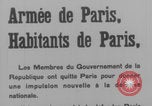
French performs reconnaissance and prepares Paris defense before Battle of Marne WWI
A proclamation issued on September 3, 1914 from General Joseph Simon Gallieni urging the defense of Paris in light of the French government’s evacuation for Bordeaux and the incoming Battle of Marne during World War 1. “MILITARY GOVERNMENT OF PARIS Army of Paris, Residents of Paris, The members of the Government of the Republic have left Paris to give a new impulse to the national defense. I have received the mandate to defend Paris against the invader. This mandate, I shall carry out to the end. Paris, 3 September 1914 The Military Governor of Paris, Commanding the Army of Paris, GALLIENI” translated in English. Workers using pickaxes to break stones at a park in Paris, France. Soldiers in position behind a trench made of tree branches. A soldier uses a telephone while hiding under a tent of twigs. A French military official answers call. French soldiers towing a reconnaissance aircraft. A French Blériot XI observation aircraft takes off from an airfield for a reconnaissance mission. Aerial view of countryside outside Paris and surrounding areas as seen from a Blériot XI’s , with the French Army incorporating cameras in reconnaissance planes from the beginning of World War 1. The Blériot XI aircraft lands back to the airbase. Reconnaissance pilot reports his findings, showing his logbook. French military official working at his desk. French officers consulting reports posted on a wall inside their office. Under a canopy of twigs, a military officer uses a telephone to receive orders.
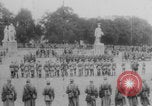
Allied dignitaries arrive at the Palaces of Versailles for the Treaty of Versailles (WWI)
Statesmen arrive at the Palace of Versailles for the signing of the Treaty of Versailles, which ends the state of war between Germany and the Allied Powers in World War 1. Dignitaries such as French Prime Minister Georges Clemenceau arrive by car. World leaders and dignitaries walking on the palace grounds of Versailles. United States President Woodrow Wilson is seen in between Georges Clemenceau and Italian Prime Minister Francesco Savero Nitti as they walk to the Palace of Versailles. Delegates seated and talking to each other inside the Hall of Mirrors, where the treaty is signed. View of hand leafing through the Treaty of Versailles affixed with the official seals.

Captured German prisoners receive food from Allied troops in WWI
French soldiers marching with flags, officers on horseback, during an offensive in World War 1. Captured German soldiers, carrying blankets, march as Allied troops look on. A truck containing Allied soldiers drives by. Soldiers riding horses (pulling a cart) pass by a dead soldier. Horses pull carts carrying supplies and artillery. German prisoners-of-war sit on the ground after arriving at a camp. Allied soldiers distribute food rations to German prisoners. Food being tossed to Germans. German prisoners scramble to pick up tossed food packs on the ground.

Militaristic parade displaying German Empire (Second Reich) and Nazi flags in Berlin; former Crown Prince Wilhelm observes parade
A military parade displaying symbols of the former German Empire and the Nazi party in Berlin, Germany after the First World War. A marching band playing. Soldiers raise the German Empire (Second Reich) flags and symbols such as the Imperial Eagle. Military officials salute past spectators from their open car. Former German Empire Crown Prince Wilhelm, the son of the former Emperor Wilhelm II, speaks to a military official at a roof deck, likely near the Berlin Zoologischergarten (Berlin Zoo), the Daimler-Motoren-Gesellschaft logo can be seen from the background. Soldiers holding the war flags of the German Empire. A woman uses binoculars to watch the parade. Crown Prince Wilhelm salutes the parade. Marching band parades from the Charlottenburger Chaussee (now known as the Straße des 17. Juni), passing through the Brandenburg Gate (Brandenburger Tor Pariser Platz, 10117 Berlin, Germany). Soldiers holding Nazi flags and marching band parades through Under den Linden boulevard. Some spectators perform the Nazi salute at the parade. Some spectators carry umbrellas while watching the Nazi parade.

German invasion of Brussels, attack on Louvain (Leuven) during WWI
German invasion of Brussels after the German Empire declared war on Belgium in World War 1. Belgian Army cavalry respond to German attack in Louvain (Leuven). Fallen tree in the middle of a road. German artillery bombing of Louvain (Leuven). Military officials at the observation point as German First Army attacks Louvain. Railway gun aiming. Railway guns firing at Louvain. Explosions in the battlefield. Belgians evacuate from attack by the German First Army. Louvain in ruins. German soldiers marching into Brussels. German soldiers marching at the Grand Place or Grote Markt (Grand Place, Brussels, Brussels-Capital Region 1000), the central square of Brussels.
Kaiser Wilhelm II meets military officials as German forces depart Germany during WWI
The Imperial German Army (“Deutsches Heer” in German) leaves for Belgium and France after the German Empire declares war on Russia and France in World War 1. A steam locomotive train moves past a forest, moving slowly beside a crowd of Imperial German troops. German troops march out after the train has come to a full stop. German Army officials greet each other. German Kaiser Wilhelm II shakes hands with a high-ranking military official. German military officials inspect infantry. Kaiser Wilhelm II shakes hands firmly with a German military officer after raising his clenched fist in the air.
CRITICALPAST.COM: About Us | Contact Us | FAQs - How to Order | License Agreement | My Account | My Lightboxes | Shopping Cart | Advanced Search | Featured Collections | Website Terms & Conditions | Privacy Policy ©2026 CriticalPast LLC.
License Agreement |
Terms & Conditions |
Privacy Policy
©2026 CriticalPast LLC.