


 Francais
 Deutsch
 Italiano

Refine Your Search
Greek-Civil-War stock footage and images
- Showing 15523 to 15528 of 27579 results more
 Hide
101st Airborne and 4th Armored Division defend Bastogne (WW2)
Map showing Stavelot and Bastogne in Belgium during World War II. A soldier uses binoculars to inspect United States Army Air Force planes in the sky. Soldiers watch aerial combat between United States and German Luftwaffe Air Force planes. Smoke from planes hit by flack lingers in sky. 101st Airborne division soldiers march to the outskirts of Bastogne. Soldiers ride an armored vehicle and march on foot. 4th Armored Division M4 Sherman tanks move on snow covered road. Explosion during battle in Bastogne. Douglas C-47 Skytrain transport planes from bases in Britain and France bring supplies to the defenders of Bastogne. German prisoners of war marching by as the transport planes arrive. The C-47 transport planes airdrop supplies over Bastogne.
General Hata inspects Japanese troops in Central China (WW2)
A plane takes off from Nanjing, China. Commander-in-chief General Shunroku Hata talks to a military officer in flight to Central China. General Hata and other Imperial Japanese Army officers in Central China. General Hata and other officers inspect Central China Expeditionary Army in China during the Second Sino-Japanese War (World War II).

Chinese laborers mine iron ore in Japanese-occupied Hainan Island (WW2)
Coconut trees on Japanese-occupied Hainan Island during the Second Sino-Japanese War (World War II). Native Chinese laborers work on railway tracks and in Tandoku Iron Mine, near Sanya, Hainan Island. Chinese laborers digging for iron ore in open pit mining. The laborers scoop iron ore and load into rail cars. A group of laborers push the rail wagons filled with iron ore into pit. A Japanese man supervises the miners. A laborer fills wagon with iron ore while another pushes a cart away. The wagons filled with iron ore move on railway track.
President Johnson addresses the public on United States actions against North Vietnam
During the Vietnam War, President Lyndon B. Johnson addresses the United States public during the “Radio and Television Report to the American People Following Renewed Aggression in the Gulf of Tonkin” from the Fish Room at the White House in August 4, 1964. "Renewed hostile actions against United States ships on the high seas in the Gulf of Tonkin have today required me to order the military forces of the United States to take action in reply,” says President Johnson. The USS Constellation (CV-64) aircraft carrier sailing. Pilots walk away from Douglas EKA-3B Skywarrior fighter jets in the USS Constellation. Aircrafts fire missiles, destroying facilities in North Vietnam. United States Secretary of Defense Robert McNamara addresses the public to explain the direct attack against North Vietnam. “We wish to emphasize we seek no wider war. Our response will depend upon the action of the aggressors, in this case the North Vietnamese. The key to the situation remains the cessation of infiltration from the North into the South,” says Secretary McNamara.
United States soldiers find captured North Vietnamese weapons and ammunition with Chinese markings
United States soldiers unload weapons and place them on the ground during the Vietnam War. Crates with various markings. Captured North Vietnamese weapons such as rifles, submachine guns, and ammunition on display. The soldiers inspect Chinese anti-tank and mortar rounds captured from North Vietnamese forces. A finger points to Chinese markings. North Vietnamese leader Ho Chi Minh meets with delegates. Ho Chi Minh and other North Vietnamese communist leaders attend meeting with United States officials. “Our war aim in South Vietnam is peace. President Johnson has directed me to do everything possible to bring this matter from the battlefield to the conference table. And so we’ve been utilizing all of the existing and available political machinery for that purpose” says Secretary of State Dean Rusk during an interview.
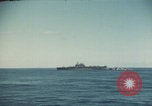
USS Bismarck Sea and USS Saratoga sailing in the Pacific Ocean (WW2)
The USS Bismarck Sea (CVE- 95) sailing in the Pacific Ocean during World War 2. Dr. Edgar Maurice Cortright, United States Navy Lieutenant, narrates his experience on board the USS Saratoga (CV-3) at the time of its bombing by Kamikaze planes during the Battle of Iwo Jima in World War II. Crewmen sitting on top of a damaged Grumman F6F Hellcat fighter plane on the USS Saratoga a day after the Japanese Kamikaze attack. Wreckage of a Grumman F6F Hellcat fighter on deck. A Jeep drives past the wreckage. Crewmen clearing debris on the flight deck. Fighter sitting on the starboard side by the flight deck crane. A gaping hole on the flight deck that went down five decks. Debris on the flight deck. Sailors removing the wreckage of destroyed fighters. They use a rope to pull the destroyed aircraft to the side.
CRITICALPAST.COM: About Us | Contact Us | FAQs - How to Order | License Agreement | My Account | My Lightboxes | Shopping Cart | Advanced Search | Featured Collections | Website Terms & Conditions | Privacy Policy ©2026 CriticalPast LLC.
License Agreement |
Terms & Conditions |
Privacy Policy
©2026 CriticalPast LLC.