


 Francais
 Deutsch
 Italiano

Refine Your Search
Greek-Civil-War stock footage and images
- Showing 15931 to 15936 of 27579 results more
 Hide
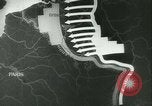
German tanks, horses and troops cross the Rhine on barges and rafts during their advance towards France in WWII.
The German assault on France during the Battle of France in World War II. An animated map depicts the German attacks on the Maginot Line and city of Paris. German Field Marshal Erwin Rommel (Desert Fox) confers with a German officer. German soldiers in a fields, pull an armored vehicle with ropes. Smoke from bomb explosions. Bomb damaged buildings. German tanks advance. The Germans cross the Rhine. Soldiers cross over a bridge and in boats, load and fire artillery. Explosions on either side of the river. Soldiers and civilians lay planks to build a bridge. Soldiers in amphibious vehicles cross the river. Tanks, horses and troops cross the Rhine on barges and rafts. Camouflaged German tanks. German officers review the advance. Soldiers eat rations, drink water and take rest. The horses are fed. Soldiers on motorbikes and in tanks on a street.
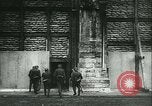
German soldiers explore a cathedral and civilians listen to an French occupation broadcast in France.
The German assault on France during the Battle of France in World War II. German soldiers enter the sandbagged Notre-Dame of Laon cathedral in Laon, France. They take a look around. Pillars and arches inside the church cathedral. A soldier plays the pipe organ in the cathedral nave. A French woman washes clothes in a stream. Little boys play by a fountain in a town. An elderly carpenter in a workshop. A woman irons clothes in a room. Civilians on a street. Pedestrians and cyclists move about. A crowd outside the 'Radiobecks' radio store on the street. Men, women and children listen to an occupation broadcast in French. Soldiers battle in fields. Machine gun fire.
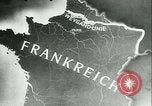
German troops advance through Hangest while German Stukas bomb Allied positions and dogfight with French airplanes.
The German assault on France during the Battle of France in World War II. A map depicts the location of Somme, Paris and the Weygand Line in France. Germans advance into France. German forces move through Hangest-en-Santerre, France. A bullet ridden sign for Hangest-en-Santerre. German soldiers take cover. Smoke due to several explosions. Bomb damaged buildings and rubble strewn on the streets. German soldiers in a 5 cm sIG 33 (Sf) auf Panzerkampfwagen I Ausf B, sometimes called a Sturmpanzer I Bison self-propelled gun as it makes its way through the streets amidst enemy fire. Machine gun fire. Tanks advance on the streets. German soldiers run for cover. Bomb damaged buildings and ruins. Soldiers amidst rubble. German Junker Ju 87 Stukas, He-111 and Ju-88 medium bombers bomb Allied positions in France. German pilots release bombs. The bombs descend to the ground and explode causing huge clouds of black smoke. View of bombing and smoke rising from targets as seen point of view from inside plexiglass nose section of German bomber aircraft. French MS-406 fighters and German Me-110 and Me-109 fighter aircraft dogfight. The crew inside a Stuka in flight. A French aircraft is hit and is seen nosediving toward ground. It crashes with a large explosion. German aircraft bomb the Weygand Line. German artillery bombards the Line.
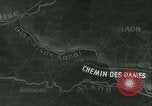
German officers confer underground and soldiers fire antiaircraft guns at Allied aircraft as they advance in France.
The German assault on France during the Battle of France in World War II. A map depicts the German advance into the Chemin des Dames sector and across the Aisne River in France. German officers confer underground. An officer briefs others using a map on a wall. Soldiers seated in candlelight. German soldiers work in a field. Allied aircraft in flight overhead. Bombs dropped causing explosions. A wrecked aircraft on the ground. Soldiers load and fire artillery and antiaircraft guns. Officers give orders to fire the guns. A few officers observe the events. Machine guns fired.
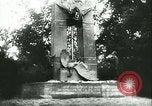
Adolf Hitler receives the French surrender from General Huntziger in the form of the Second Armistice at Compiegne in France.
The Second Armistice at Compiegne after the German victory in the Battle of France during World War II. A WWI monument covered with a German flag in Compiegne. German soldiers near the monument. German troops stand at attention. German Fuhrer Adolf Hitler, President of the Reichstag Hermann Goering, German Field Marshal Wilhelm Keitel and other German officers arrive at the venue. The leaders and officers walk past the soldiers at attention. Hitler gives the Nazi salute. Hitler and the other officers enter the WWI Armistice railway car. French General Charles Huntziger and other French officers and officials arrive at the venue. The German and French officers seated around a table inside the WWI Armistice railway car. Hitler receives the French surrender from General Huntziger on June 22, 1940. The Second Armistice on the table. An animated map depicts Frankreich. Bells toll at a Parisian cathedral. Adolf Hitler with several German officers inside the cathedral. Arches, pillars and carvings in the cathedral.
V-mail procedures including cutting, microfilming, transport, photographic enlargement, and processing during WWII.
The use of V-mail (Victory Mail) by the United States during World War II. V-mail procedures including cutting, microfilming, transport, photographic enlargement, and processing of V-mail letters and post. A poster promoting the use of V-mail. Women in a line at a post office. The post office staff at counter windows serves the customers. A woman collects a V-mail letter, writes her message and then addresses the letter. The preferred use of a softer pencil in V-mails. Cutting: Specially trained soldiers unpack the V-mails and use a cutting machine to open each mail. Processing: The experienced staff sorts mails into the respective destination groups at sorting tables. Soldiers open mails to photograph them. A soldier sorts mail that can't be photographed and are to be sent back. These mails include stamps, enclosures, snapshots and bad writing. The correct mails are then sorted into given numbers in bundles. Microfilming: Women use Airgraph machines to photograph each mail on 16mm films. 1600 mails on 100 feet of film. The complete reels are sent for developing. Women put in new reels of negatives into the cameras. Developers dry the film reels. Stacks of reels on a table containing images of thousands of letters. Soldiers packing and stacking many hundreds of sacks filled with V-mail letter microfilm images. A Boeing 314 Pan American Clipper flying boat sea plane (military designation C-98) is seen taking off to transport V-mail to major destination points. A bag of microfilm reels is delivered to an officer. He unpacks the reels and sends them to the printing room. Enlargement: Enlargement machines are used to enlarge the snapshots. Men and women operate the printing machines. Soldiers with the printed facsimiles on tables. Processing: Women slice the prints into separate letters. Machines used to insert facsimiles into V-mail envelopes and seal them. The mails are then sent to the exact destinations by ordinary post. Soldiers gather around as a comrade distributes mail at a U.S. military base in the combat area.
CRITICALPAST.COM: About Us | Contact Us | FAQs - How to Order | License Agreement | My Account | My Lightboxes | Shopping Cart | Advanced Search | Featured Collections | Website Terms & Conditions | Privacy Policy ©2026 CriticalPast LLC.
License Agreement |
Terms & Conditions |
Privacy Policy
©2026 CriticalPast LLC.