


 Francais
 Deutsch
 Italiano

Refine Your Search
Greek-Civil-War stock footage and images
- Showing 16825 to 16830 of 27581 results more
 Hide
Color Sound
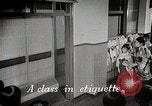
Elementary schoolgirls learn traditional Japanese tea ceremony and sewing in Japan.
The Japanese school system and its deficiencies up to World War II. The film emphasizes the role of schools in developing nationalism, Japan. Girls are taught the traditional Japanese tea ceremony. Female students learn to bow their heads and sit well. The teacher and other students watch a girl demonstrate good tea ceremony etiquette. The girl slides a door open and bows to another girl in kimono. Teacher teaches etiquettes of receiving guest. Girls wearing kimonos learn the ritual for serving and drinking tea. The girl brings a tray of rice cake or wagashi. Teacher teaches etiquette of drinking tea to girls. Japanese sewing class: Students make embroidery in sewing class. Geometrical designs for embroidery displayed. A Japanese sewing kit with thread, thread snippers and seam ripper. Girl takes out a needle from a sandal-shaped pincushion. The girl puts a thread into the needle before sewing the fabric. Girls sew the clothes and put kimono on mannequins. Girls sew at sewing machine.
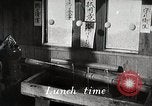
Japanese children wash hands, eat food and taught to learn physical exercise in Japan.
Japanese films show school activities to explain the school system and deficiencies are noted by narrator. The films emphasize the school's role to develop nationalism in Japan. Lunch time: Children wash their hands and come out from the building to take lunch. Children served vegetables and fish in food. Emphasis on physical culture by calisthenics and gymnastics: Children run for exercise. Children do physical exercise. Children learn the correct methods of formal exercise. Children are taught to exercise for strong and good health, which is necessary for soldier. Children do calisthenics under trained teacher. Children do gymnastic to build body and make formation. Boys doing calisthenics. (World War II period; anti-Japanese propaganda).
Japanese adult and children in volunteers work corps toil in Japan (WW2)
Children and adults volunteer and are recruited to work for ammunition factories and community work in Japan during World War II. Japanese schoolchildren with brooms head to a Shinto shrine. Children and adults worship at the Shinto shrine. They bow in front of the shrine. Japanese volunteers salute the Japanese flag. Volunteers cut grass in the field. Schoolchildren carrying buckets. Middle school students pile up rocks, cut grass and bushes on the hillside and clean up the temple. Japanese student volunteers march in a parade on the beach.1945.
Government buildings in Tokyo, Japan
The entrance to the Imperial Palace in Tokyo, Japan. View of the Japanese Ministry of Foreign Affairs building in the Kasumigaseki district before it was destroyed by fire during the Great Kanto Earthquake. A car drives away from the Ministry of Foreign Affairs building. Pedestrians walking outside the Ministry of Justice building (1-1-1 Kasumigaseki, Chiyoda-ku, Tokyo 100-0013). View of the Imperial Diet building, now known as the National Diet building (1 Chome-7-1 Nagatachō, Chiyoda City, Tokyo 100-0014, Japan). Emperor Hirohito on horseback inspects Japanese troops. Marching Imperial Japanese Army troops before World War II. Emperor Hirohito boards a Japanese Navy ship. Sailors in Japanese Navy ships.
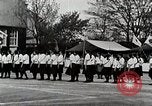
Sports day at school in Japan
Students participate in sports day activities in school. Girls compete in Tug of War contest. Girls dance and demonstrate Naginata with polearms, boy displays martial art skills and students play games to participate in sports day. Film shot in approximately 1934-35.
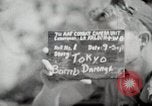
Bomb Damage in Kamata district after bombing of Tokyo
Destroyed ammunition factory in Kamata district in Tokyo city after it was bombed. Civilians among ruins of factory. Remains of laundry in Kamata district. Japanese shrine and bus station in Kamata district. Wrecked Japanese buses.9 September 1945. (World War II period).
CRITICALPAST.COM: About Us | Contact Us | FAQs - How to Order | License Agreement | My Account | My Lightboxes | Shopping Cart | Advanced Search | Featured Collections | Website Terms & Conditions | Privacy Policy ©2026 CriticalPast LLC.
License Agreement |
Terms & Conditions |
Privacy Policy
©2026 CriticalPast LLC.