


 Francais
 Deutsch
 Italiano
Refine Your Search
Greek-Civil-War stock footage and images
- Showing 1723 to 1728 of 27579 results more
more Hide
Hide
General Anton Dostler, a Nazi German war criminal being executed by firing squad in Aversa, Italy
A newsreel titled 'Nazi war criminal executed' shows General Anton Dostler, a Nazi German war criminal arriving at the execution site in Aversa, Italy. General Dostler, guilty of ordering the shooting of 15 American soldiers during World War II, stands against a pole with his hands tied at the back. A priest recites a prayer as troops remain lined up. General's face is covered and he is executed by firing squad.
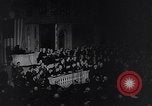
President Franklin D. Roosevelt asks Congress to declare war, after Japanese attack on Pearl Harbor (WW2)
On December 8, 1941, U.S. President Franklin D. Roosevelt, addresses the Congress, calling for a declaration of War against Japan in World War II. He calls December 7, 1941 "a date which will live in infamy." Roosevelt notes the United States was at peace and in conversation with Japan's government and Emperor Hirohito, about maintaining peace in the Pacific. Japanese ambassador and statesmen are seen visiting State Department offices to meet with the U.S. Secretary of State. Photographers take pictures of the visiting Japanese statesmen. President Roosevelt asks Congress to affirm that a state of War exists between the United States and the Japanese Empire.
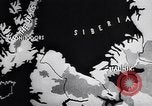
Steel manufacturing in Stalinsk and mining of coal and copper east of Ural mountains, USSR, during World War II
Map of Siberia and environs highlights the Urals, Magnitogors, and Stalinsk ( now Novokuznetsk) in Russia. Camera pans over industrial complex in the city of Stalinsk, Soviet Union, during World War 2. Numerous plants and smoke stacks are seen and narrator describes large increases in production and output to supply the Soviet war effort. Closeup of flaming coke being discharged from a coking furnace. Cooled coke being discharged into a large pile. Interior of a steel mill where workers have just tapped an open hearth furnace, amidst fire and smoke. Fiery molten steel pouring from the furnace. Hot ingots being moved to rolling mills. Russian steel workers controlling the mills. Large long ribbons of steel emerge from the top of a rolling mill. War production workers lift them up and place them back into the mill below the roller, this time, which then pulls them away in a second pass, moving away from the camera. Hot ribbon of steel moves in a circular path within a pathway atop a large machine. Men working at machinery with numerous valve handles. Closeup of a steel worker. Change of scene to a mine where a miner tends five drills boring into the ceiling of a mine cavity. He installs a shaft onto one of the drills. Small gauge rail cars transport ore out of the mine. Next, an open air copper mine is seen with Steam shovels digging the ore. A meeting of factory workers with a poster of Joseph Stalin displayed. A speaker extends thanks from Soviet leaders and from Soviet soldiers at the front. Closeups of speakers and listening workers. A woman operating controls to rotate a drum of crushed copper ore and empty it. Workers tending numerous banks of copper ore washing machines.
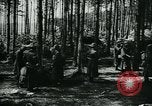
Soviet forces engage invading German forces during World War II
Opening scene shows Soviet troops gathered in a forest during World War 2. Artillery fire is heard in background. Next Soviet artillerymen are firing a 122 mm howitzer M1910/30 at a front line position during World War 2. . A Soviet Polikarpov I-16 aircraft is seen briefly, in flight overhead. Soviet infantry advancing across a field behind a T-34 tank. Heavy smoke clouds nearby in the background. Soviet infantry moving through forest as machine gun fire is heard. One soldier places a slit shield in front of himself and fires through it with his rifle, while standing in a trench. View of him firing alongside a comrade in the trench. Soviet troops jumping from an army truck to take up positions in the field. Soviet Marshal Semyon Timoshenko is seen at the battle front accompanied by another officer. . A string of dropped bombs explode in the distance. Soviet soldiers in a trench looking for enemy aircraft with binoculars. Infantry passing through barbed wire. One carries a mine detector. Soviet machine gunners duck as a shell explodes near them. Infantry charging through the woods.Soviet Polikarpov.I-16 aircraft attack German tanks that maneuver in attempt to escape them. Bombs explode among the tanks. A Soviet Polikarpov I-16 aircraft climbs rapidly overhead. View from Russian aircraft of German tanks racing across a field, that appear to be emitting smoke screens. Soviet tanks moving past a blazing wooden structure. Wrecked German army motorcycle and side car displaying the Totenkopf (death head) symbol. Closeup of the symbol. Dead German soldiers in the grass and lying next to a motorcycle. Remains of a downed German airplane, in flames. Dead German flyer entangled in remains of parachute. Soviet soldier examines a knocked out German Panzer I tank. Partial views of other destroyed German tanks. Smoke drifts across a quiet battlefield. Soviet infantry moving forward. Several views of German prisoners of war being marched in various locations. Closeup of Totenkopf and number 13 on the side of a German armored vehicle. A Soviet soldier begins to scrub it off the vehicle. Camera pans closely over some of the prisoners. A German soldier, who wants to stop fighting, presents a pass to a Soviet soldier as he surrenders. Closeup of the pass, one of many that had been scattered among the German forces, by the Soviets. It invites a bearer, who is fed up with killing, to come to the Soviets. The document states boldly, "Geht mit diesem ausweis durch die front." (Go with these identification papers through the front.) Soviet soldiers escort the German soldier away. Soviet soldiers help a wounded comrade from a tank camouflaged under hay. Soviet medical corps women and a male doctor tend to the wounds of a soldier. A Soviet non-commissioned officer speaks at a battlefront funeral in woods. Afterwards, all attending stand and remove their hats in respect. View of the grave marker and flowers covering the grave.
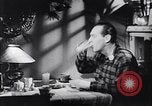
Importance of well balanced diet for American citizens at home and at work during World War II
Importance of well balanced diet during World War 2. American man seated at a table eats food. A housewife serves more food to him. Narrator talks about importance of nutrition, having three square meals each day, eggs and other protein foods, and vitamin B rich foods such as cereal of whole wheat, or enriched white bread. A worker on the job is shown taking a lunch break. Close up view of his open thermos with a hot drink and his sandwich and fruit and a chocolate bar. A couple dining together at a table for dinner are seen. Narrator suggest chicken, fish, liver, or sweetbreads as a main course, served with green leafy salad and also cooked vegetables like peas or carrots. A man carves meat. Men walk near a war materiel production factory gate, with a sign, "Let's step it up." Women at a factory production plant prepare large numbers of sandwiches for workers, with the help of automated machinery. Narrator says average workers need twice as many vegetables and fruits as they now consume. A group of men in an industrial kitchen work to prepare carrots, spinach, cauliflower, and other vegetables like squash, parsnips, and lima beans. African American cooks prepare food. Factory workers line up and take prepared food trays at a factory kitchen. Workers sit outside and enjoy food during a lunch break. Young men and women in a cafeteria line select foods to eat. War workers exit at the end of a work day. View of the U.S. Capitol dome. On screen public service message text says "U.S. Needs US strong. Eat nutritional food."
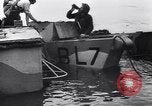
Aftermath of the Allied raid on Dieppe in 1942 during World War II
Film opens showing a German soldier giving a canteen of water to an English soldier on a landing craft at Dieppe, after the ill-fated Allied raid there in World War 2. Numerous Allied prisoners (mostly Canadians) make their way across the sands of Dieppe. Some toss their helmets away. They carry a wounded on a litter. They proceed along a road with seaside Church of Notre-dame-de-bon-secours in the background. Some prisoners are barefoot. One is carried on a litter. Next a contingent of Canadian prisoners is seen marching in formation, three abreast, with arms raised. Destroyed and damaged buildings are behind them. Several carry wounded comrades, as they proceed into the center of town. Views of damage to buildings in Dieppe, from bombing and shelling. Canadian prisoners of war being escorted by German guards through town. View from high point overlooking Dieppe, showing the town, with smoke rising in places, and the beach with Allied boats and equipment strewn on it. German officers interview prisoners, including some wearing swim fins. Closeup of one with injured bloody face. Allied prisoners huddled together in a large group. Piles of weapons and equipment collected from the prisoners. Ambulatory prisoners being marched through Dieppe on their way to a prisoner of war camp. The prisoners marching on roads through rural areas. Closeups of some as they pass a camera. View of Dieppe harbor and environs from a high overlook. French residents walking on the streets of Dieppe, as life returns to normal. German soldiers manning a 2 Cm Flak 38 anti aircraft gun overlooking the beach, as a formation of German infantry marches past in the background. View of beach from bunker housing a German coastal gun. A formation of German Ju 88 bombers overhead, and viewed from one of the aircraft in the formation in flight. German gunboats racing through the water.
CRITICALPAST.COM: About Us | Contact Us | FAQs - How to Order | License Agreement | My Account | My Lightboxes | Shopping Cart | Advanced Search | Featured Collections | Website Terms & Conditions | Privacy Policy ©2026 CriticalPast LLC.
License Agreement |
Terms & Conditions |
Privacy Policy
©2026 CriticalPast LLC.