


 Francais
 Deutsch
 Italiano
Refine Your Search
Greek-Civil-War stock footage and images
- Showing 1807 to 1812 of 27579 results more
more Hide
Hide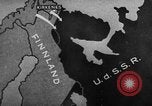
German forces assist Finland combating Soviet forces in World War II
Gernan involvement in Russo-Finnish war ("Winter War") overlapping with World War II. Opening scene shows map with arrows indicating movement of German forces from Norway, into Finland to help them defend against the Soviets. A sign wreathed in greenery, at the border, reads "Finnland" (in German) and "Suomi" (in Finnish). (Narrator says Finland is no more alone.) Next, a German soldier moves a barrier at the border and German troops on motorcycles, led by a staff car, begin crossing into Finland. They cross a bridge over water. A long line of German trucks, cars and motorcycles moves along a country road. One motorcycle, with sidecar, stops and the two German soldier occupants examine a sign marking the Arctic Circle. A steam locomotive pulling a train leaves a Finnish railroad station. Views from aboard the train as local Finns wave at German soldiers who look out the train windows. Change of scene shows German infantry wading through some snow, (Other places are dry.) They are moving forward and taking up firing positions. Closeup of a German soldier firing his rifle. German gun crew firing a a 7.92mm MG37(t) machine gun. Closeup of the gun firing. German soldiers firing a mortar and the shell exploding in the distance. Closeup of another German gun crew firing an MG37 machine gun. (They are probably from the 6th SS Mountain Division Nord.) Shells exploding as German infantry run forward through light brush. Another 3-man German machine gun crew viewed from behind as they fire their weapon at Soviet positions.
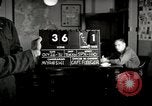
A colonel, officers and an American civilian at a conference table discuss about targets in Korea during the Korean War.
U.S. Psychological Warfare (Psy War) team in Korea during the Korean War. A conference table. Officers and an American civilian of the Psy War department seated around the table. They stand as a colonel enters and sits. They begin their discussion. One of the officers smokes. An officer makes a point using a wall illustration. A colonel aide points out targets on a map of Korea.
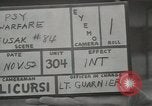
Eight United States Army soldier artists work on a new poster in Seoul, Korea during the Korean War.
Eight United States Army (EUSA) for the psychological warfare (Psy War) in Seoul, Korea during the Korean War. Psy Warfare building of EUSAK (Eight United States Army in Korea). A soldier enters the building. A bomb with an inscription 'G-3 Psy War'. Soldier artists work on a new poster. A clerk gives a paper to a girl at a Chinese typewriter and she types.
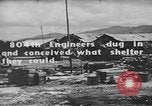
U.S. 804th Aviation Engineers rebuild Aslito Airfield to be used by the 318th Fighter Squadron, Saipan Island, in World War II
Pacific campaign of World War 2 fought on Island of Saipan, Mariana Islands in World War II. Aslito Air Field area showing temporary huts erected by the 804th Aviation Engineers. Men washing clothes in small metal containers. Jeep made into stretcher bearer showing two patients on stretchers on jeep. Medical officers setting up tables and preparing for operation. Men being brought into the hospital. Several of the patients, military and civilian, foreign and Japanese all treated at the same hospital. Wounded Japanese sitting around the outside of the hospital. Small wounded child wrapped in bandages. Several civilians that had been treated at the hospital. Japanese prisoners as they unload the gasoline from trucks, push it across the area, and stack it up in supply dump area. Men pushing the drums of gas onto a truck. Gasoline pouring out of the drum into a trough. Japanese prisoners of war sitting around in the area resting. Grader moving across the finished field. Deck of carrier underway at sea off the coast of Saipan showing the blinker system used to correspond between ships at sea. Tower and operators of the blinker system.
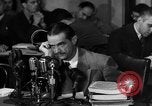
Howard Hughes testifies before a Senate Subcommittee investigating war contracts, in Washington, DC, United States
Howard Hughes testifies before the "Brewster" Senate Subcommittee, investigating war contracts. He talks about World War 2 contracts involving ordering of aircraft, light aircraft carriers, and the atomic bomb by President Roosevelt, through channels outside normal procurement bureaus. He states that he did not make 15 million dollars of profit on 40 million dollars in war contracts, despite assertions that gave the public that impression. In another comment he says, "If TWA (Trans World Airways) does anything wrong, I get blamed for it. But when TWA does anything right, then I had nothing to do with it. That's like Hollywood. When it's a good picture, Sam Goldwyn made it, but when its a bad picture, Willi Wyler (William Wyler) made it."
British Lancashires returning from front lines with German prisoners in Battle of Somme during World War I
From "The Battle of the Somme." A Battalion of British Lancashires return after a successful attack on Germans during Battle of the Somme in World War 1. Ambulatory wounded British and German (prisoners) walking back from the front, assisting one another. British troops escorting German prisoners of war. Two Germans carrying a wounded comrade on a stretcher. Lancashires posing with German prisoners. A long line of returning Lancashires interspersed with German prisoners of war. More German soldiers (prisoners) carrying wounded comrades on stretchers.
CRITICALPAST.COM: About Us | Contact Us | FAQs - How to Order | License Agreement | My Account | My Lightboxes | Shopping Cart | Advanced Search | Featured Collections | Website Terms & Conditions | Privacy Policy ©2026 CriticalPast LLC.
License Agreement |
Terms & Conditions |
Privacy Policy
©2026 CriticalPast LLC.