


 Francais
 Deutsch
 Italiano

Refine Your Search
Greek-Civil-War stock footage and images
- Showing 18283 to 18288 of 27588 results more
 Hide
Color Sound

Military vehicles and supplies from the United States arrive in United Kingdom warehouses and bases (WW2)
Trucks arrive at Toddington Manor (Toddington, Cheltenham GL54 5DN, United Kingdom) in Gloucestershire, England. British children playing jump rope as vehicles transport tanks on the road. Rows of aircraft are transported by vehicles into town. The preparations for the D-Day invasion of France by Allied Forces, during World War II. A crane moves boxes. Boxes move in conveyer belts. Sacks, boxes, and crates stored at a distribution point. A man drives a forklift transporting boxes inside a warehouse. Military supplies arriving in Britain from the United States. Piles of tires, barbed wires, concrete tubes stored in docks and warehouses. Cranes move oil barrels into a pile. Military locomotives and freight cars bound for continental Europe at a railway yard. Soldiers open a crate containing a United States Army truck. A crane lowers a tank. A man inspects a row of military trucks. Rows of M3 half-track armored personnel carriers and M4 Tractors in England. A man helps a tank back up. Rows of tanks, artillery, and guns from the United States. Men stocking shells inside an underground storage. Piles of shells outdoors. A truck transports shell. Rows of fighters at an airfield. A man moves a search light at night. Anti-aircraft guns fire at German night bombers attempting to attack bases in the United Kingdom. Barrage balloons fly above warships. A sailor drops an anti-ship mine in the sea. Minesweepers seek and destroy such mines from the sea. Consolidated PBY-5A attacks a German ship.
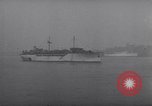
Refugees and former prisoners of Nazi concentration camps are among passengers arriving by ship in New York harbor
The Steamship, SS Marine Flasher, arriving in the port of New York after voyage from Bremen, Germany . She is assisted by several tugboats. Her passengers, include many refugees,including former prisoners of Nazi concentration camps. A number have benefited from President Truman's December 22, 1945 Directive giving preference to Displaced Persons in obtaining visas. Passengers crowd the deck and wave enthusiastically. Brief glimpse of a ferry boat passing behind the Marine Flasher. The ship has nautical flags and flags of various nations displayed aloft. (World War II period).
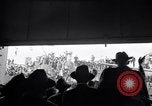
Steamship passengers, including many Displaced Persons and former prisoners of Nazi concentration camps, arrive in New York
The steamship, "SS Marine Flasher," arrives in the port of New York, after steaming from Bremen, Germany. In addition to U.S. citizens, her passengers include many refugees, and former prisoners of Nazi concentration camps, who benefited from President Truman's directive of December 22, 1945, giving preference to Displaced Persons in obtaining visas. Views among the crowds gathered at the dock to welcome loved ones. People waving and smiling. One woman angrily shouting at a guard. Men, women, and children aboard the ship, many wearing identification ribbons. Passengers enter the dock area. Their relatives and friends greet them warmly. A man kisses a woman and weeps. Two men embrace. (World War II period).

Displaced Persons, refugees, and former prisoners of Nazi concentration camps arrive by ship in New York City
Views of men, women, and children aboard the steamship "SS "Marine Flasher" docked at a pier in New York harbor after a voyage from Bremen, Germany. Her passengers include many refugees and former prisoners of Nazi concentration camps. Many benefited from U.S. Presidential Directive No. 29, issued on December 22, 1945, giving preference to Displaced Persons in obtaining visas. A woman with her child smiles. A boy waves at friends and relatives on shore. A young brother and sister in the ship. An older and younger woman, likely mother and daughter, show the prisoner number tattooed by Nazis on their arms. The tattoos are sequentially numbered, A-26587 and A-26588. Reuniting people hold each other with warmth and weep. A family of 7 children spanning a range of ages, with no parents evident. (Note: this is the Weber family ranging in age from 4-18. In order of age from oldest to youngest they are Alfons, Senta, Ruth, Gertrude, Renee, Judith, and Virginia (Ginger) nee Bela. The family settled in Chicago. All married and had 24 children and now numerous grandchildren. The children and grandchildren live in across the U.S. in Chicago, Maryland, Texas, Alabama, California, Virginia, Minnesota and in London, England. This Information provided in 2014, by Lynn Chapman daughter of Gertrude.) (World War II period).

A Japanese man carries flowers from a garden and places them near a miniature Japanese pagoda.
"Project Japanese evacuation" seen on slate held by uniformed U.S. Army soldier. View of multi-tiered pagoda (Buddhist shrine) surrounded by trees and landscaping at the Japanese Tea Garden in Golden Gate Park, in San Francisco, California. A man of Japanese descent gathers a large bouquet of flowers at the base of the pagoda. A moving van with sign "Lyon Van and Storage, Let your Lyon guard your Goods" written on side of van is seen parked in front of a pagoda at the tea garden. The moving truck is seen driving away. (During period of relocation of Japanese American civilians to internment camps during World War 2.)

Japanese-American men and women interviewed and registered at Japanese Registration Control Station building at San Francisco.
Japanese-American men and women walk out of Japanese Registration Control Station building at San Francisco, during World War 2 period when Japanese-American citizens were being relocated to internment camps in the U.S. Japanese people at the office interviewed by social workers, who fill details of them on paper records. Receptionist and other workers of the office busy at work.
CRITICALPAST.COM: About Us | Contact Us | FAQs - How to Order | License Agreement | My Account | My Lightboxes | Shopping Cart | Advanced Search | Featured Collections | Website Terms & Conditions | Privacy Policy ©2026 CriticalPast LLC.
License Agreement |
Terms & Conditions |
Privacy Policy
©2026 CriticalPast LLC.