


 Francais
 Deutsch
 Italiano

Refine Your Search
Greek-Civil-War stock footage and images
- Showing 1843 to 1848 of 27579 results more
 Hide

A U.S. Navy film promoting participation by Navy personnel and civilians at home, in the Fourth Liberty Loan of World War I
A U.S. sailor, sitting on the deck of a warship, fills out a post card made by the Navy Department, to be sent home encouraging friends and family to buy bonds in the 4th Liberty Loan Drive of World War 1. A civilian in a post office, in America, sends a return post card to the sailor, acknowledging his request. On the pre-printed card, he states that he bought $100 worth of the Liberty Loan. It is dated October 2, 1918. The front of the post card is addressed by hand and in place of postage, contains the words: "Sailors' Mail FREE." Another respondents post card is also shown, dated October 1st. This Navy Liberty Loan promotion is explained by slates, and ends with the question: "Have you bought yours?" followed by a display of the American flag. (World War I; World War 1; WWI; WW1)
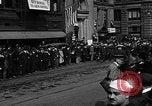
Liberty Loan Drive in New York City during World War I
Fourth Liberty Loan Drive activities in New York City during World War 1. Crowd lines sidewalks to watch as a New York City Policemen's brass band leads a parade along an avenue. A sign on building, above the spectators reads: "Buy Bonds to Arm Armies." A color guard of policemen follows the band, and behind them, a group of mounted policemen moving two-by-two, ahead of a formation of policemen. Scene changes to a street filled with people. Some hold flags and signs. A crowd hangs the Kaiser in effigy outside the Woolworth Building, at 233 Broadway ( between Park Place and Barclay Street in Lower Manhattan, opposite City Hall). Sign on the building reads: "Fight Buy Bonds." Above, a dozen business men watch the events from the window of the Irving National Bank. Gate of the first floor Rathskeller is seen at sidewalk level. Soon, another effigy of the Kaiser is seen swinging from a rope. Both dangle from the third floor of the Woolworth Building. Scene changes to a brass band playing in the street. Workmen are seen on the marquee of a building being renovated. A sailor stands in their midst giving a speech. The workmen applaud. The sailor gives an impassioned call for those below to buy Liberty Bonds. (World War I; World War 1; WWI; WW1)

Secretary of Navy, Josephus Daniels opens 4th Liberty Loan drive in Pittsburgh, Pennsylvania, During World War I.
Start of the Fourth Liberty Loan Drive in World War 1. United States Secretary of Navy, Josephus Daniels opens the Liberty Loan drive, in Pittsburgh, Pennsylvania. On this occasion he delivers a speech in front of a large gathering. He also reviews a parade of 10,000 mill workers. Mill workers loaded in trucks and other vehicles move past people in a street. A Naval band plays at the parade. Mill workers carrying flags and banners march. (World War I; World War 1; WWI; WW1)

Events and newspaper headlines leading to beginning of World War 1. Includes dramatization of Franz Ferdinand assassination.
Events that led to the beginning of World War I. Archduke of Austria, Franz Ferdinand and his wife descending steps in Sarajevo Austria. Dramatization of assassination of Franz Ferdinand. Newspaper headlines from The Sun: "Austrian Archduke Assassinated at Serajevo"; The Washington Post: "Austrian Ultimatum to Servia"; Pittsburgh Gazette Times "Kaiser Calls Up Army"; the Oakland Tribune: "War! Germans launch French Attack". Views of mobilization of German troops. German troops march as people cheer them on. A small boy dressed as a German soldier gives a salute. Troops march with a dachsund dog wearing a German Army helmet. A German woman buys a brooch with the face of Kaiser Wilhelm II, German Emperor, to put on her dress before a parade including Wilhelm II. German citizens waving at German military parade. Infantry and cavalry units march past a large crowd in streets on the way to war.
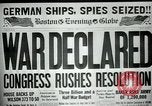
United States declares war on Germany and troops march ahead in European Theater
Events during World War I. A newspaper headline reads ' U.S. declares war' American soldiers embark onto a ship and wave as they leave for the war front. In the European Theater soldiers disembark from the ship and march forward with their weapons. Soldiers march ahead as people cheer them. A cavalry units marches ahead with wrecked houses in the background.
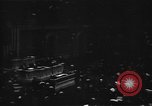
President Franklin D Roosevelt gives a message to the Congress about rearmament during World War II in Washington DC.
A session of the Congress in Washington DC, United States. President Franklin D Roosevelt in his message to the Congress emphasizes about the need for rearmament to avert the danger of an attack during the World War II. In his speech he talks about the need to protect the American hemisphere against an invasion. He also enumerates the possible threats to the independence of United States. He lays emphasis on the need to increase the production of war materiel and ammunition to get ready for the war in case of an attack.
CRITICALPAST.COM: About Us | Contact Us | FAQs - How to Order | License Agreement | My Account | My Lightboxes | Shopping Cart | Advanced Search | Featured Collections | Website Terms & Conditions | Privacy Policy ©2026 CriticalPast LLC.
License Agreement |
Terms & Conditions |
Privacy Policy
©2026 CriticalPast LLC.