


 Francais
 Deutsch
 Italiano

Refine Your Search
Greek-Civil-War stock footage and images
- Showing 18793 to 18798 of 27581 results more
 Hide
Color Sound

Damaged prison, church and factory due to atomic bomb explosion in Nagasaki, Japan.
Damage in Nagasaki, Japan after the World War 2 atomic bomb attack. A damaged prison building 10 miles away from the center. A damaged church. Damaged dome of the church and gas works. Two concrete wall remains of a factory building.
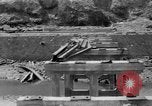
Damaged city and an undamaged road following atomic bomb explosion in Nagasaki, Japan.
World War II damage in Nagasaki, Japan after the atomic bomb attack. A damaged bridge in Nagasaki. The north street of Nagasaki undamaged due to its lower height from that of the explosion. People and truck on a road. Damaged houses. Survivors busy with restoration of their homes. View of an atomic bomb explosion (this is a domestic United States testing blast).
Dr. Ad Hoi Tailor works at a radar and an animation shows the operation and the use of the radar in the United States.
Operation and the uses of the radar. A radar with 'XAF installed 1938' written on it. Allied civilian scientist Dr. Ad Hoi Tailor, Chief of Electronic Science Development and his assistant Mr. Lio Se Young at work. A diagram shows the operation of the radar. A dot of voltage barrier at a florescent screen. An animation shows how a radar traces an enemy plane. Radar equipped planes detect enemy fleet. A light mover in the radar. (World War II period).

Radars used to gun down an enemy plane and used at ports in the United States.
The operation and uses of the radar in the United States. An enemy plane comes in the range of radar detection. The receiving antenna detects entry of a plane. A search light pinpoints at the plane. Guns fire. The plane on fire. It drops down. Radar used at ports. A plane in flight. It looses altitude. A ground control man guides with accurate information and helps the pilot to land safely. Gauges show altitude and other readings. (World War II period).
Y-12 atomic production facility; Trinity Shot atomic text explosion in the United States; Truman speaks about atomic secrets.
Atomic bomb production and its use in the United States. Doctor Ernest O. Lawrence experiments with the cyclotron at the University of California, Berkeley. View of the exterior and interior of the cyclotron. An animated diagram shows the results of the splitting of the uranium atom. Diagram shows a nucleus, electrons and protons. Atomic structures of Helium, Lithium and Uranium. A diagram of the creation of barium and krypton, and the release of atomic energy. Aerial and ground views of Y-12 atomic energy testing, uranium enrichment, and manufacturing plant at Oak Ridge, Tennessee created during Manhattan Project. Workers walking on the grounds of the the plant. The Trinity Shot first atomic explosion is shown near Los Alamos, New Mexico on July 16, 1945. Flash of explosion and a cloud of smoke rises as seen from U.S. Army cameras 6 miles away. Two other views of the explosion are seen from other camera positions while narrator explains the effects. U.S. President Harry S. Truman speaks of the need to keep the secrets of the atomic bomb among the U.S., the U.K, and Canada, alone, until they find successful techniques to control the bomb and protect the world from total destruction. He indicates that he will work the the U.S. Congress in the effort and make the power a force for world peace. Truman asks that God guide the U.S. in how to use the technology in His ways and for His purposes. (World War II period).
Carrier planes bomb transportation facilities and factories in Japan.
Carrier planes of U.S. Navy 3rd fleet strike Japan. Torpedo planes bomb Japanese fleet in a sea. Carrier planes strafe ships, airbases, railroads and factories in Japan. (World War II period).
CRITICALPAST.COM: About Us | Contact Us | FAQs - How to Order | License Agreement | My Account | My Lightboxes | Shopping Cart | Advanced Search | Featured Collections | Website Terms & Conditions | Privacy Policy ©2026 CriticalPast LLC.
License Agreement |
Terms & Conditions |
Privacy Policy
©2026 CriticalPast LLC.