


 Francais
 Deutsch
 Italiano

Refine Your Search
Greek-Civil-War stock footage and images
- Showing 18901 to 18906 of 27581 results more
 Hide
Color Sound
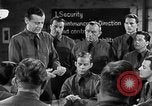
An officer briefs sergeants about the responsibility of a platoon leader, Sergeant during a platoon formation in a battle (WW2)
The advantages of the different Platoon formations during World War II. The Sergeant seated on a desk . A Rifle Squad officer uses a model to explain different responsibility of the platoon leaders, Sergeants and guides at the time of the approach march. He first talks about the job of the platoon leader. He is between the platoon squad and the leading squad. His task is to get the platoon safely forward, maintain contact with his neighbors. The job of the platoon Sergeant. He is in the center of the formation. He goes where he needs to do his job.. Supervises and control the platoon in absence of the platoon leader and acts immediately during any critical situation in the absence. The last is the job of platoon guide. He should fulfill the duty of platoon Sergeant in his absence. He moves in the rear of the platoon and keeps an eye to flank. He duty is to inform about the any unusual event. His job is the toughest one. A Sergeant asks questions to the officer about the platoon Sergeant and he answers.
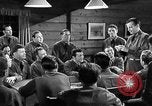
An officer highlights the basic and important points that can be used during different formations (WW2)
The advantages of the different Platoon formations during World War II. The Sergeant seated on a desk. A Rifle Squad officer stands in the center sums up with the highlights that were done in the lesson. He focuses on few big points during the formations they are provide good control, allow and use cover, get forward faster. Deploy skirmishes only when you are forced too. Always adopt a formation that will provide you with support squad. Maintain contact on the units to the right and left. To take up Echelon formation if the platoon leader has an open flank. The Sergeants listen to him.
U.S. troops show their ingenuity by designing new improvised gadgets (WW2)
A World War II documentary titled ' Yankee Noodle' depicts improvised devices and techniques used by U.S. troops to save time. Aircraft parked in a line at an aircraft industry. A man operates washing machine. Men at work on a granite launcher. A man operates a grappling wire used to trip mine. A man holds a cable binder used to put a line. Men on an elephant and put a wire. A man uses oxygen tank and a copper tube being coiled inside an oil drum for making a still for distill water. The water comes out from the tank and used for the battery. Men put the water in the battery. A U.S. aircraft lands. A man works on a gadget that takes only 20 minutes to change the tire of an aircraft. A tire loaded in a trolley and being pulled by a jeep. Three men load tire. Men hold a winch designed to tighten nuts and bolts. Mobile service and repair unit mounted on a truck. Instrument panel mounted behind the driver seat. Men at work on 110 volt generator. A work light, electric grill. A parachute used as an emergency brake for an airplane.
The military cadets undergo a training and graduate from the Tokyo School.
A documentary depicts the life of military personnel in Japan . A Japanese soldier on a horseback. The Tokyo School. Students enter the school. Students in a class appear for the military exam. A Japanese officer welcomes the students at the military school. The cadets stand in a squad and listen to him. A military candidate stands on the roof and gives a wake up call. Cadets get ready and move out. They perform different exercises. They practice Jiu-Jitsu. Japanese military cadets attend classes and study different subjects. They are being trained with various equipment. Cadets in a class as they prepare to give proper command. The cadets go into different schools like the cavalry,air force, engineer,artillery. They are being given training in the artillery. A pilot climbs in the cockpit and the aircraft in flight. All the cadets get graduated and a ceremony being conducted. Emperor Hirohito reviews graduates. (World War II period).

US Army training film on Basic Signal Communication, focusing on field wire lone construction
A training documentary depicts the laying of signal communications field wire by U.S Army personnel in World War 2. A man puts a wire line in the combat area. A wire line team puts the line on a terrain. A communication officer gives instruction to the wire line team. The officer on a map outlines the general routes to be followed in laying the lines. The team members move towards the command post area from which the lines will be laid. The wires being laid and the end wire is given to the wire chief who ties it into the switch board. A member of the team puts the wire on the tree so that it is not damaged. The extra wire being tied with support and the truck moves. Another truck comes . The men on the command post follow the line to check its installation. A man ties a wire with a support and he ties a mark on it. Tags tied on the special construction points. The man after tying the tags gets in the truck. Men put the line inside of the curve. The reel of wire is exhausted and the men attach the end and a new reel being placed. The new reel being placed in the line. The wires are connected to the test telephone. A man checks the wire. Animation depicts the location of the wire and coils from the terminal. A hand holds C-114 Coil and shows the working.

Mufti Haj Amin al-Husseini in exile; People light up tapers from the Holy Fire in the Church of the Holy Sepulchre in Palestine
Holy Fire ceremony in Jerusalem, Palestine. Soldiers stand with guns. The former Grand Mufti of Jerusalem, Haj Amin al-Husseini, seated at a desk and in discussion. The Holy Fire ceremony in the Church of the Holy Sepulchre. A congregation stampedes as people light up candles from the holy fire. (World War II period).
CRITICALPAST.COM: About Us | Contact Us | FAQs - How to Order | License Agreement | My Account | My Lightboxes | Shopping Cart | Advanced Search | Featured Collections | Website Terms & Conditions | Privacy Policy ©2026 CriticalPast LLC.
License Agreement |
Terms & Conditions |
Privacy Policy
©2026 CriticalPast LLC.