


 Francais
 Deutsch
 Italiano

Refine Your Search
Greek-Civil-War stock footage and images
- Showing 1927 to 1932 of 27580 results more
 Hide
Color Sound

British and Belgian monarchs and French officers gather in France to meet with President Poincaré during World War I.
Monarchs of various European nations like England, Belgium and others meet in France during World War I. French Army officers wait at a harbor. Queen Mary with King George V arrive in France as Prince of Wales welcomes them as they tour the World War 1 front for the first time. At British Headquarters they are seen greeting and meeting with Prince Albert and Queen Elisabeth of Belgium. King George V decorates war heroes including many Belgian soldiers in a ceremony on a beach as the Belgian Royal family watches, including King Albert, Queen Elisabeth, Prince Leopold III, and Prince Charles (Count of Flanders). View of young Princess Marie José of Belgium roughly around age 12 with the other monarchs walking on a sandy beach after the ceremony. King George V and Sir Douglas Haig enter through a gate to meet with French President Poincaré, Chief General Joseph Joffre, and General Ferdinand Foch. The leaders are seen together on the terrace of General Haig's headquarters at Beauquesne.

General Patton and Lieutenant General Doolittle of U.S. Army return after World War II in Los Angeles, California.
General George S Patton Junior and Lieutenant General Jimmy Doolittle of the United States Army return to United States after World War II. A huge crowd cheers for the Generals as their parade procession marches on roads in Los Angeles, California. A crowd of around 2,000,000 cheer the Generals who lead the war and defeated Nazi Germany. Generals from their cars raise their hats towards the crowd. General Doolittle addresses the press reporters. He insists the home team to assure supplies so that field team finishes the war effectively.

The Soviet Red Army arrives after defeating the Nazis and a new government is formed in Germany after World War II.
Images from late in World War II in Europe. Nighttime views of aerial bombardment of Germany late in World War II. Aerial view of many fires and explosions on ground in Germany at night as seen from Allied aircraft. Hermann Goering touring ruins in a German city. A lineup of new German Army recruits late in the war, including a very young boy soldier in full Army uniform, talking to an official who, from the back, appears to be Joseph Goebbels. Allies advancing into Berlin. Artillery and rockets being fired during Battle of Berlin. A German civilian woman walking among rubble and ruins in a German city. Victory celebrations in Paris during he liberation of Paris. Crowds in Paris cheering happily, view of Arc de Triomphe with band marching. View of Winston Churchill and Charles de Gaulle walking side-by-side down a Paris boulevard as crowds cheer them. Soviet (?) military personnel wearing large improvised warm shoes walk in a snowy climate, exhausted. View of explosion as Nazi Swastika atop grandstand at Zeppelin field (Zeppelinfeld) in Nuremberg, Germany, is blown up by the U.S. Army after the defeat of Germany.
Refugees fleeing Korean War; Stalin's death in 1953, Workers strugging in East Germany with more work and less pay
Communist-backed North Korea at war with South Korea. Views of U.S. Navy warships firing on North Korean targets, U.S. Army tanks moving through a city in Korea, and U.S. soldiers scrambling in a fire fight. A U.S. Army chaplain hugs a dying American soldier and pats his face. The chaplain closely prays over the dying soldier. A U.S. Army officer lifts a shocked Korean child into a truck. Young Korean children, possibly orphans, eating food at a table. Korean civilians including women and children fleeing the war. UN council in a meeting regarding the Korean War. Soldiers from multiple nations mobilizing for the effort in Korea. View of Kremlin in Soviet Union. Scene of Stalin dead, lying in state surrounded by flowers around his casket. Other Soviet political leaders look on. Citizens pass by site where Stalin is memorialized. East German leader Walter Ulbricht speaking at a podium. Laborers in East Germany struggling as they work longer hours for less pay. Workers construct buildings. East German construction workers sitting idle on the scaffolds of a building under construction as they begin their strike in June 1953, initiating the Uprising of 1953 in East Germany.
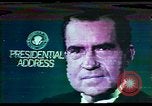
United States President Richard Nixon addresses the nation about the Vietnam War from White House, Washington DC.
News correspondent reads news about stand of U.S. President Richard Nixon on Vietnam War. President Nixon addresses the nation about the Vietnam War from White House. He details how United States got involved in the war. Nixon says that time has come to end the battle in Vietnam. (This became known as Nixon's "Silent Majority" speech.)

U.S. President Richard Nixon's silent majority speech from White House about Vietnam War.
A news special report about U.S. President Richard Nixon's speech from the White House about Vietnam War. A news correspondent reads news about the current status of war in Vietnam. President Nixon speaks from an office in the White House. President Nixon during his famous 'Silent Majority' speech. Richard Nixon details the history of Vietnam War and the ways North Vietnamese communists adopted to impose their government in South Vietnam. He says that immediate withdrawal of the United States forces would be a disaster for South Vietnam and the U.S. as well. He talks about steps taken to resume peace in the region and the progress of Paris Peace Talks.
CRITICALPAST.COM: About Us | Contact Us | FAQs - How to Order | License Agreement | My Account | My Lightboxes | Shopping Cart | Advanced Search | Featured Collections | Website Terms & Conditions | Privacy Policy ©2026 CriticalPast LLC.
License Agreement |
Terms & Conditions |
Privacy Policy
©2026 CriticalPast LLC.