


 Francais
 Deutsch
 Italiano

Refine Your Search
Greek-Civil-War stock footage and images
- Showing 19699 to 19704 of 27579 results more
 Hide
U.S. Army 9th Air Force planes strafe German positions and The 104th Division enters Eschweiler and smaller villages in Germany.
Activities of American First Army during offensive into Germany in World War 2. U.S. Army Air Force 9th Air Force planes strafe German positions near the town of Stolberg, then U.S. Army troops attack with machine guns (view from machine gun being fired at houses), heavy guns like the self-propelled 155 mm Gun Motor Carriage M12; and massed American 3rd Armored Division tanks acting as artillery in attacking Stolberg. Civilian refugees seen removing their belongings out of the battered city. An American soldier guards a German POW who assists a civilian in moving a loaded cart down a street. View of collapsed building and wreckage after the attack as Stolberg is cleared by forces of the U.S. Army 104th Division, facing booby traps and mines. U.S. forces blast structures that could not be safely cleared. After two weeks of attack, the American flag raised in the city. The 104th Division enters Eschweiler and smaller villages; mined buildings are detonated as tanks move through the towns. Mop up operations last two days as German snipers are cleared. Captured German prisoners are led through the town under U.S. Army guard. U.S. Infantry troops ride on tanks on streets of city. Soldiers carrying bedding walk on street on way to a dry night's sleep. Roadblocks are cleared by U.S. Engineer battalions, including an overhead bridge blown-up by retreating Germans. Units of the 104th Infantry and 3rd Armored division continue eastward and are seen fighting German forces in Weisweiler.
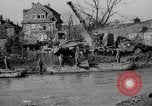
3rd Division fires rocket barrages and First United States Army Infantry advances through German towns east of Inde River
Activities of First United States Army pressing eastward in Germany during World War 2. U.S. engineers and soldiers build a bridge over the Inde River since all nearby crossings had been destroyed by retreating German forces. Army vehicles cross the completed bridge. Soldiers bring heavy artillery and adjust it. View changes to Mausbach area to the South, where rockets are launched by 3rd Armored Division toward the river. Line of 75 U.S. Army rockets seen being loaded by U.S. soldiers and then fired together. Bright flashes and smoke as rockets are fired. Tanks of the 3rd Division moving out from the town. A U.S. vehicle in the advancing column toward Gressenich is hit by German guns. U.S. Army tanks, lined up like artillery, fire on German forces at Gressenich. Continuous line of 3rd Armored Division tanks, armored vehicles, and 6x6 vehicles come to the front and advance on roads of cities and villages moving eastward, and supporting the U.S. First Army Infantry. 1st Army infantry move through Hurtgen forest near Aachen. Ruined German factory is used as an observtion base by U.S. forces to coordinate attack on Gressenich, which was captured on November 19, 1944. 3rd Armored Division tanks move into open fields to continue offensive toward Werth, with U.S. infantry soldiers staying close to tanks for cover. Soldiers carry the wounded U.S. tank commander after German counter fire hits lead U.S. tank in the column. The wounded soldier is dragged to safety. Men of U.S. Army 1st Division Infantry enter town of Werth under German mortar fire and move from house to house clearing enemy snipers and mopping up in the ruins. U.S. Army soldiers guard a column of German prisoners (POW) who surrendered in Werth. View of ruined and destroyed buildings in German towns like Hamich after defeat. U.S. Army soldiers move through the town on foot with a small church in the background. U.S. Army trucks arrive in a rubbled village with food and ammunition for the offensive drive toward the Ruhr.
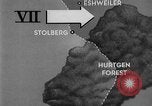
U.S. 4th and 8th infantry divisions enter Hurtgen Forest and 5th and 8th Inf. divs enter into Kleinhau to attack in Germany.
Activities of American first Army in Germany, advancing eastward in late 1944 during World War 2. Animated map shows: 4th and 8th infantry division move out from Stolberg and enter into Hurtgen Forest . U.S. 4th Infantry attack with field guns and artillery. Field gun amidst pile of shells fires toward Hurtgen Forest. 4th Infantry Division troops crawl up a hill in the Hurtgen Forest, sometimes pinned down under enemy German fire. Armor comes to their aid and casualties are treated by medical corps personnel. U.S. Army tanks arrive to support the infantry and they continue forward, where footage shows U.S. mortars and artillery bombing Grosshau, and point of view shot of a U.S. Army machine gun firing at a target in the town of Grosshau. Animated map shows: 5th and 8th Inf. Divisions enter into Kleinhau. Kleinhau is bombarded by a heavy volley of U.S. Army rockets and artillery from units of the 5th and 8th Infantry Divisions. Allied fighter bombers in flight over the area. Artillery is loaded and fired at close-range on target of Kleinhau which was then captured. U.S. Army Soldiers around the ruined buildings of Hurtgen, eating and drinking during a break. Infantry division move towards another towns. U.S. Army soldiers take a moment to relax during the long drive eastward. U.S. soldiers fire mortars from positions along the west bank of the Ruhr.

American 1st Army fights retreating Germans and enters into German towns and villages on eastward drive toward Duren
Activities of American First Army advancing eastward in Germany in December of 1944 during World War 2. Units of the 9th Divisions are moved up by truck and meet retiring units of the 1st Division at a road intersection. They enter town of Lucherberg after an artillery barrage, then attack through Inden and close in on Pier Germany. View of ruined buildings and wreckage in Pier, Germany. Sign of 'Duren'. U.S. Army 3rd Armored Division enters into German town on trucks and army tanks. 3rd Armored Division fires artillery at town of Schlich Germany, and are joined in the attack by soldiers of newly arrived 9th Infantry Division. Artillery barrage underway, with targets in Schlich visible in distance. Armored vehicles and soldiers move through mud advancing on Schlich with new piece of equipment known as a rotary mine exploder. German troops are rounded up as prisoners by U.S. Infantry. Gunners fire. On December 11, German prisoners assemble for inspection. Some of the German prisoners appear to be young boys. Smoke screen thrown up by Allies to cover movement of armored column heading into German towns across open field. U.S. Army soldiers enter into wrecked town of Geich, Germany, where buildings are destroyed and still burning. Armor and supply vehicles move through mud. Infantry of 83rd Division arrive as reinforcements and march in snow covered area toward a suburb of Duren. U.S. mortar fire pins Germans retreating toward Ruhr. Infantry attack to clear town outside Duren, and Infantry mop up, clearing German snipers. German troops and female collaborators are rounded up as prisoners. American First Army infantry forces marching on a road, continuing eastward.

Activities of U.S. Army air and ground forces in Aachen, Germany.
American air and ground forces cooperate in taking Aachen, Germany during World War 2. View of Allied planes. U.S. Army officers and soldiers study map Close-up view of U.S. Army soldier talking on radio. Wounded soldiers loaded on jeeps. American soldiers seated and talking in a meeting.

Robot bomb damage in England; launching sites and wide gauge tracks for transporting bombs in Cherbourg, France (WWII)
U.S. Army 9th Air Force North American P-51 Mustang fighters in flight and tracking a V-1 Flying bomb to shoot it down over Southern England, United Kingdom, during World War II. Crowds inspect damage caused by V1 flying bombs and V2 rockets, also known as “robot bombs.” A crater formed by a German robot bomb. A U.S. Army soldier collects fragments while inspecting the bottom of the bomb crater. British and American soldiers and British civilians inspect the damage. Aerial and ground views of an unfinished German V-1 and V-2 launch site on the Cherbourg Peninsula in Normandy, France after its capture by Allied forces. The main rocket ramp is seen on the launch site. A crane at the unfinished launch site. A concrete strip under construction. An unfinished section at the Cherbourg rocket launch site. The rich concrete mixture used in the construction of the massive installation is reinforced by lattice-type steel rods (half inch thick woven in squares). Unfinished and destroyed platforms from 29 rocket launch installations made by German forces at Cherbourg before the Normandy landings. Large solid underground structures intended as showrooms for shells and equipment. Unfinished or damaged narrow-gauge railroad used for supplies and construction. Carts are seen on the railroad. Netting laced with metal leaves to prevent fading is used for camouflage. A soldier arranges green coverings outside a bunker. A man stands on a crater. Wide gauge tracks to bring bombs to the platform. Some parts of the installation are bombed by Allied bombers.
CRITICALPAST.COM: About Us | Contact Us | FAQs - How to Order | License Agreement | My Account | My Lightboxes | Shopping Cart | Advanced Search | Featured Collections | Website Terms & Conditions | Privacy Policy ©2026 CriticalPast LLC.
License Agreement |
Terms & Conditions |
Privacy Policy
©2026 CriticalPast LLC.