


 Francais
 Deutsch
 Italiano

Refine Your Search
Greek-Civil-War stock footage and images
- Showing 1969 to 1974 of 27580 results more
 Hide
Color Sound

Tanks and guns manufactured and anti tank guns tested at the Rock Island Arsenal in Illinois during World War II.
War production workers in factory manufacturing tanks and guns at the Rock Island Arsenal in Illinois during World War II. Assembly and research plant at the Rock Island Arsenal shows war materiel production workers working on tanks and guns. Anti tank guns are tested.
United States 9th Army troops and equipment cross the Rhine River in Europe during World War II.
A 1976 training film in the United States details the role of Combat Military Police of the United States Army in supporting river crossing during war. A member of U.S. Military Police looks through binoculars on a hillside while the division advances on a training battlefield. Rest of clip shows actual footage from World War 2: U.S. 9th Army troops cross the Rhine River in Europe in 1945 during World War II. Equipment and U.S. Army soldiers cross the river. Landing crafts and barges across the Rhine River. The troops disembark from landing crafts at the river bank. A pontoon bridge is built by men. An MP directs traffic of vehicles and other equipment along the bridge.

Austrian troops battle enemy in the European Theater during World War I.
Austrian troops in the European Theater during World War I. Austrian cavalry parade on a field. Horse-drawn wagons move along the field. Charles I of Austria, on horseback, speaks to members of royal family in a carriage. Funeral service for Japanese Navy Admiral Heihachiro Togo, Tokyo, Japan. German troops marching to war in 1914. Newspapers announce outbreak of World War I. British troops standing by trenches, fix their bayonets on rifles and advance to take cover in a bomb crater. Gas shells explode near them as they advance across No Man's Land. Litter bearers pick up casualties from the battlefield.
Wartime assembly line production in munitions factories and troops in the United States prepare for war against Japan.
After America declares war on Japan during World War 2, a propaganda piece urging U.S. citizens to be involved in the war effort, praying, working, and fighting for Freedom. Interior of an ammunition factory in the United States. Massive rail gun or naval gun barrel during assembly process. An assembly line with tanks. U.S. Army M2 tanks on proving ground being tested. Destroyer ships and Victory ships being launched. An aircraft factory showing fuselages of bomber aircraft lined up. Engines lined up ready for an assembly line. West Point Army cadets march. U.S. Army General Douglas MacArthur salutes troops. Narrator statement at end is "So wake up America. We must win or die." A large American flag shown waving.
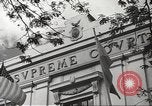
Courts and legislature in the Philippines shortly before World War 2, also President Quezon and Moro people
Scenes in the Philippines before World War II, from a 1944 film. Exterior of the Supreme Court of the Philippines. Judges and officials of the court seated in the court and trials being conducted. Exterior of House of Congress. Interior view with legislature in session. Filipino President Manuel Luis Quezon seen speaking to legislators and seated at a desk in discussion by telephone and with officials. View of his Vice Presiden, Sergio Osmeña, seated in an office. Filpino children pray in front of an altar with the figure of Jesus at a church. Women cross themselves in church. View of beaches on islands. Moro men on Mindanao. Moro man using a bolo (steel blade with handle akin to machete) to cut open a coconut and to cut down crops in field. Moro men gathered near docks at a beach area. Earlier views of U.S. Army General John J. Pershing between time of Spanish American War and World War I. Street views in city and town areas of Zamboanga, Mindanao, with businesses, rickshaws, commercial traffic. A monkey with a very short stub of a tail that is local to Mindanao (stump-tailed macaque). Moro women and men dancers perform a traditional dance and play music. A moro woman spinning a large clay vessel to husk rice. Moro woman walking with goods piled and balanced on her head. Moro men moving a small house using large poles. Moro man getting a haircut. Moro woman washing clothes. Moro fishing vessels with small sails heading out to sea.
A man interviews two prisoners of war which were liberated from a Japanese prison camp in the Philippines.
Liberated American prisoners of war in the Philippines during World War II. Patients lying on hospital beds. A nurse gives medicines to the patients. A man interviews two of the prisoners of war from the Cabanatuan camp. One of the soldiers talks about the Bataan Death March. He states that they marched for three days and three nights. Food and water was not given to them. They were transported to prison camps in boxcars and some of the prisoners died and some were killed. Sergeant Donald Smith also talks about the conditions in the prison camps and treatment received from the Japanese.
CRITICALPAST.COM: About Us | Contact Us | FAQs - How to Order | License Agreement | My Account | My Lightboxes | Shopping Cart | Advanced Search | Featured Collections | Website Terms & Conditions | Privacy Policy ©2026 CriticalPast LLC.
License Agreement |
Terms & Conditions |
Privacy Policy
©2026 CriticalPast LLC.