


 Francais
 Deutsch
 Italiano

Refine Your Search
Greek-Civil-War stock footage and images
- Showing 1987 to 1992 of 27580 results more
 Hide
Color Sound
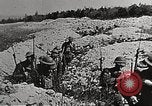
U.S. troops of the AEF engaged in trench warfare on the Western Front during World War I in France.
U.S. troops of the American Expeditionary Forces (AEF) wearing gas maskes as they occupy trenches on the Western Front, in France, during World War 1. One soldier using a large hand-held "Ayrton" fan to clear lingering gas from a trench. A shell bursting in air above a fort, as a French FT 17 tank moves across the area. American infantry in gas masks, firing rifles from a trench, as gas drifts over them. A camouflaged French rail gun firing from a railroad siding. Two other views of French rail guns firing. Smoke rising from a nearby shell burst. More views of AEF troops firing rifles from trenches during gas attack. Soldiers moving across no-man's land as shells burst. A mammoth explosion from a demolition charge or siege mortar shell. (World War I; World War 1; WWI; WW1)

American troops march along streets of New York City after World War I in a victory parade
U.S. Military troops in automobiles and marching on foot in a procession in New York City after World War I. A jubilant crowd and officials cheer for the marching troops celebrating victory in World War 1. Military troops march along streets. Few women present flower bouquets to the marching troops. U.S. Army troops with rifles march in uniform. People and officials in large numbers gather in the streets to welcome and honor soldiers. The troops march under the Arch at Washington SquareThe United States flag flutters. View of soldiers and girls dancing together in the streets of New York City celebrating armistice, the end of World War I, and victory. Friends and relatives greet and hug the soldiers. A curtain reads "It Happened To You" The End.
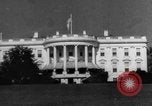
President Roosevelt and Cordell Hull in Washington DC; U.S. war production; German U-boat attack
Japanese newsreel during World War 2 shows United States President Franklin D Roosevelt signs the Lend Lease Act in Washington DC. A view of the White House. The United States flag flutters on the top of the building. United States Secretary of State Cordell Hull speaks. United States factories gear up for war production. War production workers busy with machines in a factory. A partially completed U.S. fighter aircraft on a factory floor. Men work on hand operated machines. President Roosevelt signs the Lend Lease Act. Supplies are loaded aboard ships. United States military tanks, trucks and ammunition carried by cranes onto the ships. A Red Cross van loaded aboard a ship. Scene changes to Atlantic Ocean and a convoy of ships at sea. A German submarine crew gets ready to submerge. German U-boat submerge. A convoy of ships underway at sea. Heavy seas and large waves as seen from deck of ship during rough seas. The ships are hit by German torpedoes. A ship sinks after being hit. Survivors of the Allied ship on a raft. Clip contains Japanese slates and Japanese narration.
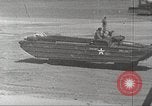
Omaha Beach, after the Allies secured the beachhead, during the invasion of Normandy, France, in World War Ii
Scenes on and around Omaha Beach after it had been secured, following the Allied D-Day amphibious invasion of Normandy in World War 2. Several U.S. soldiers move along the beach in a DUKW amphibious vehicle. A bulldozer seen in the background. About 25 German prisoners of war are seen awaiting evacuation, behind barbed wire on the beach,guarded by a U.S.military policeman. As a shell whines overhead they all instinctively drop to the ground and the shell explodes somewhere out of sight. An 83 ft. U.S. Coast Guard rescue cutter looks for Allied survivors in the water. The British Hospital ship "Prague" and others are seen at anchor, ready to receive patients. Wounded soldiers being carried on stretchers to a landing craft on the beach. A wounded man being transferred from a damaged LCI to another one. Wounded being hoisted in groups of 4 each, from the crippled and sinking LCI(L)85. The are lowered to deck of the USS Samuel Chase (APA-26). Navy Rear Admiral, John L. Hall, Jr., observing the transfer of wounded. Sweeping views of Omaha Beach after the beachhead was secured. Numerous support vessels are seen close offshore. Trucks move along roads; war materiel is stockpiled in open areas; barrage balloons fly aloft; and soldiers move everywhere. Closeup of the LCI(L) 92 ,on the beach,showing the holes blown in her. The LCI(L)553, beached sideways in the sand. Seen beached and damaged, is LCI(L)87, flagship of Coast Guard Captain Miles E. Imlay, deputy commander of the Coast Guard's Omaha Assault Group O-1. Mechanics working to repair the screw from a boat.

Post-war economy of Britain; start of Marshall Plan to rebuild Europe; New York City auto show scenes
"Get your new ration books and identity cards here" seen written on a sign. British civilians line up to obtain new post-war ration books, after the end of World War 2. Women shopping for rationed food. British ships idle in ports as exports wane. View of New York harbor with tugs and barges and Manhattan skyline and skyscrapers in background. Woman holding poster advertising First International Auto Show (held from February 5-10, 1949, at the Sixty-ninth Regiment Armory, Twenty-fifth Street and Lexington Avenue, in New York City), including European cars to be shown in New York City. British cars in their first car show. One of the cars shown is the 1948 Ghost Minx with two women seated inside it. A 1948 Jaguar convertible is also shown. Communist parades in Europe and Asia. Start of Marshall Plan to help Europe rebuild after the war. Newspaper shows President Truman signing Foreign Aid Bill (led to Marshall Plan).
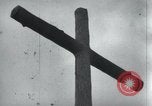
The initial World War II Memorial at Baugnez, Malmedy, Belgium 1945, honoring U.S. POWs executed there by German forces.
The first memorial erected to commemorate U.S.prisoners of war executed by the Nazis during the battle of the bulge (mostly elements of the American 285th Field Artillery Observation Battalion (FAOB), executed by the Kampfgruppe Peiper (part of the 1st SS Panzer Division). This was also known as the Massacre at Baugnez, or the Malmedy Massacre. A wooden cross and a sign reading 'USA - Belgium. To the prisoners of war of overseas who liberated the East districts and were the victims of Nazis cruelty." The wooden cross at the monument to commemorate the massacre of 115 American prisoners at Baugnez on December 17th 1944 during the Battle of Bulge, in World War 2.
CRITICALPAST.COM: About Us | Contact Us | FAQs - How to Order | License Agreement | My Account | My Lightboxes | Shopping Cart | Advanced Search | Featured Collections | Website Terms & Conditions | Privacy Policy ©2026 CriticalPast LLC.
License Agreement |
Terms & Conditions |
Privacy Policy
©2026 CriticalPast LLC.