


 Francais
 Deutsch
 Italiano
Refine Your Search
Greek-Civil-War stock footage and images
- Showing 2137 to 2142 of 27482 results more
more Hide
Hide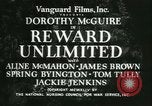
The need for cadet nurses and young girls to volunteer for military nursing service during World War II.
A film titled 'Reward Unlimited' starring Dorothy McGuire dramatizes the need for cadet nurses during World War II. Dramatization depicts why a girl called Peggy decides to become a nurse, and how she is trained. Peggy discusses marriage and future plans with her Lieutenant boyfriend. She decides to get a war job. She meets a woman who was a nurse and who gives her information about the U.S. Cadet Nurse Corps, Congress scholarships for nursing schools and duration of the courses. Peggy discusses her decision to join a nursing school with her parent. After she convinces her parents that nurses are needed, she enters training. She undergoes theoretical and practical training with many other girls in a hospital. Nursing students in classroom setting with teacher or professor at blackboard providing class instruction. Nurses receiving practical clinical instruction. Nurses using microscopes and taking notes, nurses attending patients in a hospital ward. Nurse cadet taking care of an infant baby. Nurse in surgery theater handing instruments to a doctor during operation on a patient. The graduation ceremony from the Army Nursing School. Peggy checks on a little boy called Jimmy. A government message urging young girls to volunteer for military nursing service with information about the U.S. Cadet Nurse Corps.
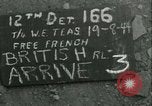
French and British troops on foot, motorcycles and tanks advance through the streets of Sées during World War II.
The French 2nd Armored Division and British troops advance through Sées, France during World War II. Tanks pass wrecked soldiers on the streets of Sées. War damage around. Soldiers on tanks. A painted sign on the wall reads 'Falaise'. Soldiers and tanks pass by the sign. Other military vehicles follow the tanks. Soldiers on tanks and motorcycles. Tanks move past a restricted district sign board amidst rubble on the ground.
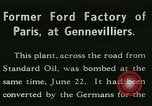
The Ford factory at Gennevilliers used by the Germans bombed during World War II.
Results of air assaults by the British Royal and U.S. Eighth Air Forces over industrial areas in and around German-occupied Paris during Wolrd War II. The former Ford factory at Gennevilliers used by the Germans for military vehicles production and maintenance, bombed on June 22, 1944. The aerial attack destroyed an estimated 50% of the factory. Allied officers inspect the bombed factory. Damaged structures, tanks, machinery and war equipment inside the factory.
Dramatization depicts production, black marketing of gas coupons and citizens' responsibilities in supporting World War 2 gas rationing.
'No Alternative' dramatizes citizens' responsibilities in supporting gas rationing in the United States. Dramatization: Group of men seated playing card game. Tom interrupts a poker game to lecture on rationing, after Bob offers an illegal gas coupon to Frank. He talks about the production of automotive gasoline, increasing price and limited production of crude oil. Uses of crude oil: U.S. airmen and soldiers use crude oil to fuel aircraft and tanks. A U.S. aircraft drops bombs made with the use of crude oil. Workers produce synthetic rubber from crude oil at a plant. U.S. Navy ships, merchant fleets, railroads and war industries use crude oil. Tom explains how "black market" coupons cause shortages that affect war industries and military activities. Dramatization depicts safe breakers breaking into a ration board and stealing gas coupons worth 11 million gallons. Gasoline used by farmers in tractors, to take produce to the markets, finished ammunition, guns and tanks to the railroad stations so that they can be sent to the front. Tom points out ways to make rationing work and save gasoline including: formation of car pools, scorning illegal coupons, identifying coupons with the user's license number.
Speaking from the NY State Capitol, Governor Thomas Dewey hails the Liberation of Paris by the Allied forces in World War II.
New York Governor Thomas E. Dewey hails the Liberation of Paris by the Allied forces. The New York State Capitol building (State St. and, Washington Ave, Albany, NY 12224, United States) in Albany, New York. Governor Dewey addresses the nation regarding the Liberation of Paris in World War II. He states that the incident is an inspiration to others still under the Nazi German occupation. He talks about the contribution of Allied forces to the cause, America's war efforts and the goal to defeat Germany and Japan.

The German troops pass through Aisne and Versailles before entering Paris during World War II Battle of France.
The Germans capture Paris in June 1940 during World War 2. German troops advance towards Paris in France. Soldiers on horses, on foot, and in cars advance through french towns including Sacy le Grand. An advance German party follows the fleeing French towards Chateau Thierry. Soldiers amidst wrecked cars and vehicles. They battle amidst ruins and damaged buildings in a town. The Germans engaged in street fighting. Soldiers cross the Marne River in rafts and fire machine guns. A sign board for Paris and Soissons in Aisne. Soldiers on foot, in carts, and the horse cavalry. The Germans enter the suburbs of Paris. They set petrol and oil plants on fire. Black smoke due to the fires and explosions. Military vehicles enter and leave the Palace of Versailles. The German Swastika flag is raised on the Palace roof. Paris falls to the Germans. The Eiffel Tower and other monuments. German officers and soldiers in Paris. German soldiers climb up the Eiffel Tower and hoist the Nazi state war flag atop the monument. Troops and military vehicles parade before the Arc De Triomphe at Champs Elysees.
CRITICALPAST.COM: About Us | Contact Us | FAQs - How to Order | License Agreement | My Account | My Lightboxes | Shopping Cart | Advanced Search | Featured Collections | Website Terms & Conditions | Privacy Policy ©2026 CriticalPast LLC.
License Agreement |
Terms & Conditions |
Privacy Policy
©2026 CriticalPast LLC.