


 Francais
 Deutsch
 Italiano
Refine Your Search
Greek-Civil-War stock footage and images
- Showing 2197 to 2202 of 27482 results more
more Hide
Hide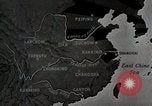
Chungking (Chongqing), new capital of China, is bombed by Japanese forces during Second Sino-Japanese war
The Republic of China establishes its wartime capital at Chungking (Chongqing), China during the Second Sino-Japanese War. Animated map depicts areas of Japanese occupation and highlights cities including Lanchow (Lanzhou), Chengtu (Chengdu), and Kunming. It highlights Chungking (Chongqing) as the new capital of Nationalist China. Generalissimo Chiang Kai-shek is seen leading a group of Chinese leaders as they walk through an arched gate in Chungking (Chongqing). A busy street with shops and apartment houses, in the commercial district. It is filled with pedestrians, cart traffic along the curbs, and automobiles in the road center. Boatmen on the Yangtze River are seen below long steep steps leading up to the streets above. Views of houses clustered along the cliffs, and workmen digging bomb shelters into the cliffs. View from inside a shelter being hollowed out of the rock. Back in the Japanese occupied area, a car brings a Japanese Air Force leader who addresses a large group of fliers at an airbase. Next, Japanese air crews are seen running to their airplanes from their camp on the airfield and taking off in their Mitsubishi G3M bombers, to attack Chungking (Chongqing). Nakajima Ki-27 airplanes take off from the field and join in large formations overhead. A formation of Chinese World War 1 era is seen inflight, ostensibly to engage incoming Japanese bombers. Japanese crew member in a bomber sees the Chinese fighters and gunners in the bombers get ready to fire on them. The Chinese fighter planes dive at the bombers but are intercepted by Nakajima Ki-27 airplanes flying cover. Aerial dogfights ensue with Chinese planes being shot down, and the bombers continuing their way. Air raid sirens sound in Chungking and people run to their shelters, including many school children. Views of bomber crews at their stations and then of bombs falling with the Yangtze River below. Bombs exploding along the riverfront and inland, along the cliffs. View of machinery operating, and Chinese workers occupied in underground factories in Chungking (Chongqing). Fires burning throughout the city, from the bombing, and Chinese fire fighters working to extinguish them.
Recruitment of Civilians for Chinese Peoples Army during 2nd Sino-Japanese war. First All-volunteer Group (Flying Tigers) formed by Claire Chennault
Events in 2nd Sino-Japanese War covering late 1930's through 1943 in World War 2 Scene opens with two Chinese army buglers sounding a call. Next, a line of recruits is seen marching on a field. Chinese officers sit at a table with civilian officials. A Huge crowd of army volunteers are seated, each holding a small white flag. Two more buglers sounding a call. Crowd of recruits move through a gate. Northern Chinese soldiers in fur hats march. Recruits are shown from the East and West of China. Recruits in formation. Bugler sounding a call. Chinese cavalrymen joining the army. More scenes of Chinese people joining together to fight the Japanese. Recruits engaged in close order drill and physical training. Uniformed soldiers in helmets, performing Calisthenics with rifles. Platoons of Chinese soldiers practicing marching and tactical maneuvers. Chinese youth training as first aid workers, carrying stretchers and learning first aid techniques. Chinese women in uniform marching with rifles. A Chinese girl kneels down behind a Maxim machine gun, as an officer instructs and other girls sit around in a group. Glimpse of girls training with rifles on an outdoor firing range. Claire Lee Chennault and his American "Flying Tigers" pilots and P-40 airplanes at an airfield. The American flag flying from a flagpole behind them. Pilots scrambling to their aircraft. Chenneult, now a U.S.A.A.F Major General, commander of 14th Air Force in China, in seen congratulating Chinese army aviators. He is accompanied by a Chinese Air Force General. Behind them is parked a B-24 Liberator bomber of the 308th Bombardment Group. A Chinese Nationalist P-40 with tiger teeth logo on air intake, starts its engine and taxis out for takeoff. View from cockpit of a P-40 pursuing and shooting down a Japanese Nakajima Ki-27 aircraft. Chinese soldiers in precision drills at a garrison.
China builds Burma Road to carry war materiel and supplies and creates flood of Yellow River to thwart Westward expansion of Japanese occupied territory
Japanese officials meeting in strategy session. Japanese infantry on mission to cut Chinese supply lines during 2nd Sino-Japanese war. Black smoke rises as they move along a river bank. Chinese prisoner-workers are forced to rebuild railroads destroyed by the Chinese people during their great Westward trek. Japanese soldier closely guards workers. A Japanese army armored train underway on the rebuilt railroad, as Japanese soldiers cheer. Animated map shows China's supply lines by sea, to Tsingtao, Hangchow, and Amoy, cut off by Japanese naval blockade. Japanese Navy launch with officers and crew moving near commercial ships as they take over Chinese river ports. War materiel and other supplies destined for China, including trucks, sit idle, unable to be transported to their destinations. Large oil tanks and drums of gasoline are shown, as well as gun barrels and a flightline filled with parked Curtiss P-36 Hawk aircraft. The Imperial Japanese Navy destroyer Asakaze (DD-3) and another, next to it, in a Chinese river port. A Japanese freighter with anchored weighed, secured by long lines to a wharf. Small boats flying Japanese Naval ensigns are next to it. View of map showing china, Burma, Indo-China, and Chungking, with Japanese blockading fleet stationed in the South China Sea. It traces path of narrow gauge rail line from Indo-china to Kumming,China, where it connected to an overland road to Chungking. Next it traced the old Camel Caravan route, across China, from Russia. Narrator notes these were to small to be useful and too close to Japanese-occupied territory. Next, the map traces a railroad that from the port of Rangoon to Lashio, Burma. It is separated from the road to Chungking, by mountains and gorges. Views of the actual mountainous terrain. Animal pack trains moving through the area. Construction engineers in a large drafting room designing a road to transit the area. View of modern road-building caterpillar tractor equipment of the type needed to accomplish this. View of Chinese laborers using manpower instead. They push large rollers and employ pickaxes and other hand-held tools to carve away and dig road beds. Masses of Chinese laborers at work, carving a road along the edge of a mountain. Two-men teams using manual tampers to pound down the roadbed. Children are employed along with adults. A woman with a baby on her back, pounding large rocks into gravel, surrounded by other children doing the same. View from above of the "Burma Road," the product of their labors, winding its way through the mountains and gorges. Many scenes of trucks moving along portions of the Burma Road. P-40 airplanes flying past white cumulus clouds, overhead. Animated map shows continued expansion of Japanese occupied areas to encompass two thirds of the rail lines in China with goal of controlling the remainder, starting at Chengchow, in Summer, 1938. View of Chengchow region, on banks of the Yellow River. Map illustrates flow pattern of the Yellow River. View from past of the Yellow River's Spring floods toward the Sea, with Chinese people throwing rocks onto dikes that keep the river flowing in a more Northerly direction than its former course. Illustration shows how with Japanese encrouching on Chengchow, the Chinese decided to destroy those dikes and allow the river to flood over its former more Southerly course. Japanese soldiers being inundated by the flooding river. Japanese infantry and tanks regrouping on their occupied side of the new (old) path of the Yellow River. Local Chinese residents of Chengchow, wade with belongings as they leave their flooded homes.
Chinese employ guerrilla warfare against Japanese occupying forces in the Second Sino-Japanese War (WW2)
Opening scene shows closeups of many smiling Chinese Guerrilla fighters during the Second Sin-Japanese War (World War II). Animated map shows Japanese occupied areas as clinging to lines of communication (roads, railroads, and waterways), Japanese troops, carrying Rising Sun flag, march into a Chinese town. A Japanese armored boat, flying the naval ensign, cruises along a narrow stretch of river, with a large Chinese fortress in the background. Its officers watch carefully through binoculars. A Japanese armored train is seen patrolling a stretch of railroad. A long line of Chinese guerrilla fighters marching along a dusty road carrying a variety of weapons. Some, both men and women, are seen. One carries a homemade flag. The camera pans across them, all carrying shouldered arms. Chinese farmers threshing grain by shoveling it into the air, as they might have done before becoming guerrilla fighters. One guerrilla carrying two grenades around his neck. Many marching with shouldered arms and conical straw hats on their backs. Views of their feet clad in sandals. More scenes of Chinese guerrilla fighters marching. Animated map shows guerrilla attacks against Japanese-held lines of communication. A Chinese guerrilla fighter running through a field, banging a tin to sound a call to arms. Others picking up weapons and responding. Next, a group of them are seen diving into a river and moving along low to the water. Others are seen running across a ridge of rock. Still others come over a hill ostensibly attacking a Japanese patrol. Two large explosions and black smoke are seen behind running guerrilla fighters. Another scene also shows Chinese guerrillas running from an explosion. Heavy smoke and Wreckage of building and equipment at a railroad site. Japanese troops struggling to transit marshes and mud, with horses pulling artillery pieces, and many men pulling a rope to retrieve a sunken field piece from a stream. One Japanese officer wipes his face with a handkerchief, as he confers with others about the situation.
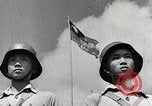
Battle of Changsha in China during the Second Sino-Japanese War (WW2)
Closeup of two Nationalist Chinese soldiers with their flag flying on tall flagpole in background. Next, countless numbers of Chinese soldiers are seen marching along the Great Wall during the Second Sino-Japanese War (World War II). Newspaper article reads: "52,000 Japanese fall at Changsha." Animated map depicts China and environs, with major cities. Areas of Japanese occupation are shown in black. The city of Changsha is highlighted by a circle. Japanese force is shown massing at Yueyang (Yochow), near Dongting Lake (Ting Tung Hu Lake), and advancing on 24 December 1941, toward Changsha. The map shows Chinses forces putting up token resistance and retreating to the East (rather than toward Changsha) and Japanese forces beginning assault on Changsha, New Year’s Day, 1942. Map shows the Chinese forces from the East attacking and cutting the Japanese supply lines. Japanese forces besieging Changsha are forced to retreat under counterattack by the Chinese. A field artillery piece being fired by Chinese forces and explosion and smoke from its shell striking. More field artillery being fired. Japanese forces carrying their Rising Sun flag as they retreat under fire. Chinese infantry firing from a berm A Japanese soldier falls to gunfire. Japanese soldiers retreating across a narrow-improvised bridge across a swamp. Chinese soldier next to a building, firing a Czech ZB vz. 26 light machine gun. Japanese running with horses through a village. Chinese gunner firing Japanese Type 92 machine gun down on Japanese troops retreating across a bridge below. Another Chinese soldier firing a Czech 26 light machine gun, from hill overlooking retreating Japanese troops, below. Victorious Nationalist Chinese troops parading in celebration along a road high above buildings of a town below in background. Men in Khaki pants and white shirts parading. Girls in white dresses, carrying Chinese flags. Soldiers marching (without weapons) celebrating.
U.S. Army Air Forces employ air power in the India-Burma theater during World War II. Chinese troops are equipped and trained by U.S. soldiers.
Camera pans across scenes showing masses of Chinese. Narrator cites their large population as a war asset. Lt Gen. Daniel Sultan Commander of US Forces, India–Burma Theater (USFIBT) describes the Allied mission as simply "placing guns in the hands of men in order that they can kill our common enemy." He describes Japan's 1942 strategy of completely isolating China from outside help. Animated map shows Japanese forces attacking China from bases in Thailand and advancing north, driving British forces into India, and leaving Burma in Japanese hands.Glimpse of Japanese troops occupying Burma. Views of American troops evacuated to India. View of Chinese soldiers boarding U.S. Air Transport Command C-46 transport planes for flights from Kunming to Dinjan and Chabua, India. Closeup of some troops inside the cabin of a plane. Chinese soldiers await transport as a C-47 aircraft takes off in the background. Aerial view of two C-47 planes in formation. View from the air of high cloud covered mountains. Storm clouds over the mountains. Downward view from an aircraft flying over the Himalayan Mountains (called flying the "hump" by U.S. pilots). View of Chinese soldiers inside a transport plane. View out the window of a transport plane landing in India. A C-46 airplane taking off. A large formation of Chinese troops seen after more were brought from China to India, later in the war. American soldiers training troops of the Chinese 38th and 22nd Divisions. General Sultan speaks of the need to build up the U.S.Air Transport Command. Two C-47 airplanes on the ground. One named "The Joker." View of sky filled with B-24 Liberator bombers. Sky filled with C-47 transport planes. Chinese soldiers training in Kunming, climbing out of trench in live fire exercise with machine guns firing over their heads and explosive charges detonating near them. Air frame of a P-47 aircraft being loaded and several of Bell P-39 Airacobra aircraft being loaded aboard ship bound to strengthen the U.S. Army 10th and 14th Air Forces in Burma, in 1944. Covered P-47 aircraft without engines being towed by jeeps along a street in Burma. A large airfield with many U.S. fighter planes parked on its ramps. Engines being installed on P-39 aircraft. A flight line filled with P-40 aircraft displaying Chinese roundels. Some fly over a flight line of U.S. Army Air Forces P-39 aircraft. Glimpse of a fighter plane escorting a transport aircraft. A formation of B-24 Liberator bombers dropping bombs and exploding on Japanese ground targets. Workers are seen unloading large amounts of cargo from a B-24 bomber. Workers rolling a large bomb from the plane onto the tailgate of a truck.
CRITICALPAST.COM: About Us | Contact Us | FAQs - How to Order | License Agreement | My Account | My Lightboxes | Shopping Cart | Advanced Search | Featured Collections | Website Terms & Conditions | Privacy Policy ©2026 CriticalPast LLC.
License Agreement |
Terms & Conditions |
Privacy Policy
©2026 CriticalPast LLC.