


 Francais
 Deutsch
 Italiano
Refine Your Search
Greek-Civil-War stock footage and images
- Showing 23431 to 23436 of 27483 results more
more Hide
Hide
Jerry Jones, played by George Murphy, receives his draft letter during his performance at the Follies in New York, 1917
A 1943 American feature film titled 'This is the Army' depicts dancer Jerry Jones, played by George Murphy, as he receives a draft letter during a Follies performance during World War I. Dramatize scenes: Uncle Sam is depicted on a poster in New York that reads: 'I Want You for the U.S. Army Enlist Now'. Buildings along a side of a street. Camera zooms to newspaper headline that reads, "Huns Boast No American Troops Will Reach France." A woman in uniform sings in the street.. She sings and men play musical instruments. Exterior of a building. A banner outside the building reads: 'US Army Recruiting Station'. 'Follies' written outside a theater. Interior of the theater. Performance of singer and dancer Jerry Jones in the theater, played by actor George Murphy. Jerry Jones sings and girls dance in colorful costumes. People watch them. A woman watches the performance of Jerry Jones. A man arrives near her and gives her mail for Jerry Jones from the office of the President. The woman reads the mail. The mail is a draft letter to Jones, inducting him into the U.S. Army.
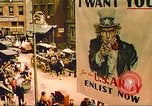
Men leave for Camp Upton in New York after their enlistment in the U.S. Army.
An American feature film depicts the life of professional dancer Jerry Jones enlisted in the U.S. Army during World War I. A poster on a wall reads: 'I Want You for the U.S. Army Enlist Now'. People walking and vehicles driving past in a vegetable market. Jerry Jones leaves for a training camp. He bids good bye to his mother. Buildings along the sides of a street. Two woman talk amongst themselves. A man plays a bugle in his house. His wife talks to him about his enlistment in the U.S. Army and cries. He leaves for the camp. Men enlisted for the U.S. Army at Camp Upton in New York. Men sleep on their beds at the camp. They wake up after a call at 5:30 am. A sergeant arrives and asks them to wake up. He scolds them. They get off their beds. The sergeant talks to two of the soldiers and scolds them. The soldiers holding rifles stand in formation on the ground.

Soldiers practice for a musical show at a camp in New York.
An American feature film depicts the life of professional dancer Jerry Jones and how he puts on musical shows for the U.S. Army during World War I. Soldiers march in a camp in New York during their training. A sergeant instructs them. The sergeant talks to dancer Jerry Jones. He says that he wants to dance and perform for the army. The sergeant talks to an officer about Jones wishes. The officer tells him to arrange a musical show for the army. Newspaper headlines about the musical show. Men practice for the show in a mess. Some of the men prepare food and sing. Others play musical instruments. Jones practices for his performance. He dances and other men sing and play instruments. The sergeant watches the practice. They prepare boards and banners for the show and practice. They discuss amongst themselves about the show. A bugler plays his bugle. Interior of a theater. The soldiers perform on a stage. People watch the show.
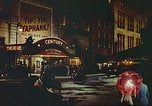
Soldiers perform on a stage in New York and leave for the front after the performance.
An American feature film depicts the life of professional dancer Jerry Jones and conduction of musical shows for the U.S. Army by him during World War I. Exterior of a theater in New York. 'Century Theater' written outside the theater. 'Yip Yip Yaphank' written on a board outside the theater. Men in a jeep arrive at the theater. People arrive to watch the live musical theater production. Officers discuss amongst themselves and salute each other. People watch the show. Soldiers perform on a stage. Family members of the soldiers watch the show. People applaud. The soldiers march from the stage. They bid good bye to their family members and leave for the front. People applaud.

People listen to the song 'God Bless America' sung by singer Kate Smith in the United States.
An American feature film 'This is The Army' depicts a performance by singer Kate Smith at the 21st anniversary of the armistice of World War I. Animated map shows Europe with fire in Poland. A man in the radio studio announces the name of Kate Smith on the stage, and noting the 21 anniversary of Armistice Day. A studio audience is present and applauds. Kate Smith introduces "God Bless America" as a new song, and then sings the song "God Bless America" with in-studio orchestra accompaniment. People watch the performance. An old man listens to the song, standing in front of his shop 'The Bugle Call.' He dusts a console radio with a feather duster and then goes inside and removes a bugle from a case labeled, ' Yip! Yip! Yaphank! 1918 ' At the Twardofsky business across the street, a man puts a small American flag into a basket as his father listens to the song on a small radio on the counter. People listen to the song in their houses and buildings. In a family living room: A couple seated in their living room listen to their console radio. A man, likely their son, seated at his desk listens to the song while studying. A woman looks at the photograph of a soldier, named Blake. Blake is then depicted listening to the same Kate Smith performance over a radio while stationed at Hickam Field in Hawaii. Characters Jerry Jones and Johnny Jones, played by actors George Murphy and Ronald Reagan are seen at the Jones and Jones production office. They listen to the radio. The character played by Ronald Reagan reads Variety Magazine.
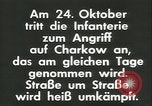
Destroyed buildings and debris on the streets after the Germans capture Kharkov in the Ukrainian Soviet Socialist Republic.
German ground and air offensive in Kharkov in the Ukrainian Soviet Socialist Republic during World War II. German field artillery and troops attack Kharkov. Soldiers advance on the battlefront. Destroyed buildings along the sides and debris on the streets. Smoke rises from the buildings. The soldiers advance on a street. Two German soldiers raise the German flag on a building. The Germans capture the city.
CRITICALPAST.COM: About Us | Contact Us | FAQs - How to Order | License Agreement | My Account | My Lightboxes | Shopping Cart | Advanced Search | Featured Collections | Website Terms & Conditions | Privacy Policy ©2026 CriticalPast LLC.
License Agreement |
Terms & Conditions |
Privacy Policy
©2026 CriticalPast LLC.