


 Francais
 Deutsch
 Italiano
Refine Your Search
Greek-Civil-War stock footage and images
- Showing 23713 to 23718 of 27483 results more
more Hide
Hide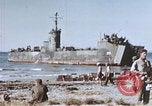
Allied invasion troops unload supplies from Landing Ship Medium to the beach in Philippines.
Philippine Islanders greet Allied invasion troops in Philippines. Allied troops unload supplies on a beachhead. An LSM (Landing Ship Medium) in the background. Jeeps and armored vehicles on the beach. Boxes piled in line. The soldiers stand in water and pass the supplies. Tracers fired at night. (World War II period).

Religious pilgrims in Palestine walk on the streets and visit Church of the Holy Sepulchre in Jerusalem.
Tourist crowd the holy city of Jerusalem after it is opened to visitors following the Six Day War of June 1967. Religious pilgrims walk on streets of the city. Thanksgiving ceremony held by Israeli people. Dome of the Rock with the Temple Mount and city in the background. View of Mount of Olives and the Damascus Gate. People enter the 'Church of the Holy Sepulchre'. Men walk in religious clothing. Board reads 'Via Dolorosa'.
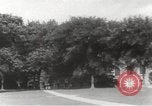
Reenactment shows early 20th century U.S. research in gas turbines that contributed to development of turbojet airplane engine
Views of Cornell University where mechanical engineer, Stanford Moss, conducted research into gas turbines as part of his doctoral thesis work in 1903. Dr. Moss later joined the staff of General Electric Company. During World War I Dr. Moss is called to Washington DC to discuss, with the National Advisory Committee on Aeronautics (NACA), development of a turbo supercharger for airplane engines. View of a biplane with turbo supercharger mounted on top of radial engine. Animated diagram illustrating workings of a turbo supercharger. Using a supercharged engine, the U.S. Army Air Services established an altitude record of 36 thousand feet. (The pilot, flying without supplemental oxygen, passes out and doesn't regain consciousness until the airplane has fallen about 30 thousand feet.)
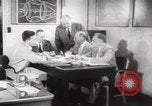
General Electric producing the first American jet airplane engine. Bell Aircraft building first U.S. jet powered airplane.
General Electric Company engineers work on designs for America's first jet aircraft engine during World War 2. In the company's plant, at Lynn, Massachusetts, machinists make parts for the engine and others assemble it. Company executives conversing about the enterprise. On April 18, 1942, the first engine produced is rolled into a test cell for operational testing. Engineers pull down the door to the test cell displaying the words: "Fort Knox." Engineers at control panel of the test cell. View into the test cell. GE Project manager, Donald F. Warner, actuates toggle switch to "on" position, and the engine ignites. Flame seen in rear of the engine. Complete change of location. View of Bell Aircraft company buildings. Bell engineers working on design of an airplane designated, XP-59A (Airacomet) to be powered by the new General Electric jet engine (later designated J-31 by the military). Views of the Bell engineering and production activities at secret facilities in Buffalo, New York. Two Bell workers expressing reservations about airplanes without propellers. A main intersection street scene in Schenectady, New York. Pedestrians walking and shopping. An F.W. Woolworth store on the corner. Copy of the Schenectady Gazette Newspaper, with headline about 500 planes raiding Berlin. A man buying a copy of the paper.
First flight of Bell YP-59A aircraft. GE develops J-33 jet engine. First flight of Lockheed P-80 jet fighter.
Official films of the flight of Bell YP-59A Airacomet jet-powered airplane, October 1, 1942. Workers at the General Electric plant in Lynn, Massachusetts, producing versions of increasingly more powerful jet engines: the I-16 with 1600 pounds of thrust and the J-33, with 4000 pounds of thrust. First flight, January 8, 1944, of a Lockheed P-80 shooting star fighter jet powered by the J-33 engine. Formation of P-80 fighter planes in flight. (World War 2 period.)
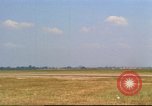
RF-4C Phantom II,EC-135A Stratospheric and other U.S. aircraft taxi and take off from Da Nang Air Base in Vietnam.
Number of United States aircraft take off from Da Nang Air Base in Vietnam during the Vietnam War. United States aircraft RF-4C Phantom II, EC-135A Stratospheric ,RF-101C Voodoo, Douglas AC-47 Spooky, T-39 Sabreliner and C-123B Provider taxi and take off from the runway.
CRITICALPAST.COM: About Us | Contact Us | FAQs - How to Order | License Agreement | My Account | My Lightboxes | Shopping Cart | Advanced Search | Featured Collections | Website Terms & Conditions | Privacy Policy ©2026 CriticalPast LLC.
License Agreement |
Terms & Conditions |
Privacy Policy
©2026 CriticalPast LLC.