


 Francais
 Deutsch
 Italiano
Refine Your Search
Greek-Civil-War stock footage and images
- Showing 24151 to 24156 of 27483 results more
more Hide
Hide
A U.S. Navy LCU (Landing Craft Utility) and an LCT (Landing Craft, Tank) on a shore during the invasion of Normandy, France.
The Normandy Landings on D-Day in France during World War II. A part of a wrecked LCVP (Landing Craft, Vehicle, Personnel) on the Normandy beachhead. A U.S. Navy LCU (Landing Craft Utility) on the shore. 'US 87' written on the LCU. Several soldiers on the shore. Men going up a gangway to the LCU. A U.S. Navy LCT (Landing Craft, Tank) moving in towards the shore. Several soldiers on the craft. 'US 541' written on the side of the craft. German prisoners standing crowded on the LCT. The LCT moving towards a U.S. Navy attack transport.

Experiments are undertaken by scientists and doctors during the development of nutritious food for soldiers in the U.S.
Scientists determine nutritious food for U.S. Army soldiers during World War 2. Conscripts receive medical examination by an army doctor before going into the U.S. Army. The new recruits holding documents waiting in a queue for their turn to be weighed on a scale. An officer seated at a table. Two military draftees talking. Members of a U.S. Army Combat Service Support Branch, the Quartermaster Corps, cutting meat for preparation. A table set for soldiers with tea cups arranged and fruits in the center. The soldiers seated at tables and having food. Quartermaster Corps serving the soldiers. Scientists in a laboratory studying food that will impart energy, strength, and improved performance to the soldiers. A soldier seated at a table and a member of the Quartermaster Corps measuring out rice into a bowl that a soldier would have to have to provide the same nutrition as in his military rations. Dr. Ansel Keys, a scientist at the University of Minnesota, seated at a table and vitamins kept on the table for the soldiers. Narrator mentions that the German military supposedly has a super man vitamin pill. Doctor dispenses vitamins from a box. Doctor measures the strength of a soldier who has been taking vitamins. Doctor gives a soldier more vitamin pills. Two seated soldiers open tins of vitamin pills. Soldiers sleeping in a room maintained at a certain high temperature during an experiment to determine what foods are best for various climates. Soldiers carrying rifles walking on a treadmill. The amount of perspiration is measured.
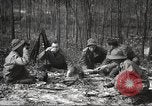
K ration developed under U.S. Army Colonel Roland for U.S. Army soldiers in the United States.
Nutritious food for U.S. Army soldiers in the United States. A group of U.S. soldiers seated among a few trees and having food. The soldiers having pre-cooked meat, which is an emergency ration developed in a laboratory. Nutritionists and army officers tasting food in a laboratory. Different cans with labels 'breakfast', 'dinner' and 'supper'. Three K ration packets developed for the army. 'U. S. Army Field Ration K, Supper Unit' written on one of the packets. A few soldiers seated on an army tank having food. One of the men puts contents of a packet in a mug. Commandos having K ration. Soldiers smoking cigarettes. Colonel Roland, who developed the K ration, speaking. He says that the K ration has been developed to provide soldiers with food under emergency situations and is suitable for all climatic conditions. The items used in K ration are tested. Several recipes are tested for soybean biscuits. Colonel Roland seated with other officers at a table and tasting different soybean biscuits. (World War II period).
Soybean biscuits are made and K ration packets are put together in a factory in the United States for U.S. Army soldiers.
Nutritious packaged food is formulated and packaged for U.S. Army soldiers during World War 2, in the United States. Workers at soybean processing plants. View of Dr. Percy Lavon Julian, a chemist and soy expert, working in a laboratory (Dr. Julian was one of the first African Americans to receive a doctorate in chemistry). Two workers carry soy flour in sacks and put the flour into processors. Wheat flour and eggs are added. Dough is kneaded in the processor. Soybean biscuits coming out of the processor in strips. Women workers at a chewing gum factory, modified for making K ration packets, stand on the assembly line and pack the K-rations. An army officer beside the workers. The workers, at an assembly line, put a tin of meat, soy biscuits, a concentrated chocolate or a fruit bar, lemon powder, cigarettes and chewing gum in individual containers. The containers are made water and air tight, and a scientist tests some of the kits for quality of packaging. U.S. Army soldiers move in a column on an airfield and get into an aircraft. Views of U.S. Army soldiers in different settings, preparing and eating food: A group of soldiers under a tarp in the jungle preparing food. Two soldiers seated inside a snow igloo eating food. A group of soldiers seated on a tank in the desert, eating food. Group of soldiers having food seated at tables in a dining hall or mess area.
A bottle of champagne is broken at the bow of aircraft carrier USS Wasp at its launching ceremony in the United States.
Aircraft carrier USS Wasp being launched in the United States during World War II. USS Wasp decorated before being launched. Sons of the naval officers who lost their lives in the Battle of Guadalcanal at the launching ceremony. A bottle of champagne being broken at the bow of the carrier as the ship is launched. The ship takes to water.
A Soviet Lieutenant tries to make contact with Soviet forces at 83rd Division Command Post in Germany.
Soviet 83rd Division Command Post in Germany during World War II. A liberated Soviet Lieutenant brought up from the 83rd Division Command Post attempts to contact Russian forces by radio. Two German civilians stand next to him. The civilians leave the command post on bicycles carrying white flags. Soviet Lieutenant and Commander General of the 83rd Division stand near a jeep as they try to make a radio contact with Soviet troops. Two German civilians return to the command post. They park their cycles and enter a building.
CRITICALPAST.COM: About Us | Contact Us | FAQs - How to Order | License Agreement | My Account | My Lightboxes | Shopping Cart | Advanced Search | Featured Collections | Website Terms & Conditions | Privacy Policy ©2026 CriticalPast LLC.
License Agreement |
Terms & Conditions |
Privacy Policy
©2026 CriticalPast LLC.