


 Francais
 Deutsch
 Italiano

Refine Your Search
Greek-Civil-War stock footage and images
- Showing 2473 to 2478 of 27581 results more
 Hide
Color Sound
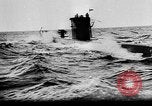
Period before U.S. formal entry into World War II. German submarines torpedo American ships and Japanese attack Pearl Harbor
Preface to U.S. in World War 2. German U-boat on surface. Crew climbing down into submarine and at duty stations while submerged. Torpedo trails bubbles underwater. Ship hit and explodes. Newspaper headlines report torpedoing of American ships: SS Robin Moor, SS Lehigh, SS Sessa, SS Steelfarer, and SS Montana, by German U-boats. Secretary of War, Henry L. Stimson calls on U.S. Navy to secure sea lanes. Wendell Wilkie agrees. U.S. Congress repeals Neutrality Act, November 17, 1941. Deck guns being placed on U.S. Merchantmen. Japanese warships docked and troops entering Indochina, as local people watch.Japanese troops by Dong Dang, near Chinese border. Situation described by animated illustrations.Japanese Special Envoy, Saburo Kurusu, is dispatched to Washington. Pan American Boeing 314 flying boat taking off. Japanese Naval Task Force of warships underway. Kurusu arriving in San Francisco, on November 14, 1941. He steps from the aircraft and makes statement to reporters. Japanese Ambassador, Kichisaburo Nomura, and Special Envoy Kurusu escorted into the White House by Secretary of State Cordell Hull, on November 17, 1941. Japanese troops in China bombarding Chinese city with artillery. November 26, 1941, View of Executive Office Building with statue of Victory atop U.S. Army First Division Monument. Secretary Hull announcing proposal to Japan.The Japanese representatives leaving the White House. Japanese aircraft carriers steaming toward Pearl Harbor. Japanese flight crews getting briefed on December 7,1941. Nakajima B5N (Kate) torpedo bombers taking off and in formation. Secretary Hull at his desk. The aloha tower and aerial view of Honolulu. Sailors at outdoor Sunday service, and relaxing at Pearl Harbor. Vehicle entering Hickam Field. Japanese airplanes bombing Pearl Harbor. Explosions on U.S. warships. USS Arizona (BB-39) suffers direct hit and explosion, as filmed from the deck of U.S. Navy Hospital Ship, USS Solace (AH-5). Shots of pilots and point of view from pilots inside Japanese bomber and attack aircraft, through a mix of dramatized segments from Japanese propaganda films about the Pearl Harbor attack, and real footage from the Pearl Harbor attack. View from Japanese planes bombing and strafing Ford Island. U.S. sailors firing antiaircraft and machine guns down Japanese planes. Secretary Hull describes memorandum from Japanese.
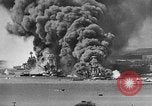
Japan attacks the United States of America at Pearl Harbor, Hawaii. President Roosevelt declares war against Empire of Japan (WW2)
Smoke billowing from U.S. warships bombed by Japanese warplanes in Pearl Harbor, Hawaii, on December 7, 1941. Japanese planes attack Pearl Harbor during World War II. Scenes at other U.S. military installations with aircraft burning in hangars and injured being carried on stretchers. Voice of President Franklin D. Roosevelt declaring war against Empire of Japan.
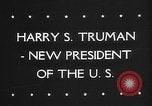
Harry S Truman assumes office of President of the United States following death of Franklin D. Roosevelt during World War 2
Harry S Truman appointed President of the United States. The U.S. Capitol building in view. Trees in the foreground. President talks on the phone. Harry Truman attends the 1944 Democratic convention with his daughter, Margaret Truman. People gather holding boards and placards of Truman in hand. A board reads: 'Truman for Vice President'. Franklin Roosevelt seated in a car during his fourth inauguration parade, on January 20, 1945, with motorcade proceeding on Constitution Avenue in Washington DC, and then driving up to the White House. Past events show President Franklin Roosevelt talking to Vice president Truman. Flag at half staff on the U.S. Capitol following death of President Roosevelt. Truman addressing a joint session of the Congress. General Marshall, Admiral King, Secretary of War Stimson all arriving at the White House to meet with President Truman. Also seen are James Byrnes and Truman receiving Lord Halifax, Anthony Eden, Secretary of State Stettinius in the White House. Truman speaks to joint session of congress on April 16, 1945 and expresses desire to continue the efforts and direction set by Franklin Roosevelt, saying, "With great humility I call upon all Americans to help me keep our nation united in defense of those ideals which have been so eloquently proclaimed by Franklin Roosevelt...." He also states, "So that there can be no possible misunderstanding, both Germany and Japan can be certain, beyond any shadow of a doubt, that America will continue to fight for Freedom until no vestige of resistance remains. Our demand has been, and it remains, unconditional surrender. We will face the problems of peace with the same courage that we have faced and mastered the problems of war. In the memory of those who have made the supreme sacrifice; in the memory of our fallen president, we shall not fail."
U.S. Douglas A-20 Havoc (aka Boston) aircraft take off from airfield in North Africa during World War II
North African Campaign in World War 2. U.S. Army Air Forces fliers of the 47th Bomb Group, , assemble for mission briefing outside a large tent at Allied airfield in North Africa, in World War 2. They look at aerial photos of targets. Red Cross women hand out refreshments to fliers. Crew members climbing, via top canopy, into an A-20 solid nose model Havoc bomber (called Boston, in British service). The aircraft is named "Boomerang." Numerous bombs are painted on its side for missions completed. An A-20 (with glass bombardier nose) is starting engines, as fireguard stands nearby. It has 38 bombs painted on its fuselage. A-20s taxiing for takeoff. One, of the 97th Bomb Squadron, with number 80 painted on its tail, takes off. A parked A-20, number 72, of the 86th Bomb Squadron. An instantaneous glimpse of several British Spitfire aircraft parked on the field. The bombers are seen flying in formation overhead. Closeup of one inflight. Aerial view of target area below. Waist gunner firing downward from a B-26 aircraft.

The Italian Campaign in World War Two. Axis POWs. Line of Sherman tanks.
The Italian Campaign in World War II. On the Road to Rome. Allied soldiers guard Axis prisoners of war inside a makeshift stockade. Allied soldiers search the prisoners. The prisoners climb onto a military truck. A line of Sherman tanks advances along the road.
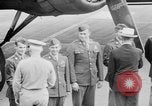
The pilot and the crew members of U.S. AA Force bomber B-17F Memphis Belle introduced in Washington DC during World War II
United States Army Air Force Bomber B-17F, Memphis Belle, lands at Washington National Airport, Washington DC, during World War 2. Secretary of War Robert P. Patterson shakes hands with the crew. Mascot Scotty dog 'Stuka' is held by a crew member. The crew member speaks about his memories when the craft took off. He discusses difficulties the crew members encountered during the mission. Captain Robert K. Morgan, pilot of Memphis Belle, speaks and introduces the members of the crew. The captain calls Sergeant John Quinlan as the Tail Gunner. Logo and name on the craft reads Memphis Belle and name of pilot. Lieutenant General Barney Mc Giles in the background.
CRITICALPAST.COM: About Us | Contact Us | FAQs - How to Order | License Agreement | My Account | My Lightboxes | Shopping Cart | Advanced Search | Featured Collections | Website Terms & Conditions | Privacy Policy ©2026 CriticalPast LLC.
License Agreement |
Terms & Conditions |
Privacy Policy
©2026 CriticalPast LLC.