


 Francais
 Deutsch
 Italiano
Refine Your Search
Greek-Civil-War stock footage and images
- Showing 24865 to 24870 of 27482 results more
more Hide
Hide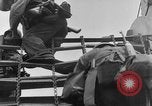
A Lieutenant holds weapons inspection aboard LST-219 and U.S. troops on LVTs head for shore at Ulithi Atoll in Caroline Island.
U.S. 81st Division, 323 Infantry Regiment troops at Ulithi Atoll in Caroline Island during World War II. The soldiers board LST (Landing Ship Tank). The U.S. soldiers on LVTs (Landing Vehicle Tracked) head for shore. The troops on LVTs underway. A Lieutenant holds weapons inspection aboard LST-219. The Lieutenant holds a rifle in his hands. He demonstrates how to load a shell. The soldiers on the deck with rifles look at him. The Lieutenant inspects the rifles of the troops. The soldiers clean rifles on the deck of LST.
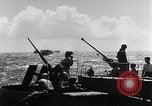
The orientation of officers and non commissioned abroad a ship and an officer speaks through a megavox, Pacific Ocean.
U.S. 81st Division, 323 Infantry Regiment troops on a LST underway in the Pacific Ocean. during World War II. Two anti aircraft guns positioned aboard LST (Landing Ship Tank). The soldier stand near the guns. An officer speaks through a megavox. He then picks up a binocular and scans sky. The officer looking through the binocular. A Captain on a bridge uses a stadimeter. He then looks through the binocular. from bridge of ship to convoy of ship. The orientation of officers and non commissioned abroad a ship. The Captain discusses a map with other officers and non commissioned officer. He holds a pencil and points out places on the map. The officers and non commissioned officer look into the map. The Captain gets up from his chair and leaves. The non commissioned officer roll the maps as the Captain leaves.
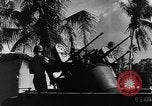
Seabees construct air strip using graders, dump trucks, power shovels and bulldozers at Ulithi Atoll, Caroline Island.
Construction of airstrip at Ulithi Atoll in Caroline Island during World War II. A bivouac area. The troops in vehicles drive down a muddy road in the area. Palm trees on either side of the road. Tents in the background. The troops walk on a road. The damaged huts. The wreckage in the forest. A sign reads '51st Naval Construction Bn'. A hangar. The Seabees construct roads and air strips using graders, dump trucks, power shovels and bulldozers. The Seabees at work during the construction. The Seebees in a jeep talk to the men. They cut bushes. The gasoline drums piles up. A man on a crane. The men pile gasoline drums on fuel dump with the help of the crane. The construction of airstrip. The dump trucks back up. A crane picking up dirt. A bulldozer rolls down.
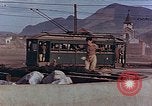
Japanese men dumps dirt into a central sewage disposal area in the center of a main street in Nagasaki, Japan.
Physical damage caused by the atomic bombings in Nagasaki, Japan during the end of World War II. A Japanese men dumps dirt into a central sewage disposal area in the center of a main street. Japanese men work around a crude brick furnace with a partially destroyed factory furnace in the background.
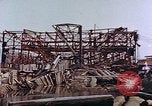
The collapsed steel framework which is the result of blast and fire and the wreckage in a sawmill after blast in Nagasaki.
Physical damage caused by the atomic bombings in Nagasaki, Japan during the end of World War II. The wreckage in a sawmill. The collapsed steel framework which is the result of blast and fire. The members of the sawmill look at the main roof of the mill. The complete collapse of the main roof. The sawmill members twisted into a tangled heap. The wrecked steel frames. A foundry situated in a casting plant. The striped wall, machines and work men. Inventories of raw materials. The inventories.
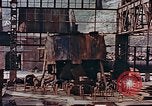
A damaged Chenzei School building and fallen concrete wall in the sawmill after the attack in Nagasaki, Japan.
Physical damage caused by the atomic bombings in Nagasaki, Japan during the end of World War II. An unidentified wrecked object underneath galvanized tin which was placed by the Japanese to keep out the elements. A damaged building. iron heaps, small castings and several different types of debris. A main roof member of a sawmill shows the total collapse of the roof. The collapsed roof. A damaged wall. A fallen concrete wall in the sawmill. The steel tie rods and their placements. The damaged concrete reinforced wall with the tie supports. The damaged Chenzei School building.
CRITICALPAST.COM: About Us | Contact Us | FAQs - How to Order | License Agreement | My Account | My Lightboxes | Shopping Cart | Advanced Search | Featured Collections | Website Terms & Conditions | Privacy Policy ©2026 CriticalPast LLC.
License Agreement |
Terms & Conditions |
Privacy Policy
©2026 CriticalPast LLC.