


 Francais
 Deutsch
 Italiano

Refine Your Search
Greek-Civil-War stock footage and images
- Showing 2497 to 2502 of 27581 results more
 Hide
Color Sound
The demonstration of guns like M-1 rifle and Sherman tank that can help in the war (WW2)
A documentary titled 'How Good Is A Gun' depicts the importance of good guns in World War II. A valley in North America. Damaged buildings. The rubble and dead bodies in the town. U.S. soldiers carrying guns walk on the rubbles. They are seated and talk about the good guns and weapons. The soldiers smoke and drink. The soldiers enter a building and are seated in a hall. Demonstration of various guns that can help the soldiers in different situations. A soldier firing the light carbines. A soldier fires a M-1 rifle. Fire by the machine guns that makes a hole in the 4 inches concrete wall. Troops in prone position and in the same line as they fire from a BAR (Browning Automatic Rifles) five times faster than a rifle. Two troops fire with a 30 caliber machine gun that cuts a tree. Air- cooled light machine gun that can fire within three miles and cuts the hill stone. Soldiers stand around a 60-mm mortar and fire. They put shell in the 80-mm mortar and fire. Smoke arises due to fire. A bazooka rocket powered and a killer tank. Troops pulls a 37-mm anti tank gun, they fire and look through binoculars. The troops around a 105-mm howitzer. The wooden logs arranged in a heap and are put three miles away. Howitzer fires and the heap being shelled. 155 rifle that lifts the roof of a German plant 15 miles away. Soldiers seated around the rifle. The rifle and the damaged German plant. A view of a war at the Italian Front. Troops pull away into positions along with artillery on the Italian front. They move forward along with the Howitzer,rifles and a Sherman tank.

Marshal Georgi Zhukov and other Russian officers inspect the ruins in Berlin after its capture by Soviet forces in World War 2
Russian officers in Berlin after its capture during World War II. Soviet flags flying on various monuments and buildings in Berlin. Soviet Marshal Georgi Zhukov and other officials inspect the ruins in the captured German city. The damaged interior of the new Reich Chancellery building with a bust of Hitler in debris. Ruined German armored cars on the streets. Marshal Zhukov looks at Victory Lady atop Victory Column in Berlin at the end of World War 2 in Europe.

Russian troops and officers pose for photographs after victory in Berlin over German forces at end of World War 2 in Europe
Russian troops after capturing Berlin during World War II. Soviet troops and officers pose for photographs on the streets of war torn Berlin. Demolished buildings in the background. Walls are marked by Russians, mentioning their city of origin.
U.S. Post World War II film, called "Conquest by Air", promoting Air Power
Scenes of trench warfare in World War I, when airpower was limited. In contrast, postwar low level aerial views show total destruction in Germany cities from aircraft bombing, alone, during World War 2. A montage of various U.S. warplanes in flight on bombing run and bombs away views with bombs falling toward targets. Planes shown include P-38, B-17, and B-26. A formation of P-38s. A formation of B-26s. A B-26 in D-Day stripes. Bombs striking ground targets. B-17s in high altitude formations with contrails.
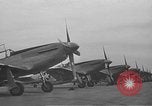
P-51 Mustangs and B-17 Flying Fortress planes attack German aircraft plants during World War II.
U.S. Army Air Force bombers attack Germany during World War II. View of U.S. P-51 Mustang aircraft in flight line at U.S. Air Base in England, United Kingdom. Aerial views of a formation of B-17 Flying Fortress planes and P-51 aircraft in flight over Germany. Bombs fall on German aircraft plants. Ruins of German aircraft plants after facing the bombings. Scene changes to show German war production workers building new Focke-Wulf aircraft (e.g., Fw 190) at production factory in Germany.

B-24 Liberator bombers raid Romania's Ploiesti oil fields and synthetic oil plants in Central Germany during World War II.
United States bombers bomb German-held oil refineries in Ploesti, Romania during World War II (Operation Tidal Wave). Allied military leaders including United States General Dwight D. Eisenhower confer prior to the Normandy Invasion. Cartoon depiction of buildings, tanks, and equipment in Romanian oil refineries. Consolidated B-24 Liberator bombers raid Romania's Ploesti oil refineries. A group of B-24 Liberator bombers dropping bombs over Ploesti. Explosions throwing billows of smoke up in air. Aerial view of Ploesti being bombarded by bombing and clouds of smoke from explosion. A map of Germany shows synthetic oil plant positions through Central Germany. Bombers drop bombs over synthetic oil plants in Germany. Firefighters rush to put out fire in oil plant during a bombing attack. Firefighters spraying water on burning oil tanks. Thick, dark clouds of smoke cover the burning oil plant. A German synthetic oil plant reduced to rubble. German workers clear the rubble from bombed plants. Ruins of German oil plants after repeated air raid attacks. “The enemy has succeeded in increasing our losses of aviation gasoline up to ninety percent” a voiceover narrates the words of Nazi German Reichsminister of Armaments and War Production Albert Speer. German Field Marshal Gerd von Rundstedt speaks to an audience.
CRITICALPAST.COM: About Us | Contact Us | FAQs - How to Order | License Agreement | My Account | My Lightboxes | Shopping Cart | Advanced Search | Featured Collections | Website Terms & Conditions | Privacy Policy ©2026 CriticalPast LLC.
License Agreement |
Terms & Conditions |
Privacy Policy
©2026 CriticalPast LLC.