


 Francais
 Deutsch
 Italiano
Refine Your Search
Greek-Civil-War stock footage and images
- Showing 25507 to 25512 of 27482 results more
more Hide
Hide
A reenactment depicts : A U.S. soldier pulls a comrade from beneath a truck in Hollywood, Los Angeles, California.
Radio Transmission Security in Hollywood, Los Angeles, California during World War II. A reenactment: a parked truck. A smoke column rises from a burning command truck in a shell hole. An actor portraying an American soldier regains consciousness. He pulls a comrade from beneath the truck.
Liberated prisoners march and a military band plays during a memorial ceremony at Buchenwald Concentration Camp in Germany.
A memorial ceremony at Buchenwald Concentration Camp in Germany during World War II. A military band plays. Camp buildings in the background. Liberated prisoners march during the memorial ceremony for the people killed in the camp. They carry French, Polish and Russian flags. A prisoner places a wreath at the foot of the monument dedicated to victims of Nazi brutality. Children march during the ceremony. A speaker addresses the gathering from a platform during the dedication ceremony. Flags flutter in wind. An effigy of German Chancellor Adolf Hitler hangs in front of the camp buildings.
Civilians place burned bodies of Gardelegen massacre victims on stretchers and carry them to burial grounds in Gardelegen, Germany.
Mass burial at the site of the Gardelegen massacre, in Gardelegen, Germany, late in World War II. View of the barn on the Isenschnibbe estate in Gardelegen where 1016 prisoners had been barricaded by Nazi forces and civilian accomplices on April 13, 1945, and then died after the barn was set on fire. German civilians walking among dead bodies outside the barn. Germany civilians walk carrying stretchers. They place burned bodies of Nazi atrocity victims on the stretchers. They carry the bodies to burial grounds. (Many of the dead were concentration camp prisoners and slave laborers in transit from the Mittelbau-Dora Concentration Camp and the Hannover-Stöcken Concentration Camp. The massacre was discovered by the U.S. Army 102nd Infantry Division when they entered the area on April 14, 1945, finding corpses in the barn and in nearby hastily dug mass graves. The U.S. Army ordered German civilians in the area to transport the bodies and dig graves for proper burial, from April 21-25, 1945.)
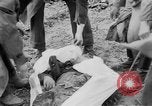
German Civilians wrap dead bodies in shrouds and place them in individual graves during a mass burial in Gardelegen, Germany.
A mass burial in Gardelegen, Germany during World War II, for victims of the Gardelegen massacre. German civilians wrap dead bodies in shrouds and place them in individual graves. They pour dirt in the graves with shovels. Burned barn building in background.. They are burying concentration camp and slave laborer victims of nazi atrocities who died after being locked in the barn that was then set on fire, in Gardelegen, Germany, on April 13, 1945. The atrocity was discovered by the U.S. Army 102nd Infantry Division on April 14, which directed the German civilians to properly bury the victims from April 21-25, 1945.
Civilians view a table displaying Nazi atrocities: Items made of human skin at Buchenwald Concentration Camp in Germany
Buchenwald Concentration Camp in Germany during World War II. During a forced tour of Nazi atrocities at the camp, German civilians view a table display of paintings on human skin, lampshades made of human skin, various parts of the human body preserved in alcohol and two heads which were shrunk to one-fifth their normal size at Buchenwald Concentration Camp.
U.S. publishers and editors take down notes at Buchenwald Concentration Camp in Weimar, Germany.
U.S. publishers and editors visit Weimar, Germany during World War II. U.S. Army Brigadier General Frank Albert Allen and officials greet and receive the publishers and editors at an airport. They pose for photographers. Aircraft in the background. They get into cars and proceed for a tour of Buchenwald Concentration Camp. Civilians watch as the cars move through streets. Press and media representatives walk in the camp area along with camp officials. They take down notes. A pile of dead bodies on the ground. The newspaper reporters question two men.
CRITICALPAST.COM: About Us | Contact Us | FAQs - How to Order | License Agreement | My Account | My Lightboxes | Shopping Cart | Advanced Search | Featured Collections | Website Terms & Conditions | Privacy Policy ©2026 CriticalPast LLC.
License Agreement |
Terms & Conditions |
Privacy Policy
©2026 CriticalPast LLC.