


 Francais
 Deutsch
 Italiano
Refine Your Search
Greek-Civil-War stock footage and images
- Showing 25525 to 25530 of 27482 results more
more Hide
Hide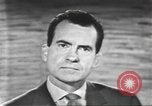
Kennedy and Nixon comment on decisions taken in favor of the U.S. during a presidential election debate in Washington DC.
The second Kennedy-Nixon Presidential Debate in Washington DC, United States. Paul Niven of CBS asks Republican candidate U.S. Vice President Richard M Nixon whether the decisions made so far for the U.S. were right. Nixon says that his decision during the Korean War was right. He disagrees with Kennedy that American prestige is at an all time low. He talks about the average income, daily meal and lifestyle of the Americans. He concludes and states that its his responsibility to correct Kennedy if he misstates. Democratic candidate Senator John F Kennedy disagrees with Nixon and gives the testimony of Senator George Aiken that majority of the Americans did not have income to afford a decent diet. He lays importance on a balanced budget.
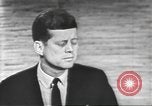
Kennedy and Nixon talk on drawing the defense line in the Far East during a presidential election debate in Washington DC.
The second Kennedy-Nixon Presidential Debate in Washington DC, United States. Edward P. Morgan of ABC asks Democratic candidate Senator John F. Kennedy to comment on whether Quemoy (Kinmen) and Matsu Islands were unwise places to draw U.S. defense line in the Far East. Kennedy states that he believes strongly in the defense of Formosa (Republic of China or Taiwan) and says that the U.S. will defend Quemoy (Kinmen) and Matsu if it is a part of a general attack on Formosa (Taiwan). He says that the U.S. should consult with the Nationalists. He states that the Americans should protect their commitments. Republican candidate U.S. Vice President Richard M Nixon states that he disagrees completely with Senator Kennedy on this point and states the example of the Korean War. Regarding Quemoy (Kinmen) and Matsu he says that these two islands are in the area of freedom and under the control of the Nationalists. He states that the U.S. should not force the Nationalist allies to get off of them and give them to the Communists because the Communists aren't after Quemoy (Kinmen) and Matsu, but after Formosa (Taiwan).
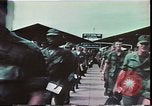
The last U.S. troops leave Vietnam and are greeted by relatives and friends upon their arrival in the United States.
The last U.S. ground units leave Vietnam during the Vietnam War. Columns of U.S. soldiers march to board an aircraft which will carry them to the United States. Troops wave to a crowd. A Vietnamese woman cries as she looks at the troops. U.S. sailors being greeted by their relatives and friends upon their arrival in the United States.
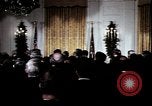
President Nixon makes remarks before signing the National Cancer Act of 1971 at the White House in Washington DC, U.S.
Signing of the National Cancer Act of 1971 in the East Room of the White House in Washington DC, United States. U.S. President Richard Nixon walks up to a microphone in the East Room. The President makes remarks. He speaks about the threat of cancer in the United States which killed many people during World War II and after that. He further speaks about the national commitment to the attempt of finding a cure through the National Cancer Act. President Nixon states that the Congress is totally committed to provide funds to ultimately eradicate cancer which is a major cause of death. He speaks that national commitment is different from government commitment because the national commitment involves all voluntary activities. A crowd applauds as President Nixon walks over to a table to sign the National Cancer Act.
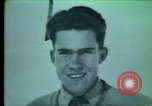
Prior to 1968 U.S. Presidential Election, Richard Nixon recounts his past when he was enlisted in the U.S. Navy.
Self-portrait of Richard Nixon aired during his 1968 presidential run against Hubert Humphrey and George Wallace in the United States. Pictures showing young Richard Nixon and his old home. An interviewer asks him about the period when he enlisted in the U.S. Navy. A 1945 picture of U.S. Navy Lieutenant Commander Richard Nixon. He speaks about his views about the problems the nation confronted in World War II.
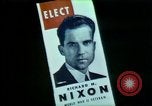
Prior to U.S. Presidential Election of 1968, Richard Nixon recounts his past and tells how he got into politics.
Self-portrait of Richard Nixon aired during his 1968 presidential run against Hubert Humphrey and George Wallace in the United States. An interviewer asks Richard Nixon that how he got into becoming a member of U.S. House of Representatives in 1947. Nixon replies that soon after World War II ended some Whittier Republicans approached him about running for a seat in the United States House of Representatives and he accepted. A picture of Nixon during his campaign in 1946. He says America is a great country because American people are competitive and it does not mean competition in the destructive sense. He considers America a great country in terms of competitive people and says that competitive spirit is a great driving force in any nation. And he says it is the reason why politics appeals to him.
CRITICALPAST.COM: About Us | Contact Us | FAQs - How to Order | License Agreement | My Account | My Lightboxes | Shopping Cart | Advanced Search | Featured Collections | Website Terms & Conditions | Privacy Policy ©2026 CriticalPast LLC.
License Agreement |
Terms & Conditions |
Privacy Policy
©2026 CriticalPast LLC.