


 Francais
 Deutsch
 Italiano
Refine Your Search
Greek-Civil-War stock footage and images
- Showing 25615 to 25620 of 27482 results more
more Hide
Hide
The Chairman of the Communist Party of China Mao Tse-Tung poses with the U.S. Ambassador to China Patrick Hurley in Chongqing, China
The Chairman of the Communist Party of China Mao Zedong and the U.S. Ambassador to China in Chongqing (Chungking), China shortly after the end of World War II. Chairman Mao followed by other Communist leaders leaves the aircraft. Chairman Mao poses with the United States Ambassador to China Patrick J. Hurley.
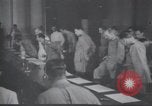
Japanese Lieutenant General Numata and British Lieutenant General Sir Frederick Browning signs the surrender treaty in Rangoon.
Signing of the surrender treaty by Japanese General at Burma Government House in Rangoon towards the end of World War II. The British delegation take their places at the conference table in the Government House. British Lieutenant General Sir Frederick Browning, Lord Mountbatten's Chief of Staff, explains surrender terms. The British officers present documents to Japanese Lieutenant General T Numata. General Numata signs the documents, after which General Browning signs.
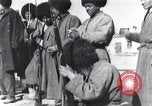
Soviet Tartar soldiers clean and adjust their rifles in Soviet Union.
Contingent of Soviet Tartar soldiers cleaning and adjusting their rifles. Most wear large black hats. although several wear smaller pointed style. (World War II period).
German armored vehicles,tanks and trucks destroyed by U.S. tactical aircraft supporting French forces in Italy
Destroyed German equipment, including some captured American armor, lines the edge of a road near Esperia, Italy during World War II. The German armored vehicles, tanks, antitank guns and trucks were destroyed by U.S. fighter bombers of the 12th Army Air Forces, on May 16, 1944, while supporting the French Expeditionary Force assault on the German Gustav line in that area. French troops stand on the side of a road. Troops examine some of the destroyed armor.
Infantrymen of U.S. 3rd Division,30th Infantry,2nd Battalion resting in a dugout near Rhine River in Vieux-Brisach,Germany.
Infantrymen of U.S. 3rd Division, 30th Infantry Regiment, 2nd Battalion in Vieux-Brisach, Germany, during World War II. Soldiers in a dugout near Rhine River, rest, shave, massage feet and write letters.
Infantrymen of U.S. 94th Division,301st Regiment destroy a German roadblock in Oberleuken, Germany (WW2)
Infantrymen of U.S. 94th Division, 301st Regiment advance in Oberleuken, Germany during World War 2. Infantrymen advance along a road. A German roadblock destroyed by explosions. Soldiers clear debris after destroying the roadblock. Soldiers use minesweepers over the area. M4 Sherman tanks and infantrymen pass after clearing of road. Soldiers set detonation wire into place. ( Note: The final column of M4 Sherman tanks are worth noting as they are M4A2 dry stowage tanks received from the British as evidenced by the "T" numbers visible on a number of the tanks in the clip and British spare track stowage. The tanks are fitted with U.S. radios, as evidenced by the antenna.)
CRITICALPAST.COM: About Us | Contact Us | FAQs - How to Order | License Agreement | My Account | My Lightboxes | Shopping Cart | Advanced Search | Featured Collections | Website Terms & Conditions | Privacy Policy ©2026 CriticalPast LLC.
License Agreement |
Terms & Conditions |
Privacy Policy
©2026 CriticalPast LLC.