


 Francais
 Deutsch
 Italiano
Refine Your Search
Greek-Civil-War stock footage and images
- Showing 25819 to 25824 of 27482 results more
more Hide
Hide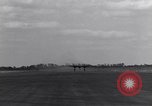
A USAAF B-25 Mitchell bomber in flight with a GB-4 bomb mounted on its fuselage during a test in the United States.
Tests of GB-4 bombs (precision guided munition) in the United States during World War II. A U.S. Army Air Force B-25 Mitchell bomber taxis and takes off from an air strip. A pilot and a copilot in the cockpit of the B-25. An antenna mounted on a side of the aircraft. Technicians put a cover on the front of camera equipment mounted under a GB-4 bomb. The B-25 Mitchell in flight with the GB-4 mounted on its fuselage. Aerial view of Auxiliary One airstrip at Eglin Air Force Base in Florida.
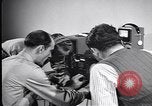
Three U.S. technicians examine a GB-4 television receiver and test equipment at Eglin Air Force Base in Florida, United States.
Tests of GB-4 bombs (precision guided munition) in the United States during World War II. Three technicians operate a GB-4 television receiver and test equipment at Eglin Air Force Base in Florida.
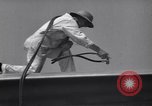
Painting and mothballing B29s and B-17s in the United States
U.S. Army Air Force B-29 Superfortress bomber aircraft at an airfield in United States during World War II. A civilian spray paints the wing of a B-29. A painter uses a roller around the wing insignia. Several civilians using ladders, paint a B-29 Superfortress. Man on forklift empties 55 gallon drum of mastic liquid into power sprayer. Sprayer nozzles are shown. Operator sprays mastic material on fuselage of mothballed B-29, to seal it. B-17 with mastic sprayed on tail section of fuselage. A Wright 3350 radial engine from a B-29, on a stand and series of views as it is gradually mothballed. View of sealed B-29 airframe, with engines removed, and hosing connected to various openings.
Aircraft workers on an assembly line during the construction of U.S. Lockheed bomber airplanes in Burbank, California.
U.S. Lockheed bomber airplanes under construction in Burbank, California during World War II. The airplanes are to be transported to England. Aircraft workers on an assembly line in a factory. The workers move out of the factory. Cars parked outside the factory.
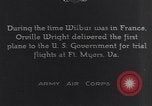
Wright airplane flies with first army personnel Lt. Frank Lahm over Fort Myer in Virginia, during an official exhibition.
Official trial of the Wright airplane at Fort Myer in Virginia, United States demonstrating compliance with specifications in the presence of the Aeronautical Board, U.S. Signal Corps. Orville Wright and U.S. Army Lieutenant Frank Lahm in the cockpit of the aircraft prior to the take off. The airplane is launched and it flies over barracks and administration buildings. U.S. soldiers remove doors from a storage building. The soldiers prepare to remove the aircraft from the storage building. U.S. Secretary of War William Taft, U.S. Army Major General George Owen Squier, Lieutenant Lahm and Major Faltpsam stand near the hangar building as the aircraft is being removed from it. Men tow launching weight up into the top of a tower. The launching tower shows weights suspended. A soldier moves the Wright aircraft out to the launching platform. Lieutenant Lahm sitting at the controls. Orville Wright stands in the front talking to a mechanic while another officer stands on the right wing of the aircraft. The aircraft is launched. Spectators watch the flight. Orville Wright making adjustments in the aircraft engine prior to the first cross-country flight in America: from Fort Meyer to Alexandria. A person in the back pulls the propeller through. U.S. Army Lieutenant Benjamin Foulois sitting in the cockpit.
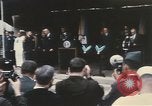
U.S. President Johnson presents a Medal of Honor to U.S. Army Specialist 5 Charles Hagemeister at the Pentagon in Virginia, U.S.
U.S. President Lyndon B. Johnson presents the Medal of Honor to a U.S. soldier in Virginia, United States for his services in the Vietnam War. Four Medal of Honor winners stand on a platform in the inner court of the Pentagon with President Lyndon Johnson during a Hall of Heroes ceremony. U.S. Secretary of Army Stanley Resor reads a citation. Chairman of the Joint Chiefs of Staff General Earle Wheeler stands in the background. President Johnson places a Medal of Honor around the neck of U.S. Army Specialist 5 Charles Hagemeister and shakes hands with him. Newsmen in the foreground record the event.
CRITICALPAST.COM: About Us | Contact Us | FAQs - How to Order | License Agreement | My Account | My Lightboxes | Shopping Cart | Advanced Search | Featured Collections | Website Terms & Conditions | Privacy Policy ©2026 CriticalPast LLC.
License Agreement |
Terms & Conditions |
Privacy Policy
©2026 CriticalPast LLC.