


 Francais
 Deutsch
 Italiano
Refine Your Search
Greek-Civil-War stock footage and images
- Showing 26437 to 26442 of 27482 results more
more Hide
Hide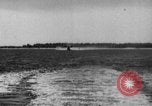
A PBM Mariner aircraft in flight and different parts that make up its design are pointed out in the United States.
A U.S. Navy training film about the role and importance of U.S. Navy PBM Mariner aircraft during World War II. A PBM Mariner takes off from the surface of a sea in the United States. The aircraft in flight. The design of a PBM Mariner III like the wings, tail and rudders forming a triangle being pointed out on a picture. The aircraft in flight. A side view of the Mariner shows the wings piled up on the top. The rudders being pointed out. The PBM Mariner in flight and different parts of the aircraft like the wings, rudders, engines and floats being pointed out.
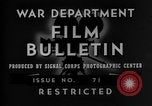
Training and working of 725th Railroad Battalion personnel at Camp Claiborne in Louisiana, United States.
A film titled 'Army railroad' about the training of 725th Railroad Operating Battalion personnel at Camp Claiborne in Louisiana. Soldiers march past a sign that reads '725th Rail Road Operating Battalion' RR battalion personnel work on locomotives. Personnel build a rail road train. A man puts a railroad wheel on fire. Activities of the 725th RR Battalion in Africa during World War II as men work on locomotives and rolling stock. A personnel writes on a board. Personnel board the train and it gets underway. 725th RR Operating Battalion personnel being imparted training in various skills including telegraph. Personnel being imparted practical training near a rail road engine. Orders to prepare a train being given and dispatched. Yard master delivers the order to a Yard Foreman. Caboose being picked up to prepare a trail. Yard engine being detached and train rolls out. Engine being attached to the train. Conductor checks his watch with the master clock and signs the outgoing train register. Engineer receives the order. A rear lamp being hanged aboard the train. Men get aboard the railroad train and it leaves.
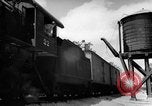
725th Railroad Battalion personnel repair a train after an air attack at Camp Claiborne in Louisiana, United States.
A film about training of 725th Railroad Operating Battalion personnel at Camp Claiborne in Louisiana. A train on the roll. Officers at a desk as they plan for a mock attack on a railroad train to impart practical training to 725th Railroad Operating Battalion personnel. Security guards aboard the train as they fire at attacking airplanes. Air attack causes damage to railroad track. Personnel inspect the damaged track. Caboose being informed about the damage. Security guards move to vantage points to provide a protection cover during repairing work. A signal man goes up a pole to make connection to an open telephone line. He makes a call to a dispatcher and the First Sergeant. The First Sergeant blows a whistle and repair parties load onto trucks. Others load onto railroad motor cars. A sign reads '725th Ry. Opn. Bn.'. The repair parties in trucks arrive at the site of the attack and equipment being unloaded. Broken tyres being removed. Another repair crew arrives. Rails being put in place and angle bar being used to tighten the bolts. A train rolls on the tracks. Guards on duty aboard the train. (World War II period).
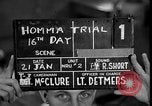
Major Tisdell recalls events of April 8, 1942 in Bataan, Philippines during the Homma trial in Manila, Philippines.
U.S. Army Major Achille C. Tisdell testifies before a military tribunal in Manila, Philippines during the trail of Japanese Army General Masaharu Homma for World War II crimes. Major Tisdell takes an oath on the 16th day of the Homma trial. He says that he was aide-de-camp to Major General E.P. King, Commanding General of the American forces in Luzon in April, 1942. Major Tisdell recalls that Japanese forces had pushed back the American forces in Bataan to a point that it was difficult for the Americans to reorganize. He also talks about the lack of ration for the American forces. Major Tisdell says that U.S. reserves were released for the forces. He says that on 9th April, 1942 General King was unable to make contact with Japanese commander and Colonel Edward C. Williams volunteered to make contact with the Japanese.
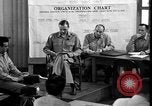
Major Tisdell talks about American surrender to the Japanese in 1942 during trial of General Hommal in Manila, Phillipines.
U.S. Army Major Achille C. Tisdell testifies before a military tribunal in Manila, Philippines during the trial of Japanese Army General Masaharu Homma for World War II crimes. Major Tisdell, aide-de-camp to Commanding General of the American forces in Luzon Major General Edward King, says that Colonel William and Major Marshall went in a jeep to contact the Japanese forces. They met the forces at a bridge. Japanese infantry elements led them to head quarters. Tisdell says that a Japanese Major General kept Colonel Williams as a hostage allowing Major Marshal to return to the American headquarters. After his return on April 9, 1942 General Edward King assembled some officers.
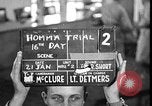
Major Tisdell talks about American surrender to the Japanese in 1942 during the trial of General Homma in Manila, Phillipines.
U.S. Army Major Achille C. Tisdell testifies before a military tribunal in Manila, Phillipines during the trial of Japanese Army General Masaharu Homma for World War II crimes. Major Tisdell, aide-de-camp to Commanding General of the American forces in Luzon Major General Edward King, speaks about the American unconditional surrender in Bataan before the Japanese forces. He recalls that an interpreter told American Commanding General Edward King to get U.S. Army General Jonathan Wainwright. General King expressed that there were no means to contact General Wainwright. He says that General King presented four conditions of surrender to the Japanese that included his return to the headquarters to notify the surrender and a 12 hour armistice. But Japanese declared that the surrender must be unconditional. General King asked if U.S. troops would be well treated. The Japanese replied that they were not barbarians.
CRITICALPAST.COM: About Us | Contact Us | FAQs - How to Order | License Agreement | My Account | My Lightboxes | Shopping Cart | Advanced Search | Featured Collections | Website Terms & Conditions | Privacy Policy ©2026 CriticalPast LLC.
License Agreement |
Terms & Conditions |
Privacy Policy
©2026 CriticalPast LLC.