


 Francais
 Deutsch
 Italiano
Refine Your Search
Greek-Civil-War stock footage and images
- Showing 27007 to 27012 of 27481 results more
more Hide
Hide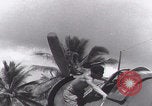
Pilot climbing out of F4U Corsair cockpit, plane captain tattoo in Espiritu Santo (WW2)
A United States pilot climbs out of a cockpit of a Vought F4U Corsair in Espiritu Santo, New Hebrides, during Pacific warfare in World War 2. A shirtless plane captain hands over the parachute of the pilot from the cockpit. A Marine signals to an aircraft. Shirtless plane captain gives signal for an aircraft to taxi in. An arm tattoo depicting an eagle with a globe and the word “Honolulu”. Two men talking outside a bungalow. Three pilots approach the two men and they started talking.
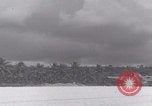
Vought F4U Corsair and other fighter aircraft taxis and take off in Espiritu Santo (WW2)
A Grumman TBF Avenger aircraft landing on a sandy airfield in Espiritu Santo during World War 2. Douglas SBD Dauntless landing. A United States pilot signals to an aircraft taxiing away. A United States Vought F4U Corsair lands, turns to park in airfield. A Vought F4U Corsair taxiing. A man runs ahead of the Vought F4U Corsair and signals to its pilot. Rear view of a group of Vought F4U Corsairs waiting in line for take-off. Group of Vought F4U Corsair aircraft taxis and take off one by one.
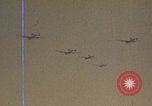
United States B-24 Liberator bombers fly over oil refineries in Romania during Operation Tidal Wave (WW2)
United States Army Air Forces B-24 Liberator bombers flying low over Romanian oil refineries in Ploesti during Operation Tidal Wave (World War 2). A group of United States B-24 Liberator bombers in flight. B-24 Liberator airplane flying over farmlands and burning oil refineries. B-24 Liberator plane flies through a thick cloud of smoke. B-24 Liberator in flight. A group of B-24 Liberators flying over farms. Round hay bales on farmland.
Animation depicting flight path of Japanese Fu-Go paper balloon bombs to United States (WW2)
Japanese Fu-Go paper balloon bombs bound for the West Coast, USA during World War 2. A Japanese paper bomb balloon in flight. Fu-Go balloon pass by a small island as winds take the balloon toward the United States. A paper balloon bomb descending. A deflated paper balloon bomb. Animated map depicting the flight path and mechanism of the wind velocity of Japanese Fu-Go paper balloon bombs to the West Coast of the United States.
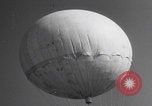
Parts of a Japanese Fu-Go paper balloon bomb (WW2)
A video explaining the components of a Japanese Fu-Go paper balloon bomb- a weapon launched by Japan to drop bombs on the United States during World War 2. A United States Navy personnel inspects the Fu-Go paper balloon on its ballast. Paper bags and sandbags tied to the ballast of the Fu-Go balloon bomb. Payload comprises of incendiaries and anti-personnel bombs. Inflated “Type B” Fu-Go balloon made of 5 ply “washi” rice paper. United States Navy personnel lets go of holding the ballast of balloon bomb. Man unfolds a piece of rice paper. Man ripping a piece of rice paper, demonstrating the durability of the material. Fu-Go bomb inflated with hydrogen gas. Man holding the escape valve of the Fu-Go balloon bomb. Escape valve is shown as made of pressed steel and has a rubber gasket. Pressure is exerted by the rubber ring the escape valve. Spider bracket of escape valve.
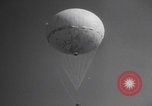
Parts of the so-called Brain Center of a Japanese Fu-Go paper balloon bomb (WW2)
A video explaining the components of the “Brain Center” of the Japanese Fu-Go paper balloon bomb- a weapon launched by Japan to drop bombs on the United States during World War 2. An inflated paper balloon bomb. A man with a pencil points to parts of the “Brain Center” of the balloon such as the electrical source (battery case), demolition block, barometer box, fused jacks, jack switches, blowout plugs, sandbags, and incendiary bombs. Man puts away his pencil. Man pulls back sandbags to show the central payload of the paper balloon bomb. Man demonstrates how ballast falls. Man demonstrates mechanism and release of the pay loads. A sandbag falls. Man attaches sandbag back to the ballast. Man shows a T-hook of the ballast. Man re-attaches a T-hook back in the ballast.
CRITICALPAST.COM: About Us | Contact Us | FAQs - How to Order | License Agreement | My Account | My Lightboxes | Shopping Cart | Advanced Search | Featured Collections | Website Terms & Conditions | Privacy Policy ©2026 CriticalPast LLC.
License Agreement |
Terms & Conditions |
Privacy Policy
©2026 CriticalPast LLC.