


 Francais
 Deutsch
 Italiano
Refine Your Search
Greek-Civil-War stock footage and images
- Showing 27547 to 27552 of 27563 results more
more Hide
Hide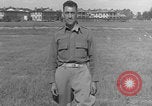
U.S. Army training film on non-verbal commands signaling different moves when training soldiers with a bayonet.
Soldier demonstrates each non-verbal command used to signal trainees when teaching bayonet skills. Each command (often a hand gesture or movement) signifies a different move with the bayonet. Narrator lists each move while the soldier demonstrates the commands associated with said moves. Performed in a large field with some sort of residential or barracks-type buildings in the background. Pre World War 2.
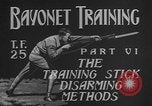
U.S. Army bayonet training film on the use of the training stick in bayonet practice.
Pre World War 2: U.S. Army description and demonstration of the use of the training stick in bayonet practice. The training stick is a long stick with a loop at the base end and padding at the far end. Footage of two soldiers practicing and switching roles by throwing the training stick and bayonet to one another, then practicing again. They practice on a large field, with suspended straw dummies behind them. Further in the distance, more soldiers can be seen walking in a line.
U.S. Army training film on the third method of disarming an opponent armed with a rifle and bayonet.
U.S. Army step-by-step demonstration and description of the third (of three) method of disarming an opponent armed with a rifle and bayonet. Third method involves a kick to the crotch or shin and a twist to remove the bayonet from the opponents hands. Closeups of the M1903 Springfield rifle and training bayonet used by soldiers. Slow motion and full speed demonstrations of the third disarming sequence, with the soldiers switching roles with each disarm. Soldiers practicing all three methods of disarming an opponent at full speed, once again switching roles with each disarm. Pre-World War 2.
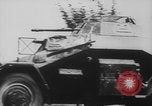
German tanks and infantry travel fast through Poland
Motorized German vehicles move quickly down a dirt road, continuing the invasion of Poland during World War II. The first vehicle shown is a light reconnaissance car, likely the Sd.Kfz 221 but potentially the 222. Another vehicle shown is the Sd.Kfz 263. Tanks and supply trucks drive on uneven roads, while soldiers on foot watch the progress. A vehicle drives through a small puddle or stream. A series of Panzer II tanks roll down a steep hill while soldiers in undershirts stand and sit to the side of the road. Many militarized vehicles are visible in a wide shot covering a bend in the road. A truck speeds past. Off the road, German soldiers look on and a cow is lead around. A massive line of German infantry marches in formation. A lone mounted cavalry soldier leads the line of troops, while military cars drive past. Close shots show the young soldiers' faces and their full uniforms. These proceedings are scored by triumphant music. The inside of a German airplane cockpit is briefly shown, looking past the heads of the pilots to the sky. German Luftwaffe crew look through documents on aircraft as they track positions of retreating Polish forces. A German soldier wearing headphones transmits a message using a radiotelegraphy machine.
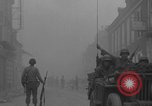
U.S. soldiers assist French civilians during liberation of Isigny-sur-Mer, France, in WW2
Rubble in the streets and burning buildings in the town of Isigny-sur-Mer, France, three days after the Allied invasion of France in World War 2. U.S. Army 29th Infantry Division soldiers stand guard in the captured city and other American Army units drive through the town, past burning buildings caused by Allied bombing the day before to counter German forces in the city. Wide view of the Place Gambetta at Rue Émile Demagny, with soldiers in distance standing near a stone pedestal and monument at center of town honoring Émile Demagny. A mix of U.S. soldiers and French civilians are seen in the streets. Close up view of flames and smoke coming from a burning building that has partially collapsed into the street. A U.S. Army soldier holds the hand of an elderly French woman and escorts her past the flames and through the rubble. Wide view shows the soldier and the woman in the center of a street with rubble from destroyed buildings on both sides.
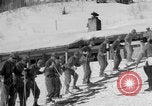
U.S. Army 503rd Parachute Infantry Regiment practices mountain skiing
Soldiers from Company B of the U.S. Army 503rd Parachute Infantry Regiment begin learning cross-country techniques such as the "side step," "herringbone" and "kick turn," as described by the narrator. The soldiers practice their skills in deep snow in Alta, Utah, hiking up steep slopes in single file. The men ski down tall slopes one by one, and in groups on wider terrain. A line of soldiers stand arrayed behind upright skis. During World War 2.
CRITICALPAST.COM: About Us | Contact Us | FAQs - How to Order | License Agreement | My Account | My Lightboxes | Shopping Cart | Advanced Search | Featured Collections | Website Terms & Conditions | Privacy Policy ©2026 CriticalPast LLC.
License Agreement |
Terms & Conditions |
Privacy Policy
©2026 CriticalPast LLC.