


 Francais
 Deutsch
 Italiano
Refine Your Search
Greek-Civil-War stock footage and images
- Showing 2989 to 2994 of 27482 results more
more Hide
Hide
Japanese-Americans make experimental rubber from guayule plants at Manzanar War Relocation center, California.
Life of Japanese-American citizens at Manzanar War Relocation center (internment camp) in California during World War II. A Japanese-American farmer on a guayule farm. A Japanese-American scientist doing an experiment in a laboratory. Dried guayule plant. Production equipment is made in a laundry from an old automobile parts. Sign reads 'Guayule Experimental Project Biology Division'. Rubber rises on surface. Man tests the rubber made in Manzanar.
Japanese-American soldiers clear an obstacle course at Poston War Relocation center, Arizona.
Japanese-American citizens and soldiers at Poston War Relocation center (internment camp) in Arizona during World War II. The American flag is lowered on pole. Men furl the flag. Army vehicles parade on street. Japanese-American soldiers clear an obstacle course. Truck loaded with soldiers, moves ahead on road. Soldier fires a gun on a field.
Japanese American soldiers at USO (United Service Organization) at Heart Mountain War Relocation Center, Wyoming, United States.
Japanese American soldiers at Heart Mountain War Relocation Center (internment) in Wyoming, United States during World War II. Japanese American battalion parades and a band plays on a field. A Japanese American soldier enters a USO (United Service Organization). Japanese American woman greets soldier. Chart reads 'Visiting Servicemen'. Soldier writes on chart. Japanese American servicemen and women dance in room. Japanese Americans at a snack bar. Japanese-American officer poses. A Japanese-American scouts band, including a drum and bugle corps, marches through an indoor gymnasium.
General Henry (Hap) Arnold reports to the nation on status of U.S. Army Air Forces in World War II
General Henry H. Arnold, Commander of the U.S. Army Air Forces, seated in front of world map, reports that since start of World War 2, the U.S. Air Force has gone from number 7, to number 1, in the world. Defense plant workers are shown walking near their place of work. A college football game shown in progress. Individual young men who left civilian life to became pilots, bombardiers, radio technicians, and gunners, in the Air Forces. A commercial DC-3 aircraft taxing to park at an airport. Shown are people who make the Air Forces possible, including many men and women workers at factories and manufacturing plants making aircraft and parts for the World War 2 effort: Steel workers, a woman working on a plane fuselage, actor James Stewart (in uniform), a welder at work, a typist, a machinist using a caliper, and an older couple at home, who forgoe driving their private car, shown covered in their garage. The flaming wreckage of U.S. aircraft at Hickam Field, on December 7, 1941. Large formation of German Heinkel He-111 bombers in flight. Formation of Japanese Mitsubishi G3M (Nell) bombers. U.S. P-40 pursuit planes taxiing out from parking places. Assembly line in U.S. aircraft manufacturing plant. U.S. Army Air Forces B-17 Flying Fortress planes on assembly lines. Workmen work on engines and aircraft fuselages. At the Douglas plant U.S. Army Air Forces B-26 Marauder bombers being assembled. Workmen inserting machine guns into a wing.
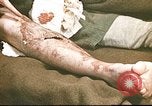
Soft tissue wounds of U.S. soldiers and their recovery after successful surgical operations in Europe during World War II.
A film shows U.S. soldiers being hit by shell fragments and their recovery after surgery in Europe during World War II. A case of soft tissue wound shows a wound on the leg of a soldier who was hit by a shell fragment. Surgery on the wound shows gentle exploration revealing the path of a muscle. The skin incision is enlarged. A blood cord is evacuated. A shell fragment is removed. The wound is dressed. The wound after few days of injury. The wound is ready for skin grafting. The graft being stitched on the wound. Stitches are removed after few weeks and the patient is discharged. A case of multiple soft tissue wound shows a wounded soldier on an evacuation hospital bed. Two wounds on the left arm of the patient. X-rays of the arm of the patient. An incision is made to connect the two wounds. Margins of the wound are divided. Multiple wounds on the hand of a patient. The wound on the left arm after two weeks. The wound is ready for secondary closure or skin grafting. Strapping is done to bring skin margins together. Surgeons operate the same patient. The wound is stitched. The patient shows his hand after healing. A soldier with a wound just below his buttock. A soldier with a scar under scapula. Wounds on right leg and left arm of a soldier. Medics evacuate a wounded soldier. A surgical operation in progress. The soldiers smile after their successful recoveries from soft tissue wounds. U.S. troops during operations of World War II.

Under Secretary of War Robert Patterson and Lieutenant General Brehon Somervell arrive at 1st Division headquarters in France.
U.S. officials arrive at U.S. 1st Division headquarters in France during World War II. U.S. Under Secretary of War Robert Patterson and U.S. Army Lieutenant General Brehon Somervell are greeted by Commanding General Clarence Huebner of U.S. 1st Infantry Division as they arrive at the headquarters.
CRITICALPAST.COM: About Us | Contact Us | FAQs - How to Order | License Agreement | My Account | My Lightboxes | Shopping Cart | Advanced Search | Featured Collections | Website Terms & Conditions | Privacy Policy ©2026 CriticalPast LLC.
License Agreement |
Terms & Conditions |
Privacy Policy
©2026 CriticalPast LLC.