


 Francais
 Deutsch
 Italiano
Refine Your Search
Greek-Civil-War stock footage and images
- Showing 3181 to 3186 of 27482 results more
more Hide
Hide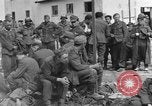
German and Italian prisoners under the guard of U.S. Army Military Police, in Anzio, Italy, during World War II.
Prisoners of war in Anzio, Italy World War 2. German and Italian prisoners in an outdoor area. The prisoners, under the guard of U.S. Army Military police, move about. The prisoners sitting against a wall of partially destroyed building.
Some U.S. Army soldiers focusing on leisure after World War 2, and some attend Army extension classes in the United States.
A post-war U.S. Army film (after World War 2) in 1945-1946 contrasts dice and pool playing soldiers with the soldiers who take Army extension classes to prepare for jobs in civilian life following demobilization and discharge from the Army. Group of U.S. Army soldiers in a room as they play pool at a billiards table. Soldiers in a barracks room seated on a bed and on the floor throwing dice in a game of craps. The soldiers play cards and smoke. Contrast is shown with U.S. Army students seated in a class. An officer takes lessons. A soldier takes notes. A young teacher or professor explains a concept with the help of a blackboard. View of the Hôtel Miramar in Biarritz, France (built in 1927 and demolished in 1978). Aerial view of a building with interconnected corridors. Street level view of the University of Calcutta Senate Hall in Calcutta (Kolkata), India (hall designed by Walter Granville; one time home to the Asutosh Museum of Indian Art; demolished in 1960). People walking in front of the Senate Hall as a car and a pulled rickshaw go by. In next scene, a sign reads 'Fox-Hole Campus'. An officer holds a mechanical model and explains a concept to students. A soldier works with equipment and an African American soldier stitches clothes at a sewing machine. A sign "Learn today; Earn tomorrow" as soldiers learn skills to help them in the civilian sector after separation from the armed forces. A solder works on a model. Pamphlets on a desk with the names of different subjects written on them that U.S. Army students can study to learn skills and jobs, including Automobile Repair Shop, Retail Bakery, Service Station, Grocery Store, Metal Working Shop, Shoe Repair Business, Small Sawmill Business, Beauty Shop.
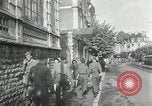
U.S. Army soldiers attend classes at Army University Study Centers, receiving job and skills training after World War 2.
A post-war film shows U.S. Army soldiers studying in barracks and in foreign universities immediately after World War II. Students at a campus in France as they walk on a pathway. Courses being offered to the soldiers. Several posters with the subject names in the background. The officers seated at a desk. A soldier takes books. Soldiers attend an animal husbandry class and examine livestock in a yard area. Students in an engineering class as they draw different drawings on paper at drafting tables. A chemistry lab. The students perform experiments and are seen working with test tubes and graduated cylinders. A woman works with clay and a U.S. soldier fashions sculpture of a dog out of clay. An officer seated on a desk and the students stand in front of him and make notes during journalism and correspondence classes. U.S. Army students in art classes. A woman holds a ball and poses. The students draw her form. The Geology class. Soldiers walk in trenches and a few stand as they make notes after observing a geologic sample. Group of U.S. Army soldiers play tennis. An officer seated in a chair. They play basketball. Soldiers seated on the field. Soldiers being awarded with diploma certificates after 4 or 8 week courses. They are gathered at a graduation ceremony receiving diplomas that they can use in applying for college credit. Students seated in a class. A French woman teaches them. Two soldiers walk among the buildings of a French campus.
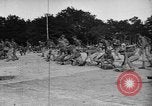
U.S. Marines in prone positions holding guns and practice the use of weapons in the United States during World War I.
U.S. Marines practice with Lewis machine guns during World War I. U.S. marine three-man machine gun teams set up Lewis machine guns and fire them during training at Key West, Florida, in World War 1. Teams set up in prone positions, with gunner ready to fire. Second man fastens circular ammunition magazine atop the gun and third man stays low behind. The guns are on a bipods, and equipped with large cooling shields around their barrels. The gunners fire one magazine, replace it, and fire again.
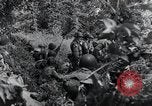
U.S. 101st Airborne Division soldiers round up and interrogate German prisoners in St. Marcouf, France during World War II.
D-Day Invasion of St. Marcouf, France during World War II. Paratroopers of the 101st Airborne Division round up and interrogate German prisoners.Opening scene shows U.S. 101st Airborne Division Paratroopers of the 506th PIR (Parachute Infantry Regiment) with Ace of Spades stenciled on their helmets. They apprehend German soldiers surrendering in midst of wooded area. A wounded German soldier is seen conversing with a U.S. trooper. He reaches out a bandaged right hand towards a Lieutenant. Another German soldier raises his hands as he surrenders. (Slate erroneously identifies 82nd Airborne.) Next, U.S. troopers are seen riding captured German Panzer I Ausf.A Sd.Ktz.101 tanks. One is pulling a field piece trooper riding on the barrel. . Ensuing sequence clearly shows Screaming Eagle shoulder patches on U.S. troopers of the 502nd PIR (hearts stenciled on their helmets) as they process German prisoners of war. Surrendered German military equipment, helmets and such, piled up on the ground.
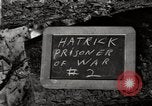
German prisoners of war cut huge pine trees in a forest area at Camp Evelyn in Munising, Michigan.
Activities of German prisoners of war at Camp Evelyn in Munising, Michigan during World War II. Chopped pine trees on the ground. German prisoners use saws and axes to chop down huge pine tress. Two prisoners chopping trees in the background. A prisoner picks up a wooden log and walks. Another cuts tree in the background. A German prisoner strikes a tree with an axe. Huge pine trees in the forest area. Two prisoners look at the trees.
CRITICALPAST.COM: About Us | Contact Us | FAQs - How to Order | License Agreement | My Account | My Lightboxes | Shopping Cart | Advanced Search | Featured Collections | Website Terms & Conditions | Privacy Policy ©2026 CriticalPast LLC.
License Agreement |
Terms & Conditions |
Privacy Policy
©2026 CriticalPast LLC.