


 Francais
 Deutsch
 Italiano

Refine Your Search
Greek-Civil-War stock footage and images
- Showing 3217 to 3222 of 27588 results more
 Hide
Color Sound

Torpedoes are loaded into racks and officers confer aboard submarine in European Theater during World War II.
War role of the German submarine in European Theater during World War II. German submarines on the surface of sea. Torpedoes loaded into racks aboard submarine. German officers seated around table in a cabin and confer. A German crewman climbs down a ladder and enters the cabin. The crew play cards. The submarine submerges. An officer watches through binoculars. The crew at work. The conning tower of the submarine. The submarine surfaces.

Enemy ships explode as German crewmen fire deck gun on submarine in European Theater during World War II.
War role of the German submarine in European Theater during World War II. German Navy sailors standing aboard a German U-boat. German officers watch through binoculars. Crewmen pass 88mm shells to each other. Shells loaded into deck gun on the submarine. Crew fire deck gun at enemy ships. The enemy ships explode and sink. Smoke rise from explosions. The submarine raises periscope as it submerges. The conning tower of the submarine. The interiors of the submarine shows men at work at the controls. The crewmen move about the submarine. An officer operates equipment in control room.

Submarine surfaces and a German officer watches through binoculars in European Theater during World War II.
War role of the German submarine in European Theater during World War II. Views of sea. A submarine surfaces. Water sweeps over deck of the submarine. A German crewman writes on a note book. The submarine underway at sea. An officer watches through binoculars. The interior of the control room shows crewmen at work.

U.S. 442nd Regimental Combat Team members practicing Hawaiian music and dancing, during their time at Camp Shelby, Mississippi in World War II
Members of the U.S. 442nd Regimental Combat Team (comprising Americans of Japanese ancestry) practice Hawaiian music and dance intended to entertain the troops, during World War 2. Several of the group take turns imitating hula dancers, as the musicians play. Numerous views of the men dancing. Musicians, including one playing guitar and another with ukulele, are seen at the end of the clip. (Note: Under auspices of Mr. Earl Finch, a businessman from Hattiesburg, Mississippi, a similar group of 442nd soldiers, coming through Camp Shelby, was formed into the "Shelby Serenaders,"later in the war. Finch also created the “Aloha” USO in Hattiesburg, and did many other things to make life more pleasant for members of the 442nd during their training times at Camp Shelby.)
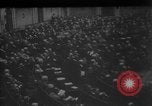
U.S. President Woodrow Wilson asks Congress for a declaration of War against Germany
Film opens showing the U.S. Congress filling the U.S. Capitol chamber on April 2, 1917, when President Woodrow Wilson asked Congress to declare war against Germany. Four days later, on April 6th, President Wilson is seen in black topcoat and top hat delivering an address from a building in Washington, DC announcing that Congress approved his request for a declaration of War. Former President Wiliam Howard Taft sits nearby. View of President Wilson dressed in summer white, relaxed and very casual, speaking impromptu to a group of persons in front of a brick building. Patriotic bunting is seen nearby. Change of scene shows Woodrow Wilson's youngest daughter, Mrs. W.G. McAdoo,Eleanor Randolph Wilson McAdoo. An unidentified old woman is nearby.

Vietnamese soldiers move into action in grassy field and ravages of war in South East Asia.
The plight of South East Asian refugees, with focus on role of international organizations in South East Asia. Vietnamese soldiers move into action in grassy field during Vietnam war. Ravages of war showing damaged homes and ruins. Trucks being driven and refugees carry their belongings.
CRITICALPAST.COM: About Us | Contact Us | FAQs - How to Order | License Agreement | My Account | My Lightboxes | Shopping Cart | Advanced Search | Featured Collections | Website Terms & Conditions | Privacy Policy ©2026 CriticalPast LLC.
License Agreement |
Terms & Conditions |
Privacy Policy
©2026 CriticalPast LLC.