


 Francais
 Deutsch
 Italiano

Refine Your Search
Greek-Civil-War stock footage and images
- Showing 3253 to 3258 of 27588 results more
 Hide
Color Sound
Vietnamese gather to pay homage to a Ho Chi Minh, lying in State in Hanoi,Vietnam, during the Vietnam war.
The body of Ho Chi Minh, lying in State, following his death, on September 2, 1969. during the Vietnam War. Recounting scenes of war, revolution and violence associated with Ho Chi Minh's life and struggles. An aircraft in flight drops bombs. A smoke column rises from explosions. People weep. Prisoners executed in a field. Pile of dead bodies, in front of clusters of Christian crosses.
U.S. soldiers loaded on tanks advance and fire artillery on a battlefield in the Korean Peninsula during the Korean War.
U.S. Army advances in the Korean Peninsula in the year 1952 during the Korean War. U.S. soldiers loaded on tanks advance towards battlefield. U.S. tanks firing artillery and troops firing heavy machine guns from truck. Army sergeant talks over a telephone. Tank burning. African American soldier using sighting device to plan artillery position and aim. Soldiers load shells and fire artillery. Numerous U.S. artillery firings from variety of weapons. A smoke column rises from explosions. U.S. officers observe from command post. A vast quantity of expended shell casings litter a field. Dead soldiers on the ground. North Korean Prisoners of war walk through streets.
Soldiers board boats and advance during the Spanish American War in Cuba
Scenes of the Spanish American War, Cuban and Puerto Rican Campaigns, in the year 1898. U.S. troops coming ashore in small boats, assembling on the beach, and advancing inland, during the Spanish American War U.S. infantry capture the San Juan Blockhouse where the Spanish flag is lowered and the American flag is raised.
Medal of Honor recipients listed in Hall of Heroes at the Pentagon. New names added in Vietnam War
John Charles Daly stands in the Hall of Heroes, at the Pentagon, Arlington, Virginia, U.S.A. Behind him is a display containing names of the American military recipients of the Medal of Honor. He points to a section of a display listing 131 names added during the Korean War. He then moves to the latest section of the display, covering the period 1964 and subsequent, in the Vietnam War. At this point, the film begins to depict scenes from the Vietnam conflict. An American soldier holding a rifle is silhouetted against a light sky background. U.S. soldiers firing M-16 rifles. shadow cast by a Bell UH-1 Iroquois (Huey) helicopter flying overhead. Soldier firing machine gun from M113 armored personnel carrier (APC). U.S. gun crews firing 105mm howitzer; 175mm self-propelled gun; M107 Howitzer; and battery of howitzers in the field. Army troops inside a helicopter. View from below of CH-47 helicopter (Jolly Green Giant) landing and troops leaving its rear door. A patrol of American soldiers firing their weapons as they move forward. Soldiers dealing with difficult terrain. One stepping through deep mud. Infantry patrol moving and taking cover. A soldier using field radio. A UH-1 flying over palm trees. Infantry moving through jungle accompanied by M113 APC. Explosions and fire. Soldiers boarding a Huey helicopter, as the ship's gunner delivers covering fire by machine gun. Soldiers having a smoke while airborne in the helicopter.
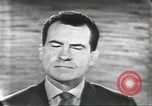
Nixon and Kennedy comment on the Cold War and Communist prestige during a presidential election debate in Washington DC.
The second Kennedy-Nixon Presidential Debate in Washington DC, United States. Edward P. Morgan of ABC News asks Republican candidate U.S. Vice President Richard M. Nixon to comment on whether the United States was doing well in the Cold War. Nixon states that they were not doing as well as they should have in the Cold War because of the presence of the Communists on the international scene. He says that the Communist prestige in the world is lower than the American prestige. He comments on cost cuttings on programs like mutual security and defense by the Democratic Congresses. Democratic candidate Senator John F Kennedy disagrees with Nixon's statement that the Congress has not provided funds for national defense. He also disagrees on the question of U.S. position in the United Nations. He mentions that various reports of Congressional committees indicate that the relative strength of the U.S. compared to that of the Soviet Union and the Chinese Communists together has deteriorated in the past years. Alvin Spivak of United Press International asks Kennedy how the losing prestige can be regained, and programs accomplished without damaging economy. Kennedy talks about the breaking off of the sugar quota with Cuba, passing of an authorization, and the development of the Inter-American Bank. He states that the U.S. has looked at the needs of Latin America. He states that instead of concentrating aid on surplus military equipment in Laos, the aid should have been concentrated in long-term loans. He concludes that Americans should identify themselves not only with the anti-Communist fight but also with the fight against poverty and hunger. Nixon presents his views and states that along with the necessity for economic assistance, the need for technical assistance should also be developed. Americans should not only think in terms of fighting Communism but also in terms of the interests of these countries. He concludes and mentions American ideals of independence, right of freedom and right of progress.
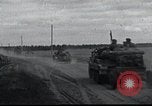
German soldiers throw food morsels to groups of Polish war prisoners (WW2)
Nazi German Army vehicles advance along a road in World War II. Polish war prisoners gathered at a hillside under the guard of German troops. German troops throw morsels of food towards a group of prisoners, who scramble for them.
CRITICALPAST.COM: About Us | Contact Us | FAQs - How to Order | License Agreement | My Account | My Lightboxes | Shopping Cart | Advanced Search | Featured Collections | Website Terms & Conditions | Privacy Policy ©2026 CriticalPast LLC.
License Agreement |
Terms & Conditions |
Privacy Policy
©2026 CriticalPast LLC.