


 Francais
 Deutsch
 Italiano
Refine Your Search
Greek-Civil-War stock footage and images
- Showing 3277 to 3282 of 27482 results more
more Hide
Hide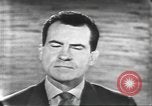
Nixon and Kennedy comment on the Cold War and Communist prestige during a presidential election debate in Washington DC.
The second Kennedy-Nixon Presidential Debate in Washington DC, United States. Edward P. Morgan of ABC News asks Republican candidate U.S. Vice President Richard M. Nixon to comment on whether the United States was doing well in the Cold War. Nixon states that they were not doing as well as they should have in the Cold War because of the presence of the Communists on the international scene. He says that the Communist prestige in the world is lower than the American prestige. He comments on cost cuttings on programs like mutual security and defense by the Democratic Congresses. Democratic candidate Senator John F Kennedy disagrees with Nixon's statement that the Congress has not provided funds for national defense. He also disagrees on the question of U.S. position in the United Nations. He mentions that various reports of Congressional committees indicate that the relative strength of the U.S. compared to that of the Soviet Union and the Chinese Communists together has deteriorated in the past years. Alvin Spivak of United Press International asks Kennedy how the losing prestige can be regained, and programs accomplished without damaging economy. Kennedy talks about the breaking off of the sugar quota with Cuba, passing of an authorization, and the development of the Inter-American Bank. He states that the U.S. has looked at the needs of Latin America. He states that instead of concentrating aid on surplus military equipment in Laos, the aid should have been concentrated in long-term loans. He concludes that Americans should identify themselves not only with the anti-Communist fight but also with the fight against poverty and hunger. Nixon presents his views and states that along with the necessity for economic assistance, the need for technical assistance should also be developed. Americans should not only think in terms of fighting Communism but also in terms of the interests of these countries. He concludes and mentions American ideals of independence, right of freedom and right of progress.
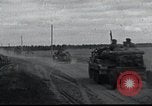
German soldiers throw food morsels to groups of Polish war prisoners (WW2)
Nazi German Army vehicles advance along a road in World War II. Polish war prisoners gathered at a hillside under the guard of German troops. German troops throw morsels of food towards a group of prisoners, who scramble for them.
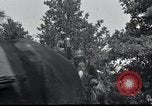
German troops on horseback, bicycles and motorcycles advance in France during World War II. Citizens evacuate. French prisoners
Invasion of France by Germany during World War II. German soldiers on horseback move out of path in woods to join a convoy of mechanized troops proceeding along a road. German soldiers ride motorcycles with sidecars. Others ride bicycles. French prisoners of war, with hands raised, are hurriedly marched on opposite side of road, towards the rear. French citizen evacuees travel in horse-drawn carriages and by bicycle, away from the battle front.
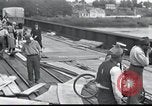
German troops, tanks and vehicles in a French town during World War II.
Invasion of France by Germany during World War II. French prisoners of war use plywood on roadway of a railroad bridge to facilitate automobile and pedestrian traffic. A woman appears to be a supervisor, of sorts. She speaks to workmen and then motions for a woman with a bicycle, to follow her. French soldier and policeman wearing white armbands, appear to be monitoring the prisoners and their work. A motorcycle carrying two German soldiers drives past the work area. A man and two French women with bicycles along with some French children, pass by the work area. German tanks and trucks roll into a French town, as local citizens watch from sidewalks. German troops set up in a town square, where they clean weapons and eat lunch.
U.S. medics treat U.S. prisoners after their liberation from a Nazi concentration camp towards the end of World War II.
American prisoners of war, at a Nazi concentration camp in Germany, towards the end of World War II. U.S. medics inspect the surviving U.S. prisoners. American nurses inspect an emaciated U.S. soldier survivor.
Marshal Josip Broz Tito at his mountain headquarters near Drvar, Bosnia.Yugoslavia. Tito's troops training in Italy during World War II
Note: This film was shown during World War 2 and edited for security reasons. Accordingly, some narrated statements are incorrect or misleading, and should be disregarded. Film opens showing a sentry posted at Yugoslav Partisan Leader Marshal Josip Broz Tito's mountain headquarters in Drvar, Western Bosnia, Yugoslavia. Marshal Tito steps from his headquarters to a lower porch where he stands with American OSS Officer, American Army Major Linn M. Farish, American Liaison to the Partisans, and British Brigadier General Fitzroy Maclean, Winston Churchill's special envoy to the Yugoslav leader. (For security reasons, they are identified as war correspondents.) Scene shifts to the town of Drvar that has experienced several periods of German occupation. Local people go about their daily activities and some pose for the camera. Women are seen salvaging silk from Allied parachutes, that they have spread out on the ground. It will be used as bandages for their Partisan army. View from above of a number of Partisan fighters gathering before the camera. One, a woman with dark hair wearing a black coat, is identified by the narrator, as a 21-year old Montenegrin who left school to join the Partisans. Closeup of that woman conversing with uniformed women soldiers. Next, a loose column of Partisan fighters is seen marching slowly through the town of Drvar. Scene shifts to a large formation of marching Yugoslav Partisan soldiers, who are training in Italy. They are seen standing if formation in a field, under Marshal Tito's command. He orders their officers forward and exchanges salutes with them. Marshal Tito then inspects the ranks. Women soldiers are seen conversing with Tito. He converses with his Chief of Staff, General Koča Popović. Closeup of a smiling woman Partisan fighter. Closeup of a soldier with a notable white moustache. Closeup of two uniformed women with Red Cross armbands. The Partisan soldiers marching across the field with shouldered arms. Film closes with closeup of Marshal Tito in front of his headquarters.
CRITICALPAST.COM: About Us | Contact Us | FAQs - How to Order | License Agreement | My Account | My Lightboxes | Shopping Cart | Advanced Search | Featured Collections | Website Terms & Conditions | Privacy Policy ©2026 CriticalPast LLC.
License Agreement |
Terms & Conditions |
Privacy Policy
©2026 CriticalPast LLC.