


 Francais
 Deutsch
 Italiano
Refine Your Search
Greek-Civil-War stock footage and images
- Showing 3355 to 3360 of 27482 results more
more Hide
Hide
Monument to the Battle of the Nations in Leipzig, Germany, seen during final days of World War II in Europe
Opening scene shows the Monument to the Battle of the Nations erected in Leipzig, in 1913, commemorating the 100th anniversary of the epic battle of Leipzig, and the defeat of Napoleon by a coalition of allies arrayed against the French. Notable are images of Teutonic knights standing guard around the upper periphery of the monument. Closeup of the base of the monument and entranceway. Some signs of war damage are visible. Camera pans upward. An American soldier is seen in lower left foreground, manning an M45 Browning .50 caliber Quadmount anti-aircraft gun. Camera continues to pan over details of the monument. (World War 2; WWII; WW2)
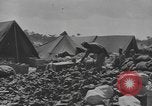
Prisoners of war remake and repair shoes for U.S. soldiers in the European Theater.
Salvage and reclamation activities in the European Theater during World War II. An African American U.S. Army soldier in a camp stands beside a large pile of old shoes and boots. Scenes inside a reclamation facility where German prisoners of war remake the shoes. POWs salvage usable parts of the shoes and sew and manufacture new shoes and boots for American soldiers using various machines.
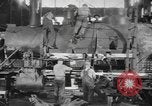
Men repair a locomotive in the European Theater damaged during the war.
Salvage and reclamation activities in the European Theater during World War II. Men working on the reclamation of equipment damaged during the war. A wrecked locomotive in a building. Men repairing the locomotive. They weld parts of the locomotive. Freight cars are repaired and wheels are changed.
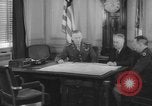
U.S. Secretary of War Henry L Stimson and General George C Marshall discussing a map with other officers in the United States (WW2)
The office of U.S. Army Chief of Staff in the United States during World War II. U.S. Secretary of War Henry L. Stimson and U.S. Army Chief of Staff General George C. Marshall seated at a desk. Deputy Chief of Staff Major General Byrden seated along with them. They discuss a map. An officer arrives and hands over a document to General Marshall. He sits at the desk. The officers discussing.

U.S. Secretary of War Henry Lewis Stimson seated at a desk in his office in Washington, DC (WW2)
U.S. Secretary of War Henry Lewis Stimson in his office in Washington during World War II. Stimson seated at his desk. He holds a document.
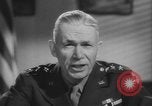
ASF Commanding General Brehon Somervell speaking about the problem of substitution and conversion of needed World War 2 supplies
Production of supplies for American soldiers during World War II. Commanding General of Army Service Forces( ASF ) Brehon B. Somervell seated at a desk in his office in the United States. He explains the serious problem of substitution and conversion and what is being done by American science to meet these needs. Somervell states that he is issuing an order: A command to think along new lines regarding every product essential to the war. He asks: 1) Can it be made as well of some less critical material; 2) Can it be made better, faster, or in greater quantity by some other method of production? He calls on viewers to draw on the brains and ingenuity. View of ordnance insignia. Interior of an office. An officer and a draftsman examine a machine gun. Exhibit of mannequins wearing uniforms with supplies for soldiers and nurses. Miniature tents and kitchen equipment. An officer and executives from two rubber production companies check synthetic rubber and collaborate on improvements. Radio engineers at work in front of equipment checking new type equipment. Workers weighing equipment and finding ways to make needed supplies lighter in weight. Chemical warfare officers at work. A soldier with a new plastic gas mask comes out of a room. Medical and other industry leaders around a conference table. Men gathered around tables planning improvements. Workers entering a large aircraft production factory. A man places a paper in a suggestion box labeled "ideas for increasing production."
CRITICALPAST.COM: About Us | Contact Us | FAQs - How to Order | License Agreement | My Account | My Lightboxes | Shopping Cart | Advanced Search | Featured Collections | Website Terms & Conditions | Privacy Policy ©2026 CriticalPast LLC.
License Agreement |
Terms & Conditions |
Privacy Policy
©2026 CriticalPast LLC.