


 Francais
 Deutsch
 Italiano
Refine Your Search
Greek-Civil-War stock footage and images
- Showing 373 to 378 of 27563 results more
more Hide
Hide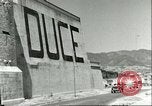
Allied forces advancing through Messina, Sicily, Italy in World War II.
Allied soldiers in a jeep and a British personnel carrier, drive past huge letters, spelling "DUCE," painted on the side of a massive concrete wall in Messina, during World War 2. Change of scene shows American soldier examining an Italian Pavesi military tractor. He is very intested in its unusual wheels. Change of scene shows the soldier climbing into the seat of another Pavesi tractor and checking out its controls. A large building across the street displays a British flag. An American technical sergeant offers an Italian civil policeman a cigarette. A closeup of the policeman as he smokes. The sergeant points to "Heil Rommel" written on a door, and other graffiti in chalk on a wall. He pauses to examine some wrecked Italian vehicles. Closeup of the wreckage.
Soviet World War II primer on high explosive bombs
Different types of high explosive bombs are shown in a Soviet civil defense film from World War 2. Bombs of different sizes are shown in a room. A Soviet specialist shows and discusses the bombs. A German Heinkel He 111 bomber aircraft in flight. The hand of a pilot at the controls, releasing bombs. A bomb explodes destroying a dwelling.
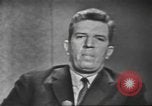
Kennedy and Nixon comment on the Indochina War, Quemoy and Matsu islands, and U-2 flights during their third debate.
Nixon and Kennedy debate questions regarding relations with Communists during the third Kennedy-Nixon Presidential Debate in the United States. Douglass Cater of Reporter magazine asks Republican candidate U.S. Vice President Richard M Nixon to comment whether there was a valid criticism of his statement of foreign policy. Nixon answers and states that the criticism is not valid. Regarding Indochina, he says that the U.S. would not have tolerated Indochina falling under Communist domination. And as a result of that the civil war there ended. He states that he supports the President's position and thinks that the President was correct in ordering the U-2 flights. Referring to Quemoy and Matsu he states that he objects to the constant reference to surrendering these islands. Democratic candidate Senator John F Kennedy disagrees with Nixon's statement on Indochina and states that reason Indochina was preserved was the Geneva Conference. On the question of the U-2 reconnaissance aircraft flights he states that he has never criticized them and never suggested stopping of espionage. On the question of keeping the Communists in doubt about the U.S. defending Quemoy and Matsu he states that the U.S. should meet its commitments to Formosa (Taiwan) and the Pescadores. He concludes by saying that he disagrees with Nixon as Nixon is extending the administration's commitment.
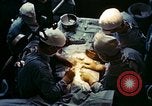
American soldiers with wounded hands being operated in the United States during World War II.
A U.S. Navy training film about the treatment of hand injuries of American soldiers during World War II. An injured hand of a man being operated upon in a civil hospital. A pneumatic cuff being tied around the arm and a bandage is rolled over it. A gauge shows the blood pressure. Wound being cleaned with soap and water. Damaged tissues being removed from the wounded area. Wounded hand is placed on an elevated platform. Doctors perform an operation inside a tent at a field hospital. A wound being diagnosed and examined. Wounded part of the hand were the bullet struck the arm. Anesthesia being administered on the arm. Pneumatic cuff being tied to the arm. Wound being washed and scrubbed.
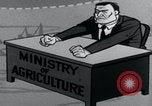
Communists take over agriculture in Cold War cartoon.
State Department Foreign Service officer Boris Hansen Klosson narrates Cold War propaganda film. A cartoon politician sits behind a desk labeled “Ministry of Agriculture”. Ministry of Agriculture distribute aid such as seed, fertilizer, and farming materials to peasants. Cartoon depicts a communist informant getting his hands on paperwork from a filing cabinet. An anonymous informant informs a communist party officer. Another communist official review paper labeled as “Anti-Communist Plans”. Block of metal labeled as “Blackmail” hangs over the intimidated man. A political diagram shows how cabinet members, civil service, and national army are gradually neutralized by communist influences. (Film is example of Anti-communist or so called Red menace propaganda)
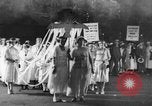
Pacifists, mostly women, march in a night time torchlight parade promoting Peace and Disarmament in the United States
A torchlight parade protesting war. Marchers are principally women. At start of film, a group of about 10 Women, all dressed in white, hold white streamers descending from a dove-like symbol of peace. The parade is conducted along a city street. Smoke rises all around from torches or bonfires beside the line of march. Some women carry a large banner reading: "Thou Shalt Not Kill." Other signs held by marchers appeal to Chemists and others who create tools of war, such as poison gas, to cease and desist such activities One sign reads: "Scientists Use Your Genius for Peace, Not War." A Bahai banner is carried by some marchers. Police officers monitor the march and marchers. Several women drape themselves in American flags. They are accompanied by a Civil War Union Army officer, carrying a sword. Many in the parade carry the same or similar signs and banners. Some are more legible when seen several times. Examples include: "Chemists, Help World Peace, Refuse to Make Poison Gas" and "Exploitation Leads to War, Abolish it." Other notable signs and slogans include: "Mothers pay the Heaviest War Tax;" "War is Not Inevitable. Human Nature does change;" "Immediate Universal Complete Disarmament;" and "We stand with Gandhi for World Peace." The last new one seen reads: " We will not give our children for another war."
CRITICALPAST.COM: About Us | Contact Us | FAQs - How to Order | License Agreement | My Account | My Lightboxes | Shopping Cart | Advanced Search | Featured Collections | Website Terms & Conditions | Privacy Policy ©2026 CriticalPast LLC.
License Agreement |
Terms & Conditions |
Privacy Policy
©2026 CriticalPast LLC.