


 Francais
 Deutsch
 Italiano
Refine Your Search
Greek-Civil-War stock footage and images
- Showing 3877 to 3882 of 27482 results more
more Hide
Hide
U.S. invasion of Okinawa, Japan, during World War II
Invasion of Okinawa in World War 2. Shoreline of Okinawa. Landing Vehicle Tracked (LVTs) and landing boats underway in foreground. The invasion force off Okinawa include at time 01:44 the battleship USS Tennessee, BB-43; time 01:27 battleship USS Idaho, BB-42; time 01:32 heavy cruiser USS Salt Lake City, CA-25; time 01:38 a Cleveland class light cruiser; Landing Craft Infantry (LCIs), Landing Ships Tank (LSTs), & auxillary ships.
U.S. warships firing and underway during invasion of Okinawa in World War II
U.S. Invasion of Okinawa in World War 2. Several DUKWs underway loaded with personnel, equipment and at least one 105mm howitzer. The battleship USS New Mexico, BB-40, in background. An OS2U Kingfisher patrol seaplane in a low approach. LSM(R)-194 launches 5-inch rockets at Okinawa. Smoke covered shore of the island of Okinawa. LSM(R)-196 and LSM(R)-197 launch 5-inch rockets at Okinawa.

Japanese invasion of Manchuria (Mukden Incident), forming Manchukuo, as part of the Second Sino-Japanese War.
A Japanese militaristic propaganda film about the material and spiritual strength of Japan. Narration by General of the Imperial Japanese Army Baron Sadao Araki. Map of Asia. Image of an artillery shell followed by animation of large blotch marks covering large sections of Asia. Scenes of Japanese troops marching in countryside and on railway beds. Sign in English 'Soochow'. Troops loaded into open rail cars and a steam engine pulling the train out of a station. Troops resting along a roadway, with civilians walking by among them. Some of the soldiers water and care for the horses. Many signs in Japanese in an urban center. Some depict warfare and conquering of territory. It appears to depict the 1931 Japanese invasion of Manchuria known as the Mukden Incident or the Manchurian Incident, part of the Second Sino-Japanese War. A parade on a city boulevard, with leaflets dropped everywhere blowing on the ground. A dragon costume controlled by many people. Children marching in a group. A regiment of Japanese soldiers marching in formation. An entrance way covered by the angled, draped flags of Japan and Manchukuo.
Agricultural scenes in Japan which is self-sufficient in food production prior to World War II.
Views of Japanese farmers at work in rice paddies and other agricultural fields in Japan before onset of World War 2. A line of women, in straw hats, labor in a rice field as a man pumps water into the paddy using a foot operated wheel. Rice being harvested and processed in the field. Farmers working in other fields containing grains such as wheat, barley, and oats and in vegetable patches. Japanese soldiers using grain straw to patch roofs. Other Japanese workers using such material for screens, parasols, and hats. Women harvesting fruit, in which Japan is 95% self-sufficient. Workers harvesting tea leaves. Workers at a seashore gathering salt evaporated from seawater. They carry some in wheelbarrows and some in containers using shoulder yoke.
Commercial fishing industry of Japan before World War II
Animated map of fishing grounds around Japan that provide one fourth of the world's catch. Movement of the seasonal catch is tracked as it moves Northward during the year. Men and women engaged in commercial fishing, gathering in nets teeming with fish. Fishing boats plying waters of an inland sea. Fishing boats moored along the shores. Larger seagoing fishing boats leaving to operate along the coast of Honshu. Fishermen letting out nets from these boats and using cable winches to retrieve them. Views of refrigerated Japanese fishing ships that also freeze their catches, operatiing in the Siberian maritime provinces and in Alaskan and Arctic waters. Fishing boats, operating before World War 2, are seen pulling crabs aboard. View inside a floating cannery ship where salmon and crabmeat are being canned for export to places like the U.S.A. Closeup of a can displaying "ICEBOUNDBRAND" and text reading: " World Renowned Floating Cannery Pack Fresh from the Deep Sea Waters of Northern Japan. Net contents 13ounces. SELECTED CRABMEAT." Japanese wading in a river, and using trained cormorants, to catch fish. View of fisherman taking fish from his cormorant and placing them into a large jug. view of edible seaweed being harvested and laid out in the sun, in racks. Animated illustration of Japanese man and items included in his dinner of rice, soybean, fish, sea slugs, sea urchins, octopus, lily bulbs, bamboo shoots, bean curd and pickled fruits and vegetables, accompanied by a little saki (rice wine).
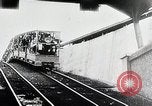
Electric Power Generation in Japan prior to World War II
A look at various sources of energy in Japan prior to World War 2. Japanese coal miners ride railcars down into a mine. View of miner using pneumatic drill to cut away coal at the face. Steam shovel bucket loading bituminous coal into open rail car. Animated map showing locations of Japan's coal mining areas in Kyushu and Hokkaido and small deposits in Honshu. Scene shifts to a river and water power generation site. View of turbines in water-powered electric generating plant. Generator buildings at side of river. Electric power transmission facilities. View from below a dam of a hydroelectric plant in central Honshu. Pipes carrying water down a mountainside. Reservoirs for storing water. Animated map depicting meager oil deposits in Japan and showing some of its oil processing and storage facilities.
CRITICALPAST.COM: About Us | Contact Us | FAQs - How to Order | License Agreement | My Account | My Lightboxes | Shopping Cart | Advanced Search | Featured Collections | Website Terms & Conditions | Privacy Policy ©2026 CriticalPast LLC.
License Agreement |
Terms & Conditions |
Privacy Policy
©2026 CriticalPast LLC.