


 Francais
 Deutsch
 Italiano
Refine Your Search
Greek-Civil-War stock footage and images
- Showing 4081 to 4086 of 27482 results more
more Hide
Hide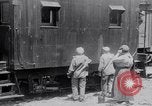
British women take on men's jobs on the homefront during World War I
Women in the industrial workforce on the homefront in Britain during World War 1. Opening scene shows several British women in working garb painting a railroad car. Other women perform manual labor alongside railroad box cars in a rail yard near a factory, as two women pass them pushing a small flatbed rail car loaded with steel rail parts. Change of scene to outdoors, where women are felling trees. Two in foreground are using a grinding wheel to sharpen an axe, while behind them, two push on a tree while two others use a long two-handled saw near its base. They jump clear as the tree falls. Women wielding axes to cut trees, elswehere in the woods. Two women with a two-handled saw, making final cuts on a standing tree, and stepping out of the way as it falls. A woman painter on a scaffold supported by block and tackle rigging four stories high on the side of a city building.
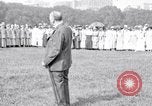
U.S. Navy Secretary Daniels, bids farewell to Navy female Yeomen(F) and female Marinettes of the U.S. Navy as they end their active duty after World War I
U.S. Navy Secretary Josephus Daniels stands in the center of a grassy field surrounded by contingents of women Navy Yeomen and Marine "Marinettes." He bids them farewell, as they are being officially released from active duty in accordance with the Naval Appropriations Act of 1919. Next, he dons his hat and steps forward to commence a final review of the women in formation. Among those accompanying him are: Assistant Navy Secretary, Franklin D. Roosevelt, Admiral William Sims (now President of the Naval War College), and Major General George Barnett, Commandant of the Marine Corps. They walk past a formation of Yeomen(F) commanded by a male Petty Officer sailor, and continue toward a contingent of women marines. Camera focuses,next, on Yeomen(F) marching in review. During the review, Assistant Secretary Roosevelt is seen speaking to Admiral Sims. Civilian spectators stand in the background. Next, the women marines march in review. The final scene shows Daniels and Roosevelt conversing as they pose with women Marinettes, a young Navy Admiral, and and a Yeomen(F) color guard. All relax and disburse as the ceremony ends.
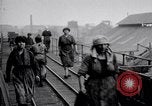
Women at work in a British industrial plant during World War I.
Women employed in a factory in Britain, during World War 1. Several women in grimy work clothes move what appears to be ore, in small open rail cars, atop a steel platform. Two women move one car to the end of the platform, where one pulls a long lever to tip it upside down and empty it. The next scene shows women pulling logs from symetrical stacks and placing them into open wooden rail cars. Two women move a log-filled car along the previously seen steel platform. Camera pans closeup of some of the women factory workers posing, with two men who appear to be supervisors. Closeup of two factory worker girls. They smile and laugh while posing.
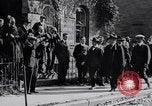
President Wilson votes in 1916 election. American soldiers cast ballots at army camp. British women work in industry to help during World War I
President Woodrow Wilson voting in the Presidential election on November 7, 1916, in Princeton, New Jersey. He is seen walking with an entourage, along the sidewalks of Chambers Street, past the entrance to G.A. Rule Real Estate offices, where men on the steps, remove their hats in acknowledgement and respect. The President and his party continue on to the old firehouse, that has been set up as a polling place. After greeting people there, President Wilson enters to vote. He comes out of the building after casting his ballot and doffs his hat to the camera and people in the vicinity. The scene shows American soldiers at an army camp casting their ballots in the election. They huddle around tables where there names are checked on voter lists and they receive ballots. One soldier is seen sealing his ballot before depositing it in a ballot box. Camera focuses on a ballot table with soldiers crowded around it. The final segment of the film contains completely unrelated footage of British women in the United Kingdom working in an industrial operation during World War 1. Some are seen at a railroad siding, clearing up scrap beside open rail cars. They use wooden wheel barrows with wooden wheels. Two women push a load of steel rail parts on a small flat rail car. In another location at the plant, women push a flat rail car loaded with lumber to a spot where several other women remove and stack it. Many steel railroad wheels are lined up in the background. The camera focuses on women pushing railroad axles, assembled with wheels, along tracks, toward a building in the rail yard. Two women touch-up paint on the side of a railroad car, as another woman (supervisor) watches. Back at the area of stacked lumber, two women fabricate something using a saw and hammer and nails on lumber placed atop wooden saw horses. Another woman wields a hammer in the background.
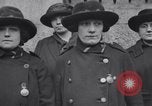
Women join ranks of police reserves in New York City, during World War I.
Closeup of women in the New York City Police reserve, during World War 1. They stand outside the 23rd Police Precinct ("Tenderloin") Station House on West 30th Street, Manhattan, New York City. Their uniforms include round-brimmed hats and overcoats, and they have round badges topped with eagles, pinned to their coats. Next, about 15 are seen, walking two abreast. All wear white gloves and badges, but otherwise, their uniforms are not identical. One supervisor woman walks beside the group, wearing a slightly different badge. Walking casually, a short distance behind the group is a woman (probably Mary Noonan) in the uniform of a captain (with "railroad tracks" insignia on her collar). Scene shifts to a street filled with a traffic mix of horse-drawn and motor vehicles, all staying fairly clear of trolley tracks visible in the center of the road. A police reserve woman stands in the center of the street, directing traffic. Next, a large group of school children is seen standing on a street corner, accompanied by a woman police officer. They begin to cross the street under the watchful eye of another woman reserve police officer, directing traffic in the street. Some adults cross behind the children. (Note: On May 9, 1918, the New York City Police Department announced formation of a new Police Reserve, that would include a women's contingent. This was the idea of Special Deputy Commissioner Rodman Wanamaker, who reasoned, since New York women had received the vote, on November 6th 1917, they should have a role in enforcing the laws. Over 3,000 women were recruited. Their Captain was Mary Noonan. Their duties did not involve direct dealings with criminals. According to the New York Times of May 10, 1918, "If need arose for use of the nightstick or other instrument for curbing crime,the work would be referred to the men members of the force.")
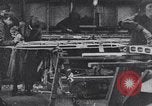
Prince of Wales visits women working in aircraft factory during World War I
British women at work in an airplane factory during World War 1. They are seen working with the framework of wings and other flying surfaces. Young Edward, Prince of Wales (later Edward VIII) in military uniform, examines parts in the factory during a visit with officials. He speaks briefly with a woman at her machine. The next scene shows women making adjustments on a Sopwith Camel aircraft. One tightens bracing on a left wing. Others rotate a propeller showing the movement of the airplane's rotary engine as its cylinders move with the propeller. Several women hold down the tail, as propwash from the running engine blows over them. Various tent-like structures are seen in the background. The number 6003 is seen on the aircraft vertical stabilizer. (WWI; WW1)
CRITICALPAST.COM: About Us | Contact Us | FAQs - How to Order | License Agreement | My Account | My Lightboxes | Shopping Cart | Advanced Search | Featured Collections | Website Terms & Conditions | Privacy Policy ©2026 CriticalPast LLC.
License Agreement |
Terms & Conditions |
Privacy Policy
©2026 CriticalPast LLC.