


 Francais
 Deutsch
 Italiano
Refine Your Search
Greek-Civil-War stock footage and images
- Showing 4249 to 4254 of 27482 results more
more Hide
Hide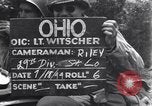
U.S. Army tanks, bulldozers, and troops on a street in St Lo, France in World War 2
A U.S. Army tank on a street in St Lo, France in World War II. Soldiers stand near the tank. Wrecked houses and buildings in the area. A U.S. Army tank fitted with a bulldozer. Destroyed houses and street in the area. Soldiers walk with rifles in the town amid the rubble.
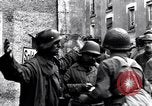
American soldiers on a street in St Lo, France and processing captured German soldiers in World War 2.
American soldiers pass by on a street in St Lo, France in World War II. Wrecked buildings on the street. A U.S. Army soldier processes an incoming German prisoner. A German prisoner (young looking boy soldier) with his hands up on the street. Smoke arises from wrecked house. Soldiers walk through rubble on the street. Destroyed houses and street in the area. Final brief scene shows an American soldier as he lights a demolition fuse.
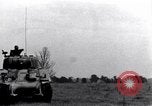
U.S. M-4 medium tanks crossing a field in St Lo, France, during World War II
U.S. M-4 medium tanks crossing a field in St Lo, France, about a month after D-Day in World War 2. Hedgerow clearing devices are seen on the M4 Sherman tanks. (These particular 'pronged' types of tank are designed to be rammed into the hedgerows, creating holes for demolition charges. Then, once the tank has reversed clear, TNT was packed into the holes and detonated.) Tank commanders are visible in the turret hatches. Trees in the background.
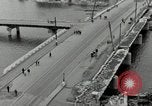
Views of damage in Hiroshima, Japan caused by Atomic Bomb explosion in World War 2
Elevated view of people walking on the damaged Ai-Oi Bridge over a river in Hiroshima, Japan. Bridge shows damage from the atomic bomb explosion in World War 2. A U.S. soldier examines a steel bridge post etched from flying debris during the blast. Views of various wrecked buildings in the city. Exterior and interior views of a destroyed school building. A building knocked partially off its foundation and leaning sideways. Ruins of destroyed Japanese military headquarters. View of he Chugoku Electric Company building made of reinforced concrete that withstood the blast better than many buildings.

Adolf Hitler greets Marshal Antonescu of Romania, in Rastenburg, East Prussia, during World War II
German leader Adolf Hitler stands with members of his staff on a snow covered train station platform in Rastenburg, East Prussia (now Poland) during World War 2. A train arrives, with icicles clinging to its roof. Romanian military officers render traditional hand salutes (not Nazi salutes) from the train as it pulls into the station. Ion Antonescu, salutes with his Marshal's baton and exchanges greeting with Hitler. He is accompanied by Romanian Foreign Minister, Mihai Antonescu. The two exchange salutes and handshakes with members of Hitler's party. (Mihal gives Nazi salute, but Ion does not.) Hitler walks past and exchanges salutes group of Romanians accompanying Antonescu. (Hitler gives his Nazi salute, but the Romanian officers render traditional hand salute to forehead.) Change of scene, shows Nazi Foreign Minister, Joachim von Ribbentrop, escorting Marshal Ion Antonescu and Foreign Minister, Mihai Antonescu, up some stairs to a meeting room.
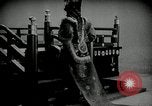
Ancient Japanese ritual dance with swords and shields. Japanese warships engaged in Russo-Japanese war.
Opening sequence shows a formal Japanese slow ritual dance performed before a gathering of beautifully costumed observers. An elegantly costumed leader ascends steps and strikes an elaborately decorated cymbal. A chorus of whistle-like sounds is heard as accompanying music throughout. Dancers perform with swords and shields in slow tempo. Slate announces year 1905. A flotilla of Japanese warships makes way through heavy seas during the Russo-Japanese war. The Japanese battleship Mikasa, flagship of Admiral Togo Heihachiro,firing her twin 12 inch guns during the battle of Tsushima. A statue of Admiral Togo. Two sailors bow before shrine to Admiral Togo.
CRITICALPAST.COM: About Us | Contact Us | FAQs - How to Order | License Agreement | My Account | My Lightboxes | Shopping Cart | Advanced Search | Featured Collections | Website Terms & Conditions | Privacy Policy ©2026 CriticalPast LLC.
License Agreement |
Terms & Conditions |
Privacy Policy
©2026 CriticalPast LLC.