


 Francais
 Deutsch
 Italiano
Refine Your Search
Greek-Civil-War stock footage and images
- Showing 4885 to 4890 of 27482 results more
more Hide
Hide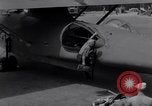
U.S. sailors load ammunition and a machine gun on a PBY Catalina and help start it's engines, in World War II.
United States sailors load ammunition and a machine gun onto a PBY Catalina amphibian plane parked on the ramp at a Navy base in the Pacific Theater, during World War 2. Sailors,standing on the aircraft wing, pull the number one propeller through before the engine is started.A sailor on the wing stands fireguard, as the number two engine is started.
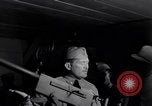
U.S. Navy Aviation officers examine a 50 caliber machine gun during World War II
Two mid-grade U.S. Navy aviation officers, one in a tropical pith helmet and the other in a side cap, discuss a 50 caliber machine gun with a Navy aviation Commodore, who handles the weapon. The scene is aboard a U.S. ship during World War 2.
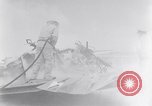
Montage of several airplane crash sites in World War II, with Navy firefighters extinguishing flames in wreckage
Views of several different crash sites at U.S. Naval bases in World War 2. Firefighter in protective suit directs stream of foam on smoldering wreckage of what appears to be a crashed low wing single engine monoplane. Several sailors and an officer also help and are seen putting out the last remaining flames. An armed marine guard watches over destroyed parts of an engine, propeller and cowling sitting in a field. In change of scene, an officer directs a firefighter in protective gear as he hoses foam on the wreckage of a larger crashed aircraft. Shallow hole in ground is shown. Another scene shows sailors working around numerous pieces of aircraft wreckage laid out on the ground. Next sequence shows sailors running toward a smoking crash site.A vehicle with flag on it's bumper is parked nearby. Sailors direct hoses on the wreckage and smoke rises from it. Armed Marines walk about the area. The smoldering wreckage indicates this was a relatively small aircraft. In final scene, firefighters in protective gear, without helmets, direct hoses on another crash site. Flames persist.
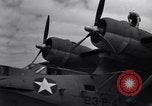
PBY-5 Catalina starts, taxis across ramp and into water during World War II. it taxis in water and returns again
Plane's Captain and a sailor check oil on engines of a U.S. Navy PBY Catalina amphibian before starting during World War 2. Plane Captain and sailor turn props through by hand in preparation for starting. Engines started on PBY-5 Catalina. This sequence is repeated from different angle. It taxis across the hard ramp, past a sandbagged antiaircraft gun emplacement. The aircraft proceeds down a ramp into the water, where it continues taxiing slowly. In next sequence, it is seen returning again.
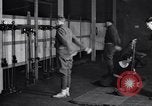
World War 1 veteran patient has prosthetic limb fitted by worker, and patients receive therapy and exercise at Fort Sheridan in Lake County, Illinois.
World War 1 soldiers recover and receive therapy at U.S. Army hospital facility of Fort Sheridan, in Lake County, Illinois. Recovering soldiers exercise, and are helped to exercise by therapists and other patients. Patient has limb prosthesis fitted by worker. Patient tries on a prosthetic artificial leg. One-legged patient on crutches, sits on bench. Injured soldier with artificial leg walks using cane.
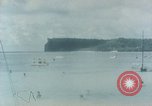
Views of Guam at end of World War II
Beach scene at Tumon Bay, Guam in 1945, at end of World War 2 . Bathers and some small boats in water of a bay. Sand beach covered with palm trees and other semitropical flora. People seated on the sands. Water of the bay and promenatory of land in background. Different sequence, showing three U.S. Landing Craft Support, Large, LCS (L) clustered together at anchor in a bay, with buildings on shore in background. The mast of a U.S.warship. A U.S. Army Air Forces B-29 bomber in flight overhead. It displays tail code of solid black square with "M" inside, identifying it as belonging to the 20th Air Force, 314th Bomb Wing, 19th Bomb Group, based at Anderson Air Force Base, Guam. Camera focuses on the bomber as it passes overhead. Sailors speed into the bay, aboard a motor boat. The B-29 circles directly overhead, passing the American flag displayed on the main mast of a warship. The B-29 appears to be descending to land at the airbase.
CRITICALPAST.COM: About Us | Contact Us | FAQs - How to Order | License Agreement | My Account | My Lightboxes | Shopping Cart | Advanced Search | Featured Collections | Website Terms & Conditions | Privacy Policy ©2026 CriticalPast LLC.
License Agreement |
Terms & Conditions |
Privacy Policy
©2026 CriticalPast LLC.