


 Francais
 Deutsch
 Italiano

Refine Your Search
Greek-Civil-War stock footage and images
- Showing 5077 to 5082 of 27591 results more
 Hide
Color Sound
Pre and post-revolution scenes of Russia during World War I
World War I views of Russia including both pre Russian Revolution scenes and post-revolution scenes. Opening scene shows workmen and soldiers at a construction (or rebuilding site) in Russia. Ordinary shops seen, closed with metal barriers across their fronts, on a commercial district street. Russian troops marching in review before Tsar Nicholas II, and other mounted officers, in a square in Russia. A military band marching across the square, watched by Russian troops in formation and by spectators. In post revolution Russia, An open phaeton car drives into the midst of a crowd of Russian soldiers and civilians. Three principal occupants step from the car including an officer carrying a bouquet of flowers. (Some enthusiastic bystanders show great interest in the car. At least one climbs into it.) The car's occupants next appear on the balcony of the Hotel National in Moscow, where they are greeted by a large crowd assembled below them. Abrupt change of scene shows Russian Tsar Nicholas II, on horseback, reviewing troops, who hold aloft a banner reading "Warrier," among other things. He continues past civilians assembled, holding various banners.
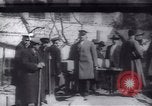
Two scenes with Mustafa Kemal Ataturk. One in mufti, circa 1924, and another in uniform, during Greco-Turkish War
Street scene in Turkey, circa 1924. Group of Turkish Government officials seen walking near a government building. Next sequence shows an official entourage of officials entering through a City Gate. They are surrounded by local dignitaries and members of a military unit. A large umbrella sunshade is being held over one or more members of the delegation. Then, with the crowd watching, Turkish troops entertain by performing Dances. A closeup of Turkish President Mustafa Kemal Atatürk, in mufti or ordinary clothes, watching the performance. Change of scene to earlier time. Mustafa Kemal Atatürk seen in military uniform, during Greco-Turkish War.
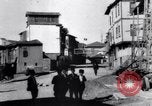
Turkish recruits muster for the Greco-Turkish War circa 1920
Turks muster to fight in the Greco-Turkish War, leaving homes and villages, bidding farewell to loved ones and assembling as infantry and cavalry.
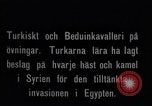
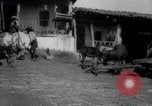
Turkish forces mobilizing in Palestine to engage British forces at the Suez Canal in Egypt during World War I
Turkish mobilization activities in World War 1. Turkish and Bedouin Cavalry engaged in exercises. Turkish authorities have enlisted every horse and camel in Syria for the anticipated military engagement with British forces defending the Suez Canal in Egypt. Individual Cavalrymen ride their horses at a gallop, while others watch. Turkish troops of the Fourth Turkish Army in Palestine, preparing to depart. They begin assembling in formation and start to march, accompanied by a brass band, in Jerusalem. Later, well-drilled and equipped troops march in good order through the streets. Turkish cavalry move through the crowded streets on horseback. Change of scene shows column of troops led by a military band,as they march out of a town. Turkish troops make their way marching, with shouldered rifles, through streets packed with people.
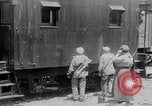
British women take on men's jobs on the homefront during World War I
Women in the industrial workforce on the homefront in Britain during World War 1. Opening scene shows several British women in working garb painting a railroad car. Other women perform manual labor alongside railroad box cars in a rail yard near a factory, as two women pass them pushing a small flatbed rail car loaded with steel rail parts. Change of scene to outdoors, where women are felling trees. Two in foreground are using a grinding wheel to sharpen an axe, while behind them, two push on a tree while two others use a long two-handled saw near its base. They jump clear as the tree falls. Women wielding axes to cut trees, elswehere in the woods. Two women with a two-handled saw, making final cuts on a standing tree, and stepping out of the way as it falls. A woman painter on a scaffold supported by block and tackle rigging four stories high on the side of a city building.
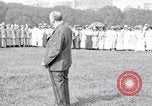
U.S. Navy Secretary Daniels, bids farewell to Navy female Yeomen(F) and female Marinettes of the U.S. Navy as they end their active duty after World War I
U.S. Navy Secretary Josephus Daniels stands in the center of a grassy field surrounded by contingents of women Navy Yeomen and Marine "Marinettes." He bids them farewell, as they are being officially released from active duty in accordance with the Naval Appropriations Act of 1919. Next, he dons his hat and steps forward to commence a final review of the women in formation. Among those accompanying him are: Assistant Navy Secretary, Franklin D. Roosevelt, Admiral William Sims (now President of the Naval War College), and Major General George Barnett, Commandant of the Marine Corps. They walk past a formation of Yeomen(F) commanded by a male Petty Officer sailor, and continue toward a contingent of women marines. Camera focuses,next, on Yeomen(F) marching in review. During the review, Assistant Secretary Roosevelt is seen speaking to Admiral Sims. Civilian spectators stand in the background. Next, the women marines march in review. The final scene shows Daniels and Roosevelt conversing as they pose with women Marinettes, a young Navy Admiral, and and a Yeomen(F) color guard. All relax and disburse as the ceremony ends.
CRITICALPAST.COM: About Us | Contact Us | FAQs - How to Order | License Agreement | My Account | My Lightboxes | Shopping Cart | Advanced Search | Featured Collections | Website Terms & Conditions | Privacy Policy ©2026 CriticalPast LLC.
License Agreement |
Terms & Conditions |
Privacy Policy
©2026 CriticalPast LLC.