


 Francais
 Deutsch
 Italiano
Refine Your Search
Greek-Civil-War stock footage and images
- Showing 5245 to 5250 of 27482 results more
more Hide
Hide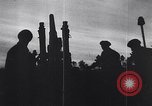
British and Canadian Infantry of 1st Canadian Army capture Kleve (Cleve) Germany during World War 2
Artillery batteries of British and Canadian forces, under command of Field Marshal Montgomery, bombard German positions on the German-Dutch border.British artillery firing BL 4.5 inch Medium Guns and 155mm heavy guns, in an 11 hour bombardment of German positions east of Nijmegen, Netherlands. Snow covers the ground. A British Land Mattress rocket launcher firing a salvo of 3-inch rockets. I Infantry of 1st Canadian Army, under command of General H.T.G Crerar, march toward an area between the Mars and Rhine rivers. They move through forest of the Reichswald, where they encounter Siegfried Line obstacles. British and Canadian tanks using heavy chain mine flails are seen beating their way through mine fields. Infantry in single file silhouetted against a light sky. Canadian Sherman tanks advancing with infantry. One is labeled "Spitfire II." Churchill tanks and heavy vehicles advance, including Churchill AVRE fascine mat-laying vehicles and Churchill ARKs (Armoured Ramp Carriers). Sherman tanks pass, including one named "Diana." British Armor pushing through rain-soaked and partly flooded towns towing BL 4.5 guns. They reach Kleve (formerly spelled Cleve) on February 11, 1945. Roadside sign reads: "Reichs-Grenze"(Border of Germany). Sherman tank of the 6th Guards Tank Brigade firing point blank on city street in Kleve. British troops taking cover behind tank destroyer moving slowly along street. Large number of German prisoners of war being marched to an assembly area. British infantry continuing their advance toward Goch, Germany.
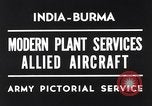
American 10th Air Force aircraft being repaired at Hindustan Aircraft Limited facilities in Bangalore, India during World War II
A film titled 'Modern plant services and Allied aircrafts' shows workers streaming out of facilities of Hindustan Aircraft Limited, in Bangladore, India, during a shift change, during World War 2. View inside one of the factory buildings, where U.S. Army Air Forces C-47 transport aircraft of the 10th Air Force are seen lined up for maintenance. Heating fires burning in containers outside one plant entrance. Inside, workers move heavy machinery. A worker in a laboratory. Outside, several U.S. Lockheed B-25 Mitchell bombers are seen in various states of repair, with Hindustan Aircraft workers working on and around them. A C-47 aircraft is seen nose into a hangar. Its empennage is mostly removed. However its tail number (41-7759) is visible on the still intact vertical stabilizer. Workers are seen on scaffolding set up around a Consolidated PBY Catalina amphibian aircraft. The final scene shows several B-24 Liberator bombers in various stages of repair, parked on an outdoor ramp.
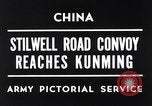
First Allied convoy reaches Kunming, China, over the Ledo Road, during World War II
U.S. military trucks, part of a convoy of 113 vehicles, led by Brigadier General Lewis Andrew Pick, are seen traversing the Ledo Road (aka the Stilwell Road) approaching their final destination of Kunming, China, on February 4, 1945, during World War 2. (They departed Ledo, India, on January 12, 1945, traveling a distance of 1,079 miles.) (Narrator gives distance as 1,044 miles.) View from an overflying airplane shows the long column of trucks on the road below. View from the ground, of the convoy reaching the city gates, where it halts as General Pick and his staff proceed through the gates to a speaker's platform set up in a covered pavilion displaying American and Chinese flags, and pictures of U.S. President Franklin D. Roosevelt and Chinese Generalissimo Chiang Kai-shek. General Pick and staff are introduced by Chinese General J.L. Wong who, speaking in English, celebrates this first convoy over the Ledo Road, and points to a banner containing four Chinese characters that spell out "The Road to Victory." General Pick takes the podium, shakes hands with General Wong, and accepts the banner from him. Camera shows the area completely filled with Chinese troops, witnessing the ceremony, including many sitting atop a nearby roof. General Pick speaks briefly, accepting the banner on behalf of the convoy members. He then leaves accompanied by the Governor of Yunnan Province, China. Officers cut a ceremonial ribbon across the road at the West Gate of the city, and the convoy is led into the city by two Chinese soldiers on motorcycles. Chinese spectators line the way and celebrate with firecrackers and cheers, as General Pick passes, standing in a jeep, displaying the Amercan flag and with the Chinese "Road to Victory" banner in its back seat. views of the convoy trucks proceeding through the city. Closeup of one, with a painting of the road, and snow capped mountains, and "First Convoy over the Ledo Road" and "Pick's Pike Life Line from India to China" painted on its canvas cover. A sign over one of the shops along the road reads in Chinese and English, "Welcome First Stilwell Highway Convoy." Views of troops waving from the trucks and Chinese citizen spectators crowding the sides of the road to watch.
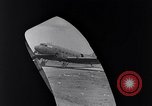
Paratroopers of the U.S. Army 11th Airborne Division make a combat drop on the Tagaytay Ridge, Luzon, Philippines, in World War II
U.S. paratroopers of the 511th Parachute Infantry Regiment (511th PIR), 11th Airborne Division, conduct a combat parachute drop to reinforce American troops engaging Japanese forces at Tagayatay Ridge, on Luzon, the Philippines, in World War 2. View from inside a C-47 transport aircraft, looking through its open rear door, at another C-47 taxiing on an airfield ramp. It displays "X44" stenciled below its cockpit. Brief aerial view of the airfield from an airplane overhead. Several C-47s seen flying in formation. Closeups of some C-47s. Next, paratroopers of the U.S. 11th Airborne Division are seen jumping from C-47s. Their chutes open rapidly after leaving the aircraft. Some of the chutes of troopers, jumping from aircraft forward of the camera plane, pass very near as they descend. Aerial view looking upward at parachutes descending with clouds behind them. Glimpse from cockpit of camera plane shows numerous parachutes deployed from C-47s some distance ahead. Closer view from below and left of three C-47s shows paratroopers exiting open aircraft doors. More parachutes seen from above, as they descend. View from C-47 cockpit of five others in formation, at the same altitude,ahead. Below them, dozens of parachutes are seen descending toward the ground. Inside a C-47, several troopers stand at the open rear door and one helps another jump from the plane. Several paratroopers passing the right wing of the camera plane as they descend.
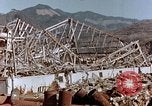
After effects of the atomic bombing in Nagasaki, Japan during World War 2
After effects of the atomic bombing in Nagasaki, Japan during World War II. A wrecked steel frame structure and broken chairs are seen.
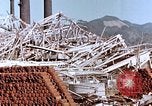
Collapsed steel frame building from atomic blast in Nagasaki, Japan, following World War 2
After effects of atomic bombing in Nagasaki, Japan during World War II. A wrecked steel frame structure and torpedo compression chambers are seen. The interior of the building shows floor covered with debris,broken corrugated asbestos roofing,pieces of chairs,blueprints and an upturned drafting table. A Japanese farmer carries 'Honey Buckets' and tightens the caps to prevent leakage. A metal steel room is seen. Floor covered with debris.
CRITICALPAST.COM: About Us | Contact Us | FAQs - How to Order | License Agreement | My Account | My Lightboxes | Shopping Cart | Advanced Search | Featured Collections | Website Terms & Conditions | Privacy Policy ©2026 CriticalPast LLC.
License Agreement |
Terms & Conditions |
Privacy Policy
©2026 CriticalPast LLC.