


 Francais
 Deutsch
 Italiano
Refine Your Search
Greek-Civil-War stock footage and images
- Showing 5581 to 5586 of 27483 results more
more Hide
Hide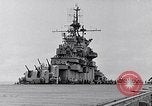
U.S. Navy F4U-1 Corsair aircraft, of Squadron VF-17, noses over during a carrier landing in World War II
View of the USS Bunker Hill (CV-17) at sea during its shakedown cruise in the Pacific, in 1943, during World War 2. An F4U-1 Corsair aircraft of U.S. Navy Fighting Squadron 17 (VF-17) lands on the carrier deck,and appears to successfully engage its tail hook. However, it bounces, and, noses over, smashing its propeller. The aircraft has a small skull and crossbones painted on its engine cowling, and 17-F-26 painted on its fuselage. In a slow-motion sequence, the aircraft, is seen to be dragged backwards slowly,by arresting gear, along the deck. Responding ship's crew members run towards it. One grabs the right wing to stabilize it.
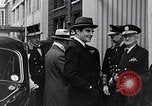
U.S. SECNAV Franklin Knox visits U.S. Admiral Harold Stark and British Vice-Admiral Sir Bertram H Ramsay in London during World War II
Franklin Knox, U.S. Secretary of the Navy (SECNAV) shakes hands with U.S. Navy Admiral Harold Stark, Commander of U.S. Naval Forces in Europe, British Vice-Admiral Sir Bertram H Ramsay, and other British and American naval officers, after visiting them in Stark's headquarters at 20 Grosvenor Square, London, England, during World War 2. Secretary Knox enters a car. Scene shifts to an RAF airfield where Secretary Knox stands with Admiral Stark and two military aides,near the wing of a U.S. Army Air Forces C-47 airplane. Stark and Knox stand together and then Knox bids Stark goodbye, as he prepares to board the C-47 airplane. Admiral Stark salutes as Secretary Knox climbs aboard the plane. Admiral Stark and aides wave goodbye as the aircraft taxis out. Several members of British Women's Auxiliary Air Force (WAAF) walk across the airfield ramp, as the C-47 taxis out for takeoff
United States rushes to build new military bases in the Pacific during World War II
Local Pacific Islanders are seen in wooden dugout boats in the vicinity of U.S. Navy warships, in a bay during World War 2. Closeup of a man in one canoe with an outrigger. A boy sitting in one carrying a box of fruit. U.S. military engineers aboard a ship, look at shore with binoculars. Sailors in stern of a boat flying Naval ensign. Sailors on a barge, transport the fuselage and float of a OS2U Kingfisher Floatplane to an island, where they bring it ashore amidst grove of palm trees. Sailors roll 55gallon drums of fuel shore from a barge. A jeep is lowered over the side of a ship and driven ashore. Supplies, including foodstuffs, are brought ashore. Cartons containing canned corned beef; canned cherries, and many other foods, are stacked up in a warehouse. Engineers chart water depth in a bay as they mark boundaries for construction of a seaplane base. Caterpillar tractors level trees and clear land for the base. Soldiers install a 155mm long tom gun in position for coastal defense. Marines prepare temporary shelters of palm fronds. A U.S. Navy PBY Catalina seaplane flies overhead.
American women in military service during World War II
U.S. Navy commissioned Women officer nurses stand in formation, dressed in summer white uniforms, as they are inspected by senior officers during World War 2. Closeups of several nurses. Several women nurses, in uniforms of various armed services, pose for the camera. Closeups of some of them. Scene shifts to the first director of the Women's Army Corps (WAC), Colonel Oveta Culp Hobby, seen standing in front of an Army recruiting poster, and at her desk in Washington, DC. Women volunteers seen in a recruiting station, applying to join the new WAC. Colonel Hobby walking along sidewalk of the Arlington Memorial Bridge, across the Potomac River, in Washington, DC. She stops and poses for the camera. Next she is seen approaching two army officers on the bridge, who both come to attention and salute as she comes close enough for them to see the Colonel's eagles on her uniform shoulders. She returns their salute, smartly, and continues on her way. Next, four armed WAC members in field garb, stand on the side of a mountain as two of them consult a map and the others use binoculars. Below them, on a dirt path, women of a WAC motorcycle corps unit ride their Harley Davidson motorcycles. They also ford a stream on their motorcycles.

Americans send letters to service personnel overseas via "V-mail," during World War II
View of a U.S. Post Office building. Patrons line up inside, to use the new "V-mail" system for sending mail to service personnel overseas, during World War 2. They are seen writing letters on special forms that also serve as envelopes, when folded. Senders stamp, and mail them, just like ordinary letters. Next, after being opened and passed by military censors, the letters are fed into machines and photograpned onto rolls of microfilm. Views of microfilm in 100 foot rolls, that carry 1500 letters, each. View of a strip of microfilm with individual letters on it. Bags of mail on the floor of an Army postal facility and a soldier holding one small bag of microfilm letters that contains the same number of letters as all the other bags. Servicemen overseas reading their letters (that have been blown up and printed at normal size).
Graduates of U.S. Military Academy go directly into World War II
First Graduation ceremony of United States Military Academy during World War 2. General George C. Marshall, Army Chief of Staff, awards diplomas. U.S. flag seen. General Marshall gives a speech and reviews graduates. The graduates marching.
CRITICALPAST.COM: About Us | Contact Us | FAQs - How to Order | License Agreement | My Account | My Lightboxes | Shopping Cart | Advanced Search | Featured Collections | Website Terms & Conditions | Privacy Policy ©2026 CriticalPast LLC.
License Agreement |
Terms & Conditions |
Privacy Policy
©2026 CriticalPast LLC.