


 Francais
 Deutsch
 Italiano
Refine Your Search
Greek-Civil-War stock footage and images
- Showing 5629 to 5634 of 27483 results more
more Hide
Hide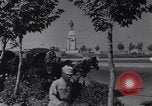
Views of Tehran, when Iran was the "Persian Corridor" for American Lend-Lease aid to the Soviet Union in World War II
Opening scene is of ordinary day in teheran, Iran, during World War 2. A horse and wagon sits quietly in shade at edge of a traffic circle centered on monument topped with a statue of Reza Shah Pahlavi . A U.S. Army truck, displaying a white star, and a jeep, drive by on the nearby roadway. A horse-drawn wagon passes at edge of toad. A military truck drives around the road closest to the statue of Reza Shah Pahlavi . Closeups of the statue. Change of scene shows an official-looking modern building, with a guard at its open gate. A sculpture above the gate depicts a crown flanked by two lions. Several pedestrians pass by casually on the road and sidewalk. The pedestrian women include some in Western dress and ant least one with head modestly covered. View through the open gate shows a circular drive around a garden and a large building behind it. Two military officers walk out the gate. One wears a steel helmet. They pass the guard standing by his booth. Street scenes showing a modern building and light traffic, including another American jeep, a horse-drawn wagon, a car and a bus. Several multistory apartment buildings. View looking down on a horse-drawn cart moving along a tree-lined city street.
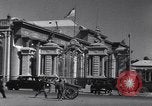
A view of the Royal Palace and street scenes in Tehran, Iran, during World War II
Scenes of Tehran, Iran during World War 2. A view of the Royal Palace of Tehran. The Sepahsalar Mosque (Jomhuri Ave Baharestan Square, Tehran 11369 Iran) and its minarets. Traffic stops for crossing camel caravan. An American soldier in a Jeep, waits for the camel caravan to pass. Camels, trucks, cars, horse drawn carriage, bicycles, and bus, in a traffic circle in Tehran. Veiled women in streets. A commercial shopping district in the city, with streets, wide sidewalks, and numerous shops in buildings. Many pedestrians and shoppers are seen. Many men and women wear modern Western-style clothes. In contrast, the next scene shows camels and merchants in a traditional old-style open-air market.
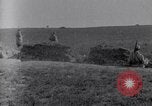
French grenades and artillery being used during World War I.
In live fire practice,during World War 1, two French soldiers walk forward and hurl hand grenades, as several others watch from behind protective barricades. The grenade throwers hit the ground as soon as they release them. Others duck down behind their barricades. New scene from atop a building in a town, an artillery shell is seen bursting and smoke rising near a building by a distant road. Two shell explosions are seen on a hillside and one releasing white smoke (possibly gas). French soldiers busy themselves at their fortified positions on high ground above a plain, while an officer slowly rotates a large finned mortar shell on its shaft, vertically. (WWI; WW1)
Newsreel "Italy mobilizes new Regiments for war service"
Prince Umberto II of Italy bestows the National colors on new regiments for war service to Ethiopia. The new regiments were organized by King Victor Emmanuel III as reinforcements for the Army fighting Ethiopian Emperor Haile Selassie's warriors in East Africa. A priest bestows blessing on the soldiers and banners. Banners are blessed in an impressive ceremony.
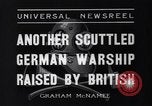
The war ship 'Koening Albert' raised by British engineers
The war ship 'Koening Albert' sunk by Germans at Seapa Flow. The ship is raised by British engineers at Rosyth in Scotland. The ship is towed to ship breaker's yard to be taken apart for junk.
Pilots discuss participation in Doolittle Raid bombing of Tokyo; scenes from start of raid in World War II.
Car pulls up to curb with Lincoln Memorial in the background, in Washington DC. Captain Ted W. Lawson and Captain Dean Davenport ascend the steps of the Lincoln Memorial, with one of them using a cane to assist, as they talk. They talk about home life and then they recall their flight as pilot and co-pilot on B-25 aircraft in the Tokyo raid in World War 2, one year earlier. Scene changes to open sea and view of the USS Hornet aircraft carrier (CV-8) underway at sea. Aircraft on the flight deck of USS Hornet ready for the operation 'The Doolittle Raid'. Airmen soldiers watch as Lt. Colonel Doolittle ties a Japanese medal onto a bomb. Closeup view of the medal on the bomb. The B-25 aircraft on flight deck ready for the attack on Tokyo. Lawson and Davenport talk about how they suffered engine failure on the return from Tokyo. The crew aboard the ship exercise, running in a group on an open part of the flight deck. Crews starting aircraft on April 18, 1942. The B-25 aircraft of Lt. Colonel Doolittle taking off first from the flight deck. Other B-25 Mitchell bombers taking off from the short flight deck. Planes in flight. Large image of United States flag waving. Still images of pilots captured by the Japanese during the raid. General Henry Arnold ("Hap" Arnold) seated at a desk and speaking, denounces the execution by the Japanese of U.S. pilots and calls on the forces of the US. Army Air Forces to continue their efforts until the enemy are destroyed.
CRITICALPAST.COM: About Us | Contact Us | FAQs - How to Order | License Agreement | My Account | My Lightboxes | Shopping Cart | Advanced Search | Featured Collections | Website Terms & Conditions | Privacy Policy ©2026 CriticalPast LLC.
License Agreement |
Terms & Conditions |
Privacy Policy
©2026 CriticalPast LLC.